Meg finished her 4 AM pump — 3.5 ounces from the left, barely 2 from the right — and sat there doing exactly what you are probably doing right now: Googling how long does breast milk take to replenish before her next session. She had been spacing pumps four hours apart, waiting for that “full” feeling, convinced she needed to let the tank refill.
That instinct cost her almost an ounce a day over three weeks. The tank metaphor is wrong — and it's the kind of wrong that quietly erodes your milk supply before you realize what happened.
Your Breasts Are a Factory, Not a Tank
Milk is synthesized in the alveoli — grape-like clusters of secretory cells deep in your breast tissue — and moves into ducts where it pools until removed. Production runs continuously. There is no off switch between sessions, no waiting period, no refill countdown.
The tank model feels intuitive because breasts get fuller over time. But that fullness is storage accumulating, not capacity recharging. Picture a faucet dripping into a cup: the fuller the cup gets, the more back-pressure builds, and the slower the drip becomes. Your breasts work the same way — except the back-pressure is chemical, not physical. (More on that in the FIL section below.)
This matters because the tank metaphor makes you wait for fullness before pumping. Waiting actually slows how fast breast milk replenishes.
How Breast Milk Production Actually Works
Your body runs two overlapping production systems, and they hand off control as your baby grows.
For the first six to twelve weeks, prolactin does most of the driving. Each time your nipples are stimulated — by baby or by pump — your pituitary gland releases prolactin, which tells the alveoli to synthesize milk. WHO-published research on breastfeeding physiology calls this endocrine control. Frequent stimulation keeps prolactin elevated, which is why 8–12 daily sessions in the newborn phase matter so much for building long-term supply.
Then, around 6–12 weeks, something shifts.
Your breast starts managing its own output based on local demand — how often and how thoroughly milk gets removed. Researchers call this autocrine control, and StatPearls breast milk physiology research describes it as the breast becoming “demand-driven.” After this transition, your pumping schedule — not hormones alone — is the primary lever. More demand, more milk. Skip a session, and your body reads it as “make less.”
The Real Answer: Milk Starts Replenishing Immediately
The moment you disconnect your pump, synthesis resumes. No waiting period. Your alveoli actually speed up right after a thorough emptying, because the chemical brake (FIL — explained below) has been cleared.
You will hear “about one ounce per hour” tossed around, and it is a reasonable ballpark — but your actual rate depends on storage capacity, time of day, weeks postpartum, and how completely you emptied. A breast drained to softness refills faster than one where you disconnected at the five-minute mark and left milk (and FIL) sitting there.
| Scenario | Approx. Rate | Why |
|---|---|---|
| Thorough emptying, early postpartum | 1–1.5 oz/hour | High prolactin + FIL cleared = fast synthesis |
| Thorough emptying, regulated supply | 0.5–1 oz/hour | Demand-driven; rate matches established output pattern |
| Partial emptying | 0.3–0.6 oz/hour | Residual FIL continues to suppress synthesis |
| Breast rarely emptied (oversupply pattern) | Slowing over days | Sustained FIL accumulation signals production to decrease |
Two moms with identical daily totals may have very different session volumes simply because one stores more milk between pumps. Storage capacity is anatomy, not effort — and it is the most underappreciated variable in this whole equation.
Why Empty Breasts Make More Milk (The FIL Effect)
This is the part that trips everyone up: an empty breast produces milk faster than a full one.
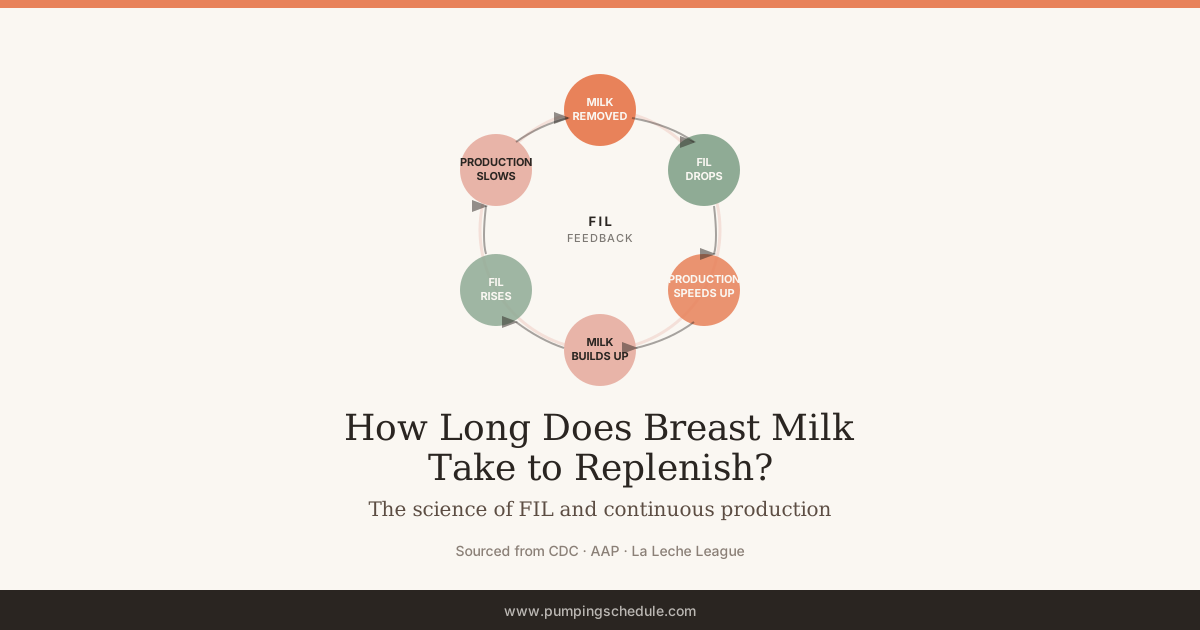
The mechanism is a whey protein called Feedback Inhibitor of Lactation — FIL for short. FIL gets produced alongside milk and accumulates as milk pools between sessions. WHO lactation physiology research identifies FIL as an autocrine suppressor: the more milk sitting in the breast, the more FIL is present, and the stronger the “slow down” signal sent to your alveoli. It's your body's brake pedal — a way to prevent engorgement if a baby stops feeding.
Pump thoroughly and you remove FIL with the milk. The brake releases. Synthesis speeds up.
Wait until your breasts feel “full” and FIL has been accumulating for hours, actively suppressing production the entire time. “I waited until I felt full and only got 2 ounces — I used to get 4 at that time of day” — paraphrased from r/ExclusivelyPumping. That pattern is classic FIL in action. Waiting for full does not build supply. It undermines it.
This is also why power pumping works: rapid cycling mimics a cluster-feeding baby, clears FIL repeatedly in a short window, and sends a demand signal strong enough to measurably increase output over three to five days.
6 Factors That Affect Your Replenishment Speed
That one-ounce-per-hour number is a starting point. Here is what pulls your actual rate higher or lower.
- How completely you emptied. Thorough emptying clears FIL and maximizes the demand signal. If you are disconnecting after five minutes of letdown and calling it done, you are leaving both milk and FIL behind. Stay until your breasts feel soft and flow has slowed to drops — on a Spectra S1 or similar hospital-grade double electric, that usually means 15–20 minutes with compression at the end. Aim for softness, not a timer.
- Pump and nursing frequency. CDC guidance on pumping emphasizes that frequent milk removal — not session length — drives hormonal output signals. Spacing sessions wider does not give milk more time to “build up.” It gives FIL more time to accumulate. Your pump does not care about your preference for three-hour gaps — and neither does prolactin, apparently.
- Time of day. Prolactin peaks roughly between 1 AM and 5 AM. Early-morning sessions tend to yield more milk and generate a stronger hormonal signal than afternoon pumps of the same length. Many exclusive pumpers protect that pre-dawn session even after dropping other overnight ones — for good reason.
- Weeks postpartum. Colostrum transitions to transitional milk around days 3–5, then mature milk by weeks 2–3. StatPearls breast milk physiology notes that volume capacity increases through weeks 4–6, then stabilizes once supply regulates. Early postpartum production is hormonally driven and somewhat forgiving; after regulation, your body pays closer attention to the pumping schedule you actually keep.
- Storage capacity. Two moms can produce 30 ounces a day — but if one stores 6 ounces per breast between sessions and the other stores 2, their ideal schedules look completely different. The low-storage mom needs more frequent sessions to hit the same daily total. Neither is better — just different hardware. The Office on Women's Health notes that individual variation in breast storage is normal and does not reflect overall production ability.
- Stress, sleep, and health. Cortisol interferes with the oxytocin release you need for letdown — which means milk stays trapped even after it has been synthesized. Illness, dehydration, and caloric deficit can all slow replenishment. The AAP breastfeeding policy statement notes that maternal wellbeing directly supports breastfeeding success.
What This Means for Your Pumping Schedule
The practical takeaway from FIL is simple: pump more often, not less. Waiting for fullness is counterproductive. More frequent emptying keeps FIL low, synthesis fast, and daily output higher — even if individual sessions feel smaller. “I was getting 2 oz six times a day. Switched to 3-hour gaps instead of 4 and started getting 2.5 oz eight times — almost 8 extra ounces a day” — paraphrased from r/breastfeeding.
For guidance on how often you should pump by stage — from the 8–12 sessions of the newborn weeks down to 4–6 at later infancy — see our frequency guide. If you are exclusively pumping, our exclusive pumping schedule maps out daily timing by age. And for session duration, how long each pumping session should last covers the 15–20 minute baseline and when to go longer.
If your supply has dipped, adding frequency is almost always the first move. Our guide to increasing milk supply while pumping covers the full toolkit — frequency, flange fit, hands-on technique, and when to escalate to power pumping. Combo feeders need to count nursing sessions too — our breastfeeding and pumping schedule shows how to tally stimulations across both.
One situation where this matters acutely: dropping a pumping session. Going from 7 to 6 sessions widens your average gap, giving FIL more accumulation time. Do it gradually — one session per week, tracking daily totals closely — so your body recalibrates instead of panicking. Cluster pumping can compensate here too: concentrating sessions in a time block offsets wider gaps at other points in the day.
Signs Your Milk Supply Is Keeping Up
After supply regulates — usually around 6–12 weeks — soft breasts are normal. Not a warning sign. This trips up a lot of moms who were accustomed to early engorgement. For the full picture of what regulation looks like, see our guide on signs of established milk supply. Here is what actually tells you things are fine.
- Wet diapers. La Leche League International considers six or more wet diapers per day (after day four) the most accessible intake marker.
- Weight gain on track. Consistent progression on WHO/CDC growth charts matters more than any single weigh-in. Watch the trend over weeks, not day-to-day fluctuations.
- Stable daily totals. Track ounces per day, not per session. Individual pumps will vary — your 6 AM session might yield 4 ounces while the 2 PM gives 1.5 — but if the daily number holds steady, breast milk replenishment is keeping pace.
When to Be Concerned About Slow Replenishment
Most supply dips have a recoverable cause — a growth spurt, a bad week of sleep, a skipped session, a head cold. Bodies fluctuate. A session that yields 1 oz instead of your usual 3 is not a crisis. Even barometric pressure can shift output on a given day. (Seriously.)
But consult an IBCLC if you notice:
- Daily pump totals dropped more than 20% over 7–10 days and have not recovered with added sessions
- Fewer than six wet diapers per day after day four, combined with declining output
- Baby falling off growth curve percentiles without explanation
- Breast pain, lumps, or redness alongside reduced output — possible plugged ducts or mastitis, which need prompt treatment
If you are not sure whether a dip is normal variation or a real supply problem, try adding one or two sessions for a week and track the response. Totals recover? Frequency-related. They do not? That is information worth bringing to an IBCLC.
Last reviewed: June 2026 by the Pumping Schedule Editorial Team. Read our editorial standards.
Related Reading
- How Often to Pump — frequency guide by stage, from newborn through weaning
- How to Increase Milk Supply While Pumping — frequency, technique, nutrition, and when to escalate
- Exclusive Pumping Schedule — daily session counts and timing for exclusive pumpers by age
- Power Pumping Schedule — how to use rapid-cycling sessions to drive supply up
- How Long to Pump Each Session — session length by stage and pump type
- Pump and Dump — when skipped or dumped sessions affect supply and when they do not