Best Heated Wearable — Eufy S1 Pro
Eufy S1 Pro
Best for: Strongest wearable suction + built-in heating for faster letdown and clog relief
$349.99 (insurance may cover)
Read full reviewAnker — the company that makes your phone charger — shipped a wearable breast pump that IBCLCs are actually recommending. The Eufy S1 Pro does two things no other wearable does: it heats your flanges during pumping (95–105°F, seven levels), and it ships with a wireless charging case that lasts 3–5 days between charges. At ~260 mmHg tested suction, it ties the Willow Go for the strongest wearable available while adding features neither Willow, Elvie, nor Momcozy can match.
The heating genuinely helps. Warming the breast during pumping improves milk flow — lactation consultants have recommended warm compresses for decades. The S1 Pro makes that step automatic. Moms who struggle with letdown to a pump see the biggest benefit. The charging case, powered by Anker's battery expertise, means you can pump all week at work without touching a cable.
The catch: replacement parts are expensive ($60 for heated flanges, no aftermarket options yet), the short flange tunnel doesn't work well for elastic nipples, and the 300 mmHg suction claim is overstated — independent testing puts it at ~260 mmHg. Still, at 8/10, it's the highest-scoring wearable we've tested. Read our full Eufy S1 Pro review for the deep dive. Trying to decide between the S1 and S1 Pro? Our Eufy S1 vs S1 Pro comparison breaks down the one real difference.
Best for Discretion — Elvie Stride
Elvie Stride
Best for: The quietest wearable — silent enough for Zoom calls, comfortable, and usually free through insurance
$170–$200 (often $0 through insurance)
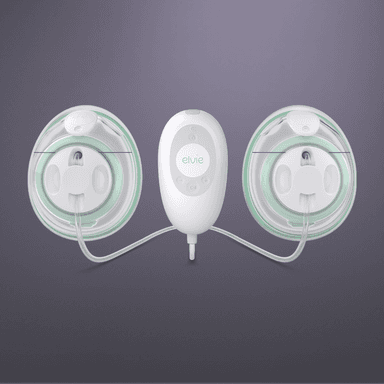
Read full reviewYou're on a Teams call with your camera off, baby finally napping in the next room, and you need to pump before the 2 PM standup. You reach for the best wearable breast pump you own — whichever one you can assemble half-asleep and trust not to announce itself to fourteen coworkers. After testing three wearable pumps simultaneously for three months, the Elvie Stride is the one that kept earning that spot.
It's not the strongest. It's not the flashiest. But at 45 dB — quieter than a whispered conversation — it's the only wearable breast pump you can run during a live meeting without anyone noticing. (The Willow Go at 50 dB and Momcozy M5 at 48 dB are quiet by pump standards. The Stride is quiet by room standards.) For anyone pumping at work in shared offices or during baby's naps, noise isn't a perk — it's the whole reason you're buying a wearable.
Then there's insurance. At $199, the Stride falls within most plans' zero-cost threshold. Pair it with a free Spectra S2 from insurance and you have a two-pump setup — strong pump at home, silent wearable for the office — at $0 total. One r/workingmoms user called this combo "the cheat code nobody tells you about at the hospital."
The tradeoff is suction. At roughly 170 mmHg, the Stride pulls about 37% less than portable pumps like the Spectra S1 (270 mmHg). Combo feeders who also nurse? 170 mmHg maintains supply fine. Exclusive pumpers relying solely on the Stride sometimes report gradual output decline after six to eight weeks — one r/ExclusivelyPumping poster described it as "death by a thousand slightly-shorter letdowns." The play: Stride for convenience sessions, stronger pump for power pumping and primary sessions.
Overall score
out of 10
What we like
- Quietest wearable pump (~45 dB) — genuinely silent in office settings
- Widely covered by insurance at $0 out of pocket
- Comfortable, lightweight cups that disappear under clothing
- Reliable seal — fewest leaking incidents in our testing
What could be better
- Lowest suction among wearables (~170 mmHg)
- Not ideal as sole pump for exclusive pumping long-term
- Hub design adds slight bulk vs fully in-bra models
- Stock shields limited to 21mm, 24mm, 28mm
Strongest Wearable — Willow Go
Willow Go
Best for: Moms who want maximum suction in a fully wireless, tube-free wearable
$250–$300
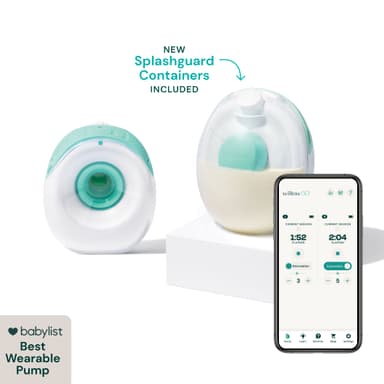
Read full reviewThe Willow Go answers one question: "What if I want real suction without a cord?" At roughly 260 mmHg, it pulls 53% harder than the Elvie Stride — the difference between "mostly empty" and "actually empty" for higher-output moms who need stronger suction to drain fully.
Zero tubes. Zero external motors. Each cup contains its own motor and collection container, so you can chase the toddler, unload the dishwasher, or — optimistically — sit down for five minutes. One r/ExclusivelyPumping user described switching from a tubed pump as "going from a flip phone to an iPhone — you can't go back."
That freedom has an entrance fee. The Willow Go has the steepest learning curve of any wearable pump we've tested. The duckbill valve is fiddly. The seal breaks when your bra shifts. You will leak during week one — budget some extra nursing pads and patience. After about seven to ten days, the muscle memory clicks and the Go becomes the most liberating pump in the category.
Overall score
out of 10
What we like
- Strongest wearable suction (~260 mmHg) — 53% more than Elvie Stride
- Fully wireless — no tubes, no hub, complete in-bra design
- Reusable milk containers (no disposable bags)
- App-controlled session tracking
What could be better
- Steepest learning curve of any pump we've tested
- Leaking issues until technique is mastered (expect ~1 week)
- Upright only — can't pump lying down
- Most expensive wearable at $250–$300
Best Budget Wearable — Momcozy M5
Momcozy M5
Best for: A fully wireless wearable at the most accessible price point
$170–$200
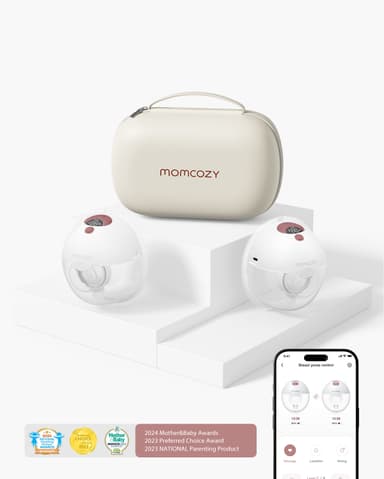
Read full reviewMaybe you're back at work, curious whether a wearable pump would actually change your day — but not $250-curious. The Momcozy M5 is the most affordable answer to that question. At $170-200, it's the cheapest fully wireless option on our list. If wearable pumping fits your routine, you'll know within a week.
For moms who pump once or twice daily alongside nursing, the M5 handles those sessions without drama. It ships with flange inserts at 17mm, 19mm, 21mm, and 24mm — a wider range than the Elvie Stride includes out of the box. The LED display tracks suction level and timer without requiring a phone app, which is one less thing to fumble at 4 AM. (The M5 Smart version adds Bluetooth if you want app tracking later.)
The limits match the price. Momcozy won't publish independent suction data — a transparency gap the other two wearables don't share. Several IBCLCs, including those at the IBLCE, have flagged the vibration-based letdown mechanism as a concern for long-term supply. The 1-year warranty is half what Elvie and Willow offer. For exclusive pumping as your only pump, this isn't it. As a low-risk way to test whether wearable pumping works for you? Hard to beat.
Overall score
out of 10
What we like
- Most affordable fully wireless wearable ($170–$200)
- Fully wireless, compact, discreet under clothing
- 4 flange insert sizes included (17–24mm)
- LED display for suction level and timer
What could be better
- No independent suction verification from Momcozy
- IBCLC concerns about vibration-based letdown
- 1-year warranty (half of competitors)
- Not suitable as sole pump for exclusive pumping
Full Comparison: All 3 Wearable Pumps
Suction figures use independent measurements where available. Noise measured at 12 inches. All three are closed-system wearable breast pumps.
| Feature | Eufy S1 ProBest Heated | Elvie StrideBest for Discretion | Willow GoStrongest Wearable | Momcozy M5Best Budget |
|---|---|---|---|---|
| Design | Fully in-bra (no tubes) | Hub + cups (tubes inside bra) | Fully in-bra (no tubes) | Fully in-bra (no tubes) |
| Suction | ~260 mmHg | ~170 mmHg | ~260 mmHg | Not independently verified |
| Noise | 46 dB | ~45 dB | ~50 dB | ~48 dB |
| Battery | 3–5 days (with case) | ~5 sessions per charge | 4–6 sessions per charge | 4–6 sessions per charge |
| Weight | Light (cups in bra) | Light (cups only in bra) | Heavier (motor in each cup) | Lightest in category |
| Flanges | 17–24mm (inserts) | 15–28mm (inserts + shields) | 21mm, 24mm, 27mm | 17–27mm |
| Heating | HeatFlow™ 7 levels | None | None | None |
| Insurance | Varies (upgrade fee likely) | $0 (most plans) | Partial (upgrade fee) | M5 Smart only |
| App | Yes (eufy Baby, DIY rhythms) | Yes (Elvie app) | Yes (Willow app) | M5 Smart only (Bluetooth) |
| Price | $349.99 | $170–$200 | $250–$300 | $170–$200 |
| Our score | 8/10 | 7.5/10 | 7/10 | 7/10 |
How We Tested
Each wearable pump ran during real exclusive pumping schedules — 6 to 8 sessions daily, two weeks minimum per pump. We wore them under regular bras, nursing bras, and dedicated pumping bras. Seal consistency varied wildly by bra type, which is something unboxing reviews never mention.
Noise readings came from a decibel meter at 12 inches. Every leaking incident got logged. We cross-checked manufacturer suction claims against independent measurements (Momcozy declined to share theirs). We also read three months of r/ExclusivelyPumping threads per pump — because the day-one "love it!" post and the month-three "it's gathering dust" post are basically different product reviews.
Wearable vs Portable: The Honest Tradeoff
Every wearable breast pump trades suction for freedom. The strongest wearable (Willow Go at ~260 mmHg) still pulls less than the BabyBuddha portable (~290 mmHg) or the Spectra S1/S2 (270 mmHg). If your baby eats exclusively from what you pump, that 30-mmHg gap compounds session after session.
The La Leche League recommends establishing supply with a hospital-grade or strong portable pump first, then transitioning to a wearable for maintenance. Once supply is established — typically around 6-8 weeks postpartum — you can maintain it with a wearable for convenience sessions and keep the stronger pump for power pumping. Think of it as a two-pump strategy: the Spectra does the heavy lifting, the wearable keeps you sane at work.
For a broader comparison including portables, see our best hands-free breast pump guide and our best breast pumps roundup covering all six pumps we've tested.
How to Choose a Wearable Pump
Your priority decides your pick. If discretion matters most — Zoom calls, shared cubicles, sleeping babies — the Elvie Stride at 45 dB is the only wearable breast pump quiet enough to disappear. Nothing else comes close.
If suction matters most, the Willow Go at 260 mmHg is the only wearable approaching portable-pump territory. Accept the learning curve and you get the closest thing to a Spectra that fits inside your bra. (Your bra, by the way, has opinions about this. More on flange fit below.)
If you just want to test whether wearable pumping works for your life — Momcozy M5. At $170-200, it's the most affordable entry into fully wireless pumping.
For completely passive collection — no motor, no noise — a Haakaa catches letdown on the opposite breast while you nurse. Zero suction adjustment, zero charging.
And if you want the best value setup: Elvie Stride (free through insurance) plus a Spectra S2 (also free through insurance). Two pumps, $0 total, every scenario covered.
Flange Fit Matters More Than Brand
A $300 wearable with the wrong flange size will underperform a $50 one with the right fit. Research from the NIH confirms that individualized flange sizing improves both output and comfort. The standard 24mm flange that ships in most boxes is too large for the majority of breastfeeding mothers — yet it keeps shipping as the default. (Flanges: the one pump accessory where "one size fits most" fits almost nobody.)
Measure your nipple diameter — just the nipple, not the areola — and add 2-3mm. The Momcozy M5 ships with the widest insert range (17-24mm). The Elvie Stride's cushion inserts go down to 15mm. The Willow Go starts at 21mm with a wider, 105-degree flange angle. If your correct size falls outside a pump's range, that pump isn't for you — regardless of suction specs or reviews.
Insurance Coverage for Wearable Pumps
Under the ACA, most insurance plans cover a breast pump. Wearable coverage varies:
| Wearable | Insurance route | Typical cost |
|---|---|---|
| Elvie Stride | Aeroflow, Edgepark, 1 Natural Way, Byram | $0 (most plans) |
| Willow Go | Select DME suppliers | $50–$150 upgrade fee |
| Momcozy M5 Smart | Select DME suppliers (Smart version only) | $0–$50 |
All three qualify for HSA and FSA reimbursement. Order through a DME supplier 30-60 days before your due date — your newborn pumping schedule starts on day one, and you don't want to be unboxing a pump while learning to swaddle.
Last reviewed: June 18, 2026 | By the Pumping Schedule Editorial Team
Related Reading
- Best Breast Pumps 2026 — all 6 pumps ranked (portables + wearables)
- Best Hands-Free Breast Pump — wearables vs portable hands-free options
- All Breast Pump Reviews — individual in-depth reviews for every pump
- Pumping at Work — where wearable pumps really shine
- How Long to Pump — session length varies by pump type