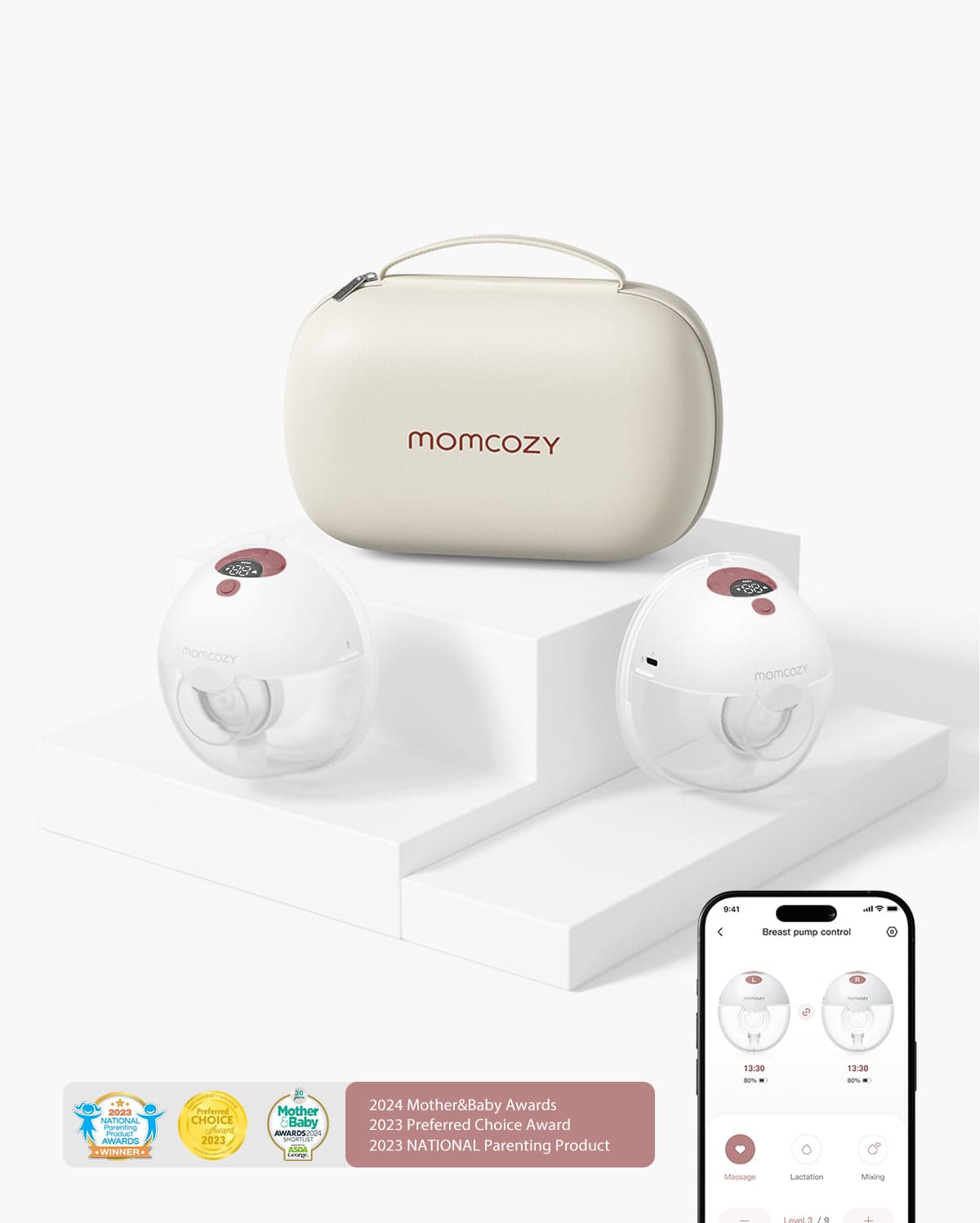
Two hundred dollars, no tubes, fits in a nursing bra, and you can pump while folding laundry. The Momcozy M5 is the best-selling wearable breast pump on Amazon for a reason — actually, for several reasons, and we'll get to all of them. But here's the part the sponsored reviews skip: at least two IBCLCs have publicly flagged the M5's suction pattern as a long-term supply risk, and Momcozy has never submitted the pump for independent testing.
So does it belong in your pumping routine? That depends on which role you're asking it to play.
What Is the Momcozy M5 (And Which Version Are You Actually Buying)?
Each Momcozy M5 cup is its own self-contained unit — motor, milk collector, controls, all in one piece that drops into a nursing bra. No tubes to route under your shirt, no hub clipped to your waistband. The company behind it, Shenzhen Moyin Technology, built one of the top-selling breast pump brands in the U.S. through aggressive Amazon placement and a deep bench of influencer partnerships.
The pump is FDA Class II cleared under 510(k) number K233880 (December 2023). That clearance puts it in the same regulatory class as other personal pumps — it does not mean the M5 performs like a hospital-grade device.
Now, the naming. Momcozy sells three M5 variants, and the differences are smaller than the names suggest:
- Momcozy M5 — the standard model. ~$180–200. Includes a carrying case. No app connectivity.
- Momcozy M5 Smart — same motor and pump hardware, but adds Bluetooth app control and is eligible for insurance coverage through DME suppliers. Same price range.
- Momcozy M5 Lite — same motor again, but strips out the carrying case to reduce cost. Cheapest entry point.
Same motor. Same 105-degree DoubleFit flange. Same suction range. You're picking between app features, accessories, and payment method — not between different pumping experiences. Insurance coverage? M5 Smart only.
Key Specs and What You Get in the Box
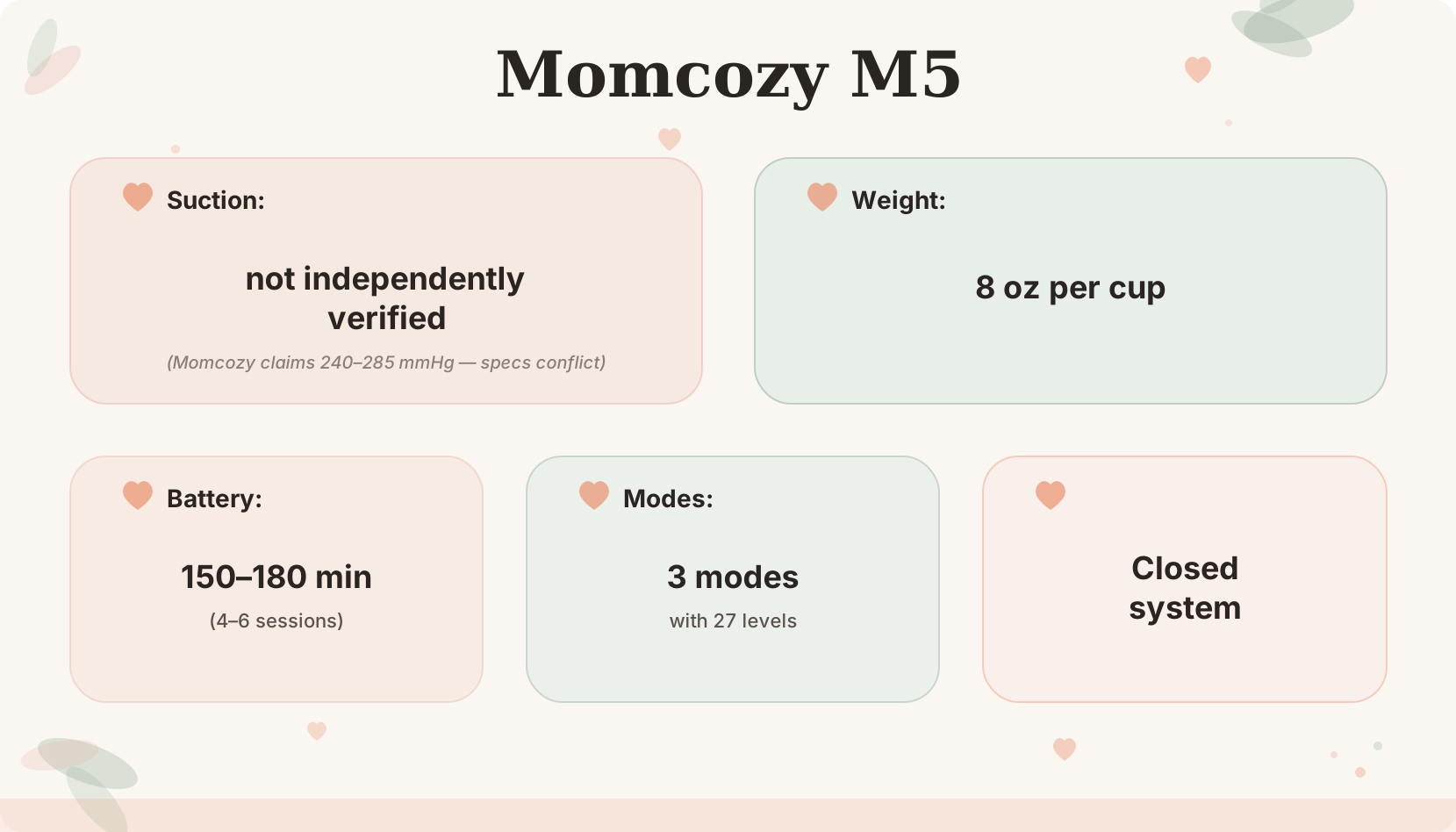
Numbers first. One thing to notice in this table: the suction spec has an asterisk the size of Texas.
| FDA Status | Class II, 510(k) cleared (K233880) |
|---|---|
| Price | ~$180–200 retail (HSA/FSA eligible; M5 Smart insurance-eligible) |
| Weight | 230g / 8 oz per cup |
| Milk Capacity | 160 ml / 5.4 oz per cup |
| Max Suction (claimed) | 240–285 mmHg (conflicting specs from Momcozy) |
| Max Suction (independently tested) | ~180–200 mmHg (community estimates; no formal lab testing) |
| Modes | 3 (Stimulation, Expression, Mixed with vibration) |
| Intensity Levels | 9 per mode (27 total settings) |
| Battery Life | 150–180 min (~4–6 sessions per charge) |
| Charge Time | ~2 hours via USB-C |
| Noise | <48 dB (claimed) |
| Flange Sizes | 24mm + inserts (17mm, 19mm, 21mm included; 27mm sold separately) |
| Design | Truly wireless — no tubes, no hub |
| System Type | Closed system, BPA-free |
| App | Momcozy app (M5 Smart only; Bluetooth) |
| Warranty | 1 year |
| Parts to Clean | 4 per side |
About that suction number: Momcozy's own pages can't agree on it. Amazon listing says 240 mmHg. Website says 285 mmHg. No third party has ever measured the actual output. We'll come back to why that gap matters.
The double pack ships with 2 motor units, 2 collectors, 2 sets of 24mm flanges, insert sets at 17mm/19mm/21mm, silicone valves, diaphragms, 2 USB-C cables, and a carrying case (M5 and M5 Smart only). Four flange sizes in the box at $200 is genuinely generous — most competitors ship one size and charge $15–20 per extra insert.

What the Momcozy M5 Does Well
The M5 earned its best-seller badge for real reasons. Here's what actually works.
Truly wireless design. Put it in your bra, press the button, walk away. Chase the toddler. Fold the laundry. Sit through the meeting. For moms pumping at work, this kind of untethered freedom changes the math on whether pumping during the day is even feasible.
The 105-degree flange angle.Most traditional pumps use a straight 90-degree flange tunnel. The M5's 105-degree angle is designed to reduce the pulling and stretching force on your nipple during suction. Research on flange fit and nipple tissue health confirms that tunnel angle affects both comfort and tissue integrity over time. This is a genuine engineering improvement, not marketing fluff.
Lightweight at 8 oz per cup. You notice them for about a minute. Then you forget. At 230g each, the M5 cups are heavier than an Elvie Stride cup but lighter than most truly wireless competitors, and the semi-circular shape sits flatter against your body than the round-cup designs.
Quiet enough for a phone call. Under 48 dB (claimed), which lands around refrigerator-hum territory. Audible in a silent room, invisible in any normal background noise. A phone call is fine. A video call with the mic six inches from your chest is a different story — ask me how I know.
Four flange inserts in the box. Proper flange fit is the single biggest factor in pumping comfort and output, and most pumps force you to guess your size and order extras at $15–20 a pop. The M5 ships 17mm, 19mm, 21mm, and 24mm. That alone saves you a sizing headache and $40–60.
Battery handles a full workday. 150–180 minutes of active pumping = 4–6 sessions before recharging. USB-C, same cable as your phone.
The price. ~$200 for a double. That undercuts the Willow Go ($350) by nearly half. It matches the Elvie Stride and BabyBuddha on price while dropping the tubes entirely.
Where the M5 Falls Short
Every pump has trade-offs. The M5's trade-offs happen to land in areas that directly affect whether your supply holds up over weeks and months.
The suction pattern concerns IBCLCs. This is the biggest issue. An IBCLC reviewer found the M5's suction “feels more like a push than a pull,” which is the opposite of how a baby naturally feeds. Research on infant suck patterns and pump design shows that effective breast emptying depends on mimicking the rhythmic vacuum a baby creates. A push-dominant pattern may trigger letdown (your body interprets the vibration as stimulation) but fail to fully empty the breast — and incomplete emptying is how supply drops.
A separate IBCLC review raised similar concerns: the M5's micro-vibration technology triggers letdowns effectively but may not provide the sustained stimulation needed to maintain the feedback inhibitor of lactation (FIL) mechanism that tells your body to keep producing milk. That reviewer reported seeing clients with “devastating loss of supply” after weeks on the M5 as their primary pump.
No formal suction testing.Elvie Stride: ~170 mmHg, independently verified. BabyBuddha: ~290 mmHg, independently verified. Willow Go: ~280 mmHg, independently verified. Momcozy M5: 240–285 mmHg claimed, with community estimates landing around 180–200 mmHg — well below every competitor at this price point. Momcozy has never submitted the M5 for third-party measurement. When every competitor has done the test and you haven't, the absence says something.
Short tunnel, elastic nipple risk.The M5's flange tunnel is shorter than traditional flanges ( our sizing guide explains how tunnel length interacts with fit). If your nipple elasticity is average, this is probably more comfortable. If your tissue stretches significantly during suction (elastic nipples — you might not know until you encounter a pump that reveals it), the short tunnel can create a tourniquet effect. Tissue swells against the walls, milk flow stops, and the resulting pain further inhibits the milk ejection reflex. You may not know you have elastic nipples until a pump like this one reveals it.
Tips over on any flat surface.That semi-circular shape that sits nicely against your body? It also means the M5 cannot stand upright on a table. At 2 AM, one hand on the baby, the other trying to transfer milk — a pump that rolls is a spill waiting to happen. “Don't cry over spilled milk” is a figure of speech until it's 4 ounces on your nightstand.
Upright pumping only. The M5 relies on gravity to move milk into the collector. Recline or lie down and output drops noticeably. Middle-of-the-night sessions in bed? Not with this pump. If your session length already runs long, a reclined position will stretch it further.
One-year warranty, spotty service.Every major competitor — Elvie, Willow, BabyBuddha — offers two years. Momcozy gives you one, and multiple IBCLC reviewers plus Amazon buyers describe customer service as slow to respond and slower to resolve claims. When you're pumping 6 times a day, a dead pump with no quick replacement path is not “an inconvenience” — it's a supply emergency.
Momcozy M5 vs Elvie Stride vs Willow Go vs BabyBuddha
Four pumps, four trade-off profiles. The “Independent Testing” row is the one to watch — it tells you which suction numbers are marketing and which are measured.
| Feature | Momcozy M5Best for: budget pick | Elvie StrideBest for: quiet pumping | Willow GoBest for: fully in-bra | BabyBuddhaBest for: strongest suction |
|---|---|---|---|---|
| Price | ~$200 | ~$200 | ~$350 | ~$205 |
| Suction (claimed) | 240–285 mmHg | 300 mmHg | 300+ mmHg | 320+ mmHg |
| Independent Testing | ~180–200 mmHg (est.) | ~170 mmHg verified | ~280 mmHg verified | ~290 mmHg verified |
| Design | Truly wireless (no tubes) | Hub + tubes wearable | Truly wireless (no tubes) | Portable + tubes |
| Battery Life | 150–180 min | ~150 min | ~150 min | ~60 min |
| Warranty | 1 year | 2 years | 2 years | 2 years |
| Flange Sizes Included | 4 (24mm + 3 inserts) | 1 (24mm) | 2 (21mm, 24mm) | 1 (24mm) |
| Insurance | M5 Smart only | Widely covered | Some coverage | Limited coverage |
The M5's pitch: truly wireless at $200. The Willow Go matches the wireless part but costs $150 more. The Elvie Stride matches the price but keeps tubes. The BabyBuddha has the strongest verified suction of the four but dies after about an hour on battery.
Insurance changes the math entirely. The Elvie Stride is widely covered — a $200 pump for $0 out of pocket, with verified suction data and a 2-year warranty. The M5 Smart is also insurance-eligible but through fewer DME suppliers. Under the ACA's breast pump coverage requirements, your plan must cover at least one pump — but they choose which models. Check with Aeroflow or your insurer to see what's available on your specific plan.
Leaning toward the premium wireless option? Our Willow Go review has the full breakdown.
Can You Exclusively Pump With the Momcozy M5?
Technically, yes. As your sole pump for 7–8 daily sessions over months? Most lactation consultants would tell you to reconsider.
The broader IBCLC stance on wearables — not just the M5 — is that they work best as secondary pumps. A 2022 survey of physicians using wearable pumps found they helped maintain breastfeeding duration by enabling pumping during work, but participants typically used them alongside a traditional pump.
The M5 specifically adds the “push not pull” wrinkle on top of that. If your exclusive pumping schedule calls for 7–8 sessions a day, you need full breast emptying every time. Leftover milk triggers the FIL (feedback inhibitor of lactation) mechanism — your body reads residual milk as “make less.” Over days and weeks, that signal compounds.
The battery math is tight.150 minutes of capacity, 8 sessions at 20 minutes each = 160 minutes needed. You're already over. If sessions stretch to 25–30 minutes (common when output slows), you're charging between every 4–5 sessions. Doable, but not the “set it and forget it” experience the marketing suggests.
What EP moms actually do.M5 for the portable sessions — work commute, school pickup, the grocery store run where you're inexplicably always letdown-ready. Then a Spectra S1, Medela PNSA, or BabyBuddha at home for the sessions that need to fully drain. Wireless freedom when you need mobility, reliable emptying when you're near an outlet.
If the M5 is your only pump right now and your supply is dropping — please hear this: it might be the pump, not you. Before adding power pumping sessions or fenugreek or panic, try one session on a different pump. If output jumps, you have your answer. Our guide to increasing milk supply while pumping covers the full troubleshooting path.
Who Should (and Shouldn't) Buy the Momcozy M5
Overall score
out of 10
What we like
- Truly wireless — no tubes, no hub, nothing to snag or clip
- 105-degree flange angle reduces nipple pulling
- Four flange insert sizes included (17mm, 19mm, 21mm, 24mm)
- Quiet enough for phone calls and shared spaces
- 150+ minute battery handles a full workday
- Half the price of Willow Go with similar wireless freedom
What could be better
- Suction pattern flagged by IBCLCs as potential supply risk
- No formal suction testing — community estimates (~180–200 mmHg) far below claimed specs
- Short flange tunnel problematic for elastic nipples
- 1-year warranty (competitors offer 2 years)
- Cannot stand upright — spill risk during milk transfer
- Must pump upright — no reclining or lying-down sessions
- Customer service widely reported as slow and difficult
Buy the M5 if:
- Combo feeders who also nurse at the breast.Baby handles most milk removal, and you're pumping 2–3 times a day for a stash or daycare bottles. The M5's convenience outweighs its suction concerns here because your baby is maintaining your supply.
- Working moms who want a discreet secondary pump.Pair it with a stronger primary pump at home, use the M5 at the office. This is the sweet spot for this pump. If you're building your pumping at work setup, the M5 earns its place in the bag.
- Occasional pumpers.Date night, errands, travel. If you pump a few times a week rather than daily, the supply concerns don't apply.
- Budget-conscious moms. If the Willow Go at $350 is out of reach and you need truly wireless (tubes are a dealbreaker), the M5 is the most accessible option in that category.
Skip the M5 if:
- Exclusive pumpers relying on one pump.The IBCLC concerns are too consistent to ignore if this pump is your baby's sole food source.
- Moms with elastic nipples.The short tunnel design creates a real tourniquet risk for elastic tissue. If you don't know your elasticity yet, a pump with a longer tunnel is a safer starting point.
- Early postpartum supply establishment. The first 12 weeks are when your body calibrates its long-term supply based on demand signals. A pump with unverified suction and a questioned stimulation pattern is not where you want to build that foundation. Start with a proven pump, then add the M5 once your supply is established.
- Moms who need verified performance data. If knowing exactly what your pump delivers matters to you (and it should), the lack of independent testing is disqualifying.
Related Reading
- Exclusive Pumping Schedule — Complete Guide by Baby's Age
- How Long Should You Pump? Session Length Guide
- Pumping at Work — Your Rights and Setup Guide
- Breast Milk Storage Guidelines
- Best Wearable Breast Pumps (2026) — Top 3 Compared
- Best Breast Pumps (2026) — 6 Pumps Ranked
- Eufy S1 Pro Review — Heated Wearable With Real Suction