You're three weeks postpartum, running on two hours of sleep, and scrolling through 47 Amazon listings at 3 a.m. trying to figure out which breast pump won't be a $300 regret. We've been there. So we tested six of the best breast pumps on the market during actual exclusive pumping schedules — not a polite single session in a product demo room. Below is what survived 6-8 daily sessions, what fell apart by month two, and what your money should go toward in 2026.
Best Overall — Spectra S2 Plus
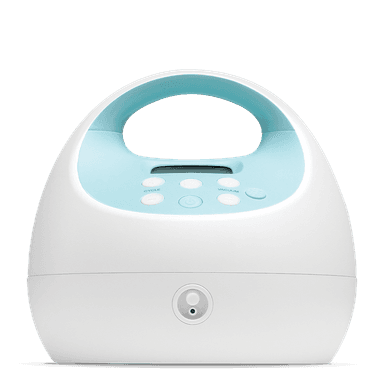
Spectra S2 Plus
Best for: Most moms — strongest suction per dollar, free through insurance, IBCLC favorite
$60–$100 (usually $0 through insurance)
Read full reviewOne breast pump. That's all you get. Which one? The Spectra S2. It pulls 270 mmHg — stronger than every wearable we tested — with adjustable cycle speed from 38 to 54 CPM. Price: usually $0 through insurance.
IBCLCs we spoke with name the S2 as their go-to for exclusive pumping. The suction is independently verified, the closed system keeps mold out of the tubing, and the 2-year warranty outlasts everything in its class. One consultant told us: "Get the free S2, spend the money you saved on a proper flange fitting, and ignore the Instagram pump ads." (If sessions are already uncomfortable, our pumping pain guide covers flange fit as the first thing to rule out before blaming the pump itself. And if you haven't measured yet, our flange size chart walks you through it.)
The catch is boring but real: no battery. You're tethered to an outlet. For most pumping schedules that happen in the same corner of the couch anyway, it doesn't matter. If you need to pump at work or while chasing a toddler, look at the S1 below.
What we like
- Strongest suction in this roundup (270 mmHg, independently verified)
- Adjustable cycle speed (38–54 CPM) — unique at this price
- Free through most insurance plans ($0 out of pocket)
- Closed system, 2-year warranty, LCD with timer and night light
What could be better
- No battery — AC power only, tethered to an outlet
- Ships with 24mm and 28mm flanges (too large for most women)
- Not portable — stays at home
Best Portable — Spectra S1 Plus
Spectra S1 Plus
Best for: Moms who want S2-level suction with the freedom to move around
$160–$225 ($30–$80 insurance upgrade)
Read full reviewSame motor, same 270 mmHg suction, same adjustable cycle speed. The only difference: a rechargeable battery that gives you about three hours (six 25-minute sessions) off the wall. The S1 is the S2 that finally cut the cord.
Insurance typically covers the upgrade for $30-80 out of pocket. If every session happens next to an outlet, save the money — or grab a $20 portable battery pack off Amazon and turn your S2 into a budget S1. But if you pump at work, travel, or just want to move between rooms without dragging an extension cord like some kind of dairy-themed ghost, the real battery is worth it.
What we like
- Identical motor and suction to the S2 (270 mmHg)
- Rechargeable battery — ~3 hours / 6 sessions per charge
- Available through insurance with modest upgrade fee
- Same adjustable cycle speed, closed system, 2-year warranty
What could be better
- Battery degrades with heavy daily use after 6–12 months
- Heavier than the S2 (3.3 lbs vs 2.7 lbs)
- Same oversized stock flanges (24mm, 28mm) as the S2
Best for Exclusive Pumping — BabyBuddha 2.0
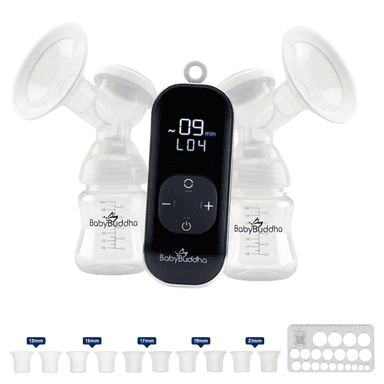
BabyBuddha 2.0
Best for: EP moms who want fast emptying and maximum suction in a portable form factor
$205–$230
Read full reviewThe BabyBuddha is smaller than a coffee mug and pulls roughly 290 mmHg — the highest suction in this roundup. Emptying takes 10-13 minutes instead of the 20-25 typical of wearables. When you're pumping 7-8 times daily, that gap reclaims about an hour. One r/ExclusivelyPumping user put it this way: "I switched from my Elvie to the BabyBuddha and got an entire extra ounce per session — and finished faster." (Paraphrased from Reddit.)
That speed also matters for supply. More complete emptying signals higher demand. IBCLCs who specialize in EP consistently point to suction strength as the variable moms underestimate first.
Battery life is the asterisk: roughly 60 minutes per charge, so three sessions before you're plugged back in. The included EasyFit Kit with 10 sizing inserts (13-21mm) is a standout — no other pump ships that range without aftermarket purchases.
What we like
- Highest suction tested (~290 mmHg) — faster, more thorough emptying
- Palm-sized and genuinely portable
- EasyFit Kit: 10 silicone inserts spanning 13–21mm included
- Hands-free capable with collection cup accessories
What could be better
- Short battery (~60 min, roughly 3 sessions)
- 4-hour charge time
- Not a true wearable — needs accessories for hands-free use
Best for Work — Elvie Stride
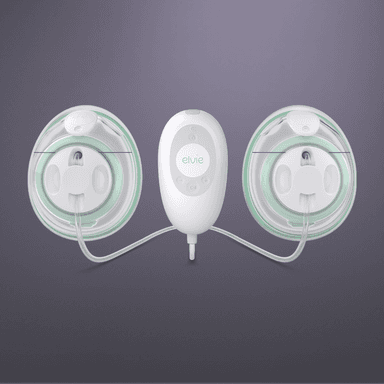
Elvie Stride
Best for: Working moms who need a quiet, discreet pump for the office
$170–$200 (often $0 through insurance)
Read full reviewForty-five decibels — quieter than a library, quieter than your coworker chewing. The Elvie Stride tucks into your bra and stays silent enough for Zoom calls. If you're pumping at work without a private room, nothing else matches it on discretion.
You pay for that silence in suction. Independent testing puts the Stride at roughly 170 mmHg, about 37% below the Spectra S2. For combo feeding moms who also nurse, that's generally enough. Exclusive pumpers relying on the Stride alone report gradual output drops after six to eight weeks. The two-pump setup most EP moms land on: Elvie at work, Spectra at home.
At $199 retail, the Stride falls within most insurance plans' zero-cost threshold. A hands-free breast pump at $0 changes the math — even as a second pump.
What we like
- Quietest pump tested (~45 dB) — genuinely discreet
- Widely covered by insurance at $0
- Lightweight cups, comfortable for all-day wear
- USB-C charging, ~5 sessions per charge
What could be better
- Lowest suction in this roundup (~170 mmHg)
- Not ideal as a sole pump for exclusive pumping
- Hub adds some bulk compared to fully wireless designs
Best Wearable — Willow Go
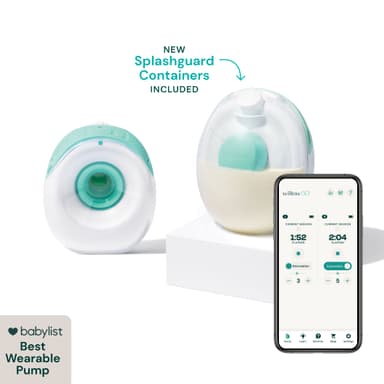
Willow Go
Best for: Moms who want the strongest suction in a fully wireless, tube-free pump
$250–$300
Read full reviewNo tubes. No external hub. The Willow Go sits entirely inside your bra and pulls roughly 260 mmHg — the strongest suction of any fully wireless wearable. Fold laundry, walk through Target, make lunch. One r/breastfeeding user described it as "the first pump that let me forget I was pumping" (paraphrased from Reddit).
Expect a learning curve. Assembly is fiddly, the duckbill valve seal demands practice, and leaking haunts the first week. r/ExclusivelyPumping threads consistently describe a "frustration hump" around day three to five before the technique clicks. You also can't lie down while wearing it — gravity is not optional.
For the full wearable comparison — including how the Willow Go stacks against the BabyBuddha with collection cups — see our best hands-free breast pump guide.
What we like
- Strongest suction among fully wireless wearables (~260 mmHg)
- No tubes, no external motor — completely in-bra
- Reusable containers (no disposable bags needed)
- App-controlled with session tracking
What could be better
- Steep learning curve with assembly and sealing
- Leaking issues until technique is mastered
- Must stay upright — no lying-down pumping
- Highest price point ($250–$300)
Best Budget — Momcozy M5
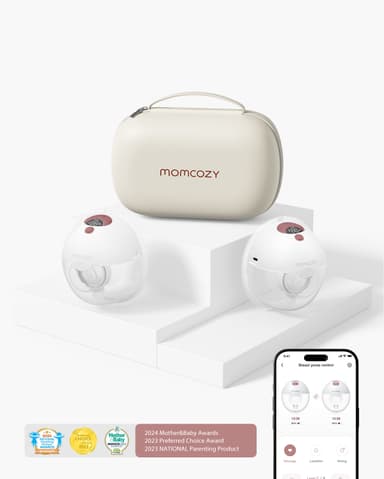
Momcozy M5
Best for: An affordable second pump for occasional hands-free sessions
$170–$200
Read full reviewThe Momcozy M5 is the most affordable fully wireless wearable on our list. At $170-200 for a fully wireless wearable, it's a solid choice for combo feeders who pump once or twice a day, or anyone who wants to test the wearable format before dropping $250+ on a Willow.
The asterisks, though. Momcozy doesn't publish independent suction data (never a great sign). The vibration-based letdown mode has drawn concern from IBCLCs like those at KellyMom who question its long-term supply impact. For a session or two daily alongside nursing? Fine. As your only pump for exclusive pumping? Think of the M5 as a gateway wearable, not the workhorse.
What we like
- Most affordable fully wireless wearable ($170–$200)
- Fully wireless, compact, discreet
- Includes 4 flange insert sizes in the box
- USB-C, 4–6 sessions per charge
What could be better
- No independently verified suction data
- IBCLC concerns about long-term supply impact
- Not recommended as sole pump for EP
- 1-year warranty vs competitors' 2 years
Full Comparison: All 6 Breast Pumps
All suction figures use independent measurements where available. Noise measured at 12 inches. "Not published" means the manufacturer hasn't released third-party data — draw your own conclusions.
| Feature | Spectra S2Best Overall | Spectra S1Best Portable | BabyBuddhaBest for EP | Elvie StrideBest for Work | Willow GoBest Wearable | Momcozy M5Best Budget |
|---|---|---|---|---|---|---|
| Type | Stationary | Portable | Portable | Wearable | Wearable | Wearable |
| Suction | 270 mmHg | 270 mmHg | ~290 mmHg | ~170 mmHg | ~260 mmHg | Not published |
| Noise | <45 dB | <45 dB | ~50 dB | ~45 dB | ~50 dB | ~48 dB |
| Battery | None (AC only) | ~3 hrs rechargeable | ~60 min | ~5 sessions | 4–6 sessions | 4–6 sessions |
| Flanges | 24mm, 28mm (aftermarket 13mm+) | 24mm, 28mm (aftermarket 13mm+) | 13–24mm (EasyFit Kit) | 15–28mm | 21mm, 24mm, 27mm | 17–27mm |
| Insurance | $0 (most plans) | $30–$80 upgrade | Yes (varies) | $0 (widely covered) | Partial | M5 Smart only |
| Price | $60–$100 | $160–$225 | $205–$230 | $170–$200 | $250–$300 | $170–$200 |
| Our score | 9/10 | 8.5/10 | 8/10 | 7.5/10 | 7/10 | 7/10 |
How We Tested
Each pump went through a real exclusive pumping schedule: 6-8 sessions per day, minimum two weeks. We tracked output across morning, midday, and evening. We measured noise with a decibel meter at 12 inches. We documented every valve failure and every "I almost threw this against the wall" moment. (There were several.)
Advertised suction was checked against independent measurements from BabyGearLab and lactation professionals with pressure gauges. When real numbers didn't match marketing — Elvie's "hospital-strength" claim being the most notable gap — we flagged it. The CDC emphasizes that effective milk removal is the foundation of sustained breastfeeding, so suction accuracy isn't a footnote — it's the headline.
We cross-referenced long-term feedback from r/ExclusivelyPumping and r/breastfeeding, focusing on posts from month three and beyond. The best breast pumps hold up at month four, not just month one — the honeymoon reviews tell you what's exciting, the long-haul posts tell you what breaks. (Spoiler: it's usually the membranes and duckbill valves. Our guide on when to replace pump parts covers the replacement schedule for every brand.)
Portable vs Wearable vs Stationary: Which Type Do You Need?
Choosing the best breast pump starts with knowing which type fits your life.
Stationary (Spectra S2, Medela Pump In Style): plugged into the wall, strongest suction, lowest cost. If you pump at home in the same spot, a stationary pump maximizes output per dollar. The S2 at $0 through insurance is the best value in any category. For NICU moms or anyone dealing with supply challenges, our hospital-grade breast pump guide covers pumps with even stronger, research-backed suction patterns.
Portable (Spectra S1, BabyBuddha): same strong suction, plus a rechargeable battery. Heavier, pricier, and batteries degrade with daily use after 6-12 months. Worth it for moms who pump at work or travel.
Wearable(Elvie Stride, Willow Go, Momcozy M5): everything inside the bra, no tubes. Suction runs 170-260 mmHg versus 270-290 for portables — a meaningful gap for EP moms. Best as a secondary pump or a primary for combo feeders. For passive collection without any motor at all, a Haakaa silicone collector catches letdown on the opposite breast while you nurse. See our best hands-free breast pump guide for the full comparison.
The AAP recommends exclusive breastmilk for the first six months. Reaching that milestone usually requires a pump that fully empties you, which is why IBCLCs lean toward portables or stationaries as the primary — regardless of what you grab for convenience sessions.
Getting a Breast Pump Through Insurance
Under the ACA, most insurance plans cover a breast pump at $0. Here's how the best breast pumps in our 2026 rankings fare through insurance:
| Pump | Insurance availability | Typical out-of-pocket |
|---|---|---|
| Spectra S2 | Almost universally covered | $0 |
| Spectra S1 | Widely available | $30–$80 upgrade fee |
| BabyBuddha | Aeroflow, Edgepark, 1 Natural Way, Storkpump | $0–$200 (varies) |
| Elvie Stride | Widely covered through DME suppliers | $0 (most plans) |
| Willow Go | Select DME suppliers | $50–$150 upgrade fee |
| Momcozy M5 | M5 Smart only, select suppliers | $0–$50 (Smart); out-of-pocket for standard |
Order through a DME supplier (Aeroflow, Edgepark, 1 Natural Way, Byram) — not Amazon — to use insurance. Start 30-60 days before your due date. Your newborn pumping schedule begins whether the box has arrived or not.
Last reviewed: June 18, 2026 · Editorial standards
Related Reading
- Best Hospital Grade Breast Pump — for NICU moms, preemie parents, and low-supply situations
- Best Hands-Free Breast Pump — deep dive on wearable and hands-free options
- All Breast Pump Reviews — full individual reviews for every pump
- Exclusive Pumping Schedule — the daily schedule your pump needs to support
- Pumping Schedule Generator — build a personalized schedule for your pump
- Breast Milk Storage Guidelines — what to do with the milk once you pump it
- Eufy S1 Pro Review — heated wearable with hospital-grade suction
- Best Pumping Bra — the right bra makes every pump session hands-free
- Pumping Essentials — everything else you need beyond the pump itself