Best Overall Hands-Free Pump — BabyBuddha
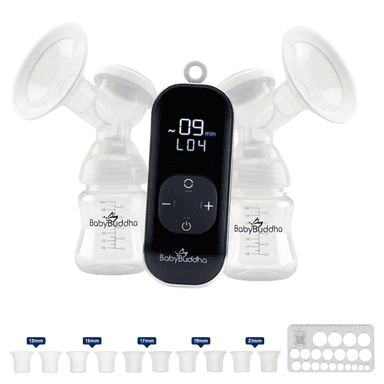
BabyBuddha
Best for: EP moms who want portable-level suction with hands-free capability
$205–$230
Read full reviewFair warning: the BabyBuddha isn't technically a wearable. It's a portable pump the size of a coffee mug that becomes hands-free with collection cup accessories and a pumping bra. But scroll through r/ExclusivelyPumping and you'll see the BabyBuddha recommended in nearly every "best hands-free breast pump" thread — because at roughly 290 mmHg, it empties faster and more completely than anything you can tuck into a bra. That's why it's our top pick for best hands-free breast pump overall. One EP mom on Reddit summed it up: "My wearable was convenient. My BabyBuddha actually gets the milk out" (paraphrased from Reddit).
That suction gap compounds over weeks of daily pumping sessions. Wearable-only moms sometimes report gradual supply dips after month two; BabyBuddha users tend to hold steady. Stronger suction = more thorough emptying = higher demand signal to your body. Lauren Fuchigami, IBCLC, has noted on KellyMom that pump strength is the variable EP moms most consistently underestimate.
The tradeoff? Battery life. Three sessions per charge means you're plugging in between pumps on a full pumping schedule. Plug in at home, save the battery for errands or work sessions. (Yes, the USB-C cable will become your emotional support accessory.)
Overall score
out of 10
What we like
- Highest suction in this roundup (~290 mmHg) — matches tabletop pumps
- Fast emptying: 10–13 minute sessions versus 20–25 with wearables
- Palm-sized motor fits anywhere — truly portable
- EasyFit Kit includes 10 sizing inserts (13–21mm) in the box
What could be better
- Not a true wearable — needs collection cup accessories for hands-free use
- Short battery life (~60 minutes, roughly 3 sessions)
- 4-hour charge time via USB-C
- Tubing required with some accessory setups
Best Fully Wireless — Willow Go
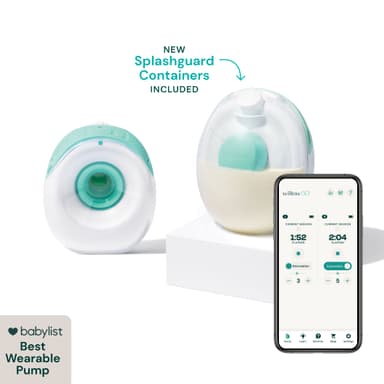
Willow Go
Best for: Moms who want the strongest suction in a fully wireless, in-bra pump
$250–$300
Read full reviewYou're folding laundry while pumping. Walking through Target with a cart in one hand and a toddler's goldfish cracker in the other. The Willow Go disappears inside your bra — no tubes, no motor dangling from a clip. At around 260 mmHg, it pulls harder than any other fully wireless wearable breast pump we've tested, making it the best fully wireless hands-free pump available. That gap matters when you're exclusively pumping and tracking every milliliter.
The learning curve is steep enough to make you question the purchase for a solid week. Duckbill valve assembly is fiddly, the seal breaks if your bra shifts even slightly, and leaking is a real issue until your hands learn the motion. As one r/ExclusivelyPumping mom put it: "I almost returned it on day three. By day ten, I couldn't imagine pumping without it" (paraphrased from Reddit).
Upright only — lying down risks leaks because the reusable containers don't seal like the Willow 360's bags.
For nighttime sessions, prop yourself up or swap to your Spectra. For daytime hands-free pumping while chasing a crawling baby or unloading groceries, nothing else in this roundup matches the Willow Go's fully wireless freedom.
Overall score
out of 10
What we like
- Strongest suction among fully wireless wearables (~260 mmHg)
- Truly hands-free — no tubes, no external motor, nothing to hold
- Reusable milk containers (no disposable bags required)
- App-controlled with session tracking
What could be better
- Steep learning curve — expect a week of frustration with assembly and sealing
- Leaking issues until you master the duckbill valve technique
- Must stay upright — can't lie down while pumping
- Highest price in this roundup at $250–$300
Best for Work — Elvie Stride
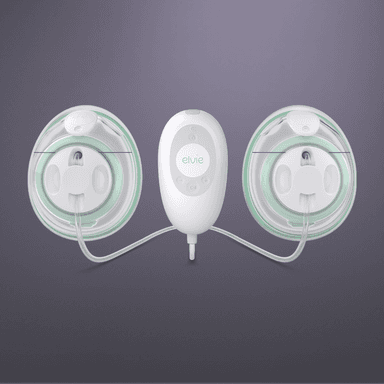
Elvie Stride
Best for: Working moms who need a quiet, discreet pump for the office
$170–$200
Read full reviewYour boss doesn't know you're pumping during the 2 PM standup. The coworker three feet away doesn't hear a thing. At roughly 45 dB, the Elvie Stride is quieter than a whispered conversation — the most discreet hands-free breast pump in this roundup by a real margin. If you're navigating workplace pumping and discretion outranks raw suction, the Stride is your pump.
The asterisk: suction. Independent testing lands the Stride at about 170 mmHg — roughly 43% below the advertised "hospital-strength" claim, 37% below the Spectra S1. Combo feeders who also nurse? Usually fine. EP moms running 7-8 daily sessions sometimes report output dipping after six to eight weeks on the Stride alone. The consensus on r/ExclusivelyPumping: Stride at work, stronger pump at home for power pumping and those early-morning sessions when volume matters most.
Insurance is where the Stride really earns its spot. $199 retail falls within most plans' zero-cost coverage. A hands-free pump at $0 out of pocket — even as your second pump alongside a Spectra — is hard to turn down. Free is free, and your FSA won't argue.
Overall score
out of 10
What we like
- Quietest pump tested (~45 dB) — genuinely discreet during meetings
- Widely covered by insurance at $0 out of pocket
- Comfortable, lightweight cups that disappear under clothing
- USB-C charging with ~5 sessions per charge
What could be better
- Weakest suction in this roundup (~170 mmHg) — 43% below advertised
- EP moms may see supply decline when using as sole pump long-term
- Hub and cup design adds bulk compared to fully wireless options
- Shields limited to 21mm, 24mm, 28mm (needs inserts for smaller sizes)
Best Budget — Momcozy M5
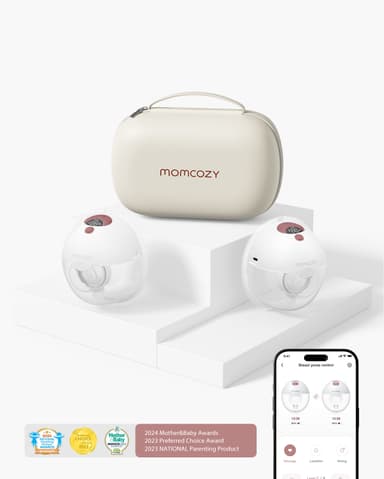
Momcozy M5
Best for: Moms who need an affordable second pump for occasional hands-free sessions
$170–$200
Read full reviewSeventy dollars. The Momcozy M5 costs less than most pumps' replacement parts kit — and for combo feeders or anyone who wants a secondary wearable breast pump for errands, it gets the job done. No tubes, no external motor, fully wireless. At this price, it's basically an impulse buy that happens to pump milk.
IBCLCs have flagged legitimate concerns. The M5's vibration-based letdown mechanism gets skeptical looks from lactation consultants, and Momcozy doesn't publish independent suction data — so verifying actual performance against the marketing claims is impossible. For one or two daily sessions alongside nursing, these issues matter less. For exclusive pumping as your only pump? Most IBCLCs would point you toward a stronger option.
The real value of the M5: it's the most affordable entry into fully wireless hands-free pumping. Plenty of moms start here, confirm they like the wearable format, then upgrade to a Willow Go for stronger suction. At $170-200, it's still the cheapest fully wireless option on this list.
Overall score
out of 10
What we like
- Most affordable fully wireless option ($170–$200)
- Fully wireless, compact, genuinely discreet under clothing
- Includes 4 flange insert sizes (17–24mm) in the box
- USB-C charging, 4–6 sessions per charge
What could be better
- No independently verified suction data from Momcozy
- IBCLC concerns about vibration-based letdown and long-term supply
- Not recommended as sole pump for exclusive pumping
- 1-year warranty (competitors offer 2 years)
Full Comparison: All 4 Hands-Free Pumps
Suction figures use independent measurements where available — not manufacturer marketing. Noise levels measured at 12 inches. If a number says "not independently verified," that's on the manufacturer, not us.
| Feature | BabyBuddhaBest Overall | Willow GoBest Fully Wireless | Elvie StrideBest for Work | Momcozy M5Best Budget |
|---|---|---|---|---|
| Type | Portable + hands-free kit | Wearable (fully in-bra) | Wearable (hub in bra) | Wearable (fully in-bra) |
| Suction | ~290 mmHg | ~260 mmHg | ~170 mmHg | Not independently verified |
| Noise | ~50 dB | ~50 dB | ~45 dB | ~48 dB |
| Battery | ~3 sessions (60 min) | 4–6 sessions | ~5 sessions | 4–6 sessions |
| Flanges | 13–24mm (EasyFit Kit) | 21mm, 24mm, 27mm | 15–28mm (inserts + shields) | 17–27mm |
| Insurance | Yes (Aeroflow, Edgepark) | Partial (upgrade fee typical) | Yes (widely covered at $0) | M5 Smart only |
| Price | $205–$230 | $250–$300 | $170–$200 | $170–$200 |
| Our score | 8/10 | 7/10 | 7.5/10 | 7/10 |
How We Tested
Each pump ran through a real exclusive pumping schedule — 6 to 8 sessions per day, at least two weeks per pump. We logged output across morning, midday, and evening sessions. Noise measured with a decibel meter at 12 inches. Assembly time, cleaning time, every single leaking incident — documented.
We also dug into what EP moms on r/ExclusivelyPumping say after month three. Week-one honeymoon reviews are useless. The real picture shows up at week twelve, when novelty has worn off and you're just trying to maintain supply on four hours of sleep.
Advertised suction numbers got compared against independent measurements from BabyGearLab and lactation professionals with pressure gauges. When a manufacturer won't publish independent data (Momcozy, we're looking at you), we flag it. Suction transparency matters — the CDC's breastfeeding guidance and the U.S. Breastfeeding Committee both emphasize adequate pump performance as critical for maintaining supply.
How to Choose a Hands-Free Breast Pump
Skip the marketing. Three questions tell you which hands-free pump fits your life:
How many sessions go hands-free? If hands-free pumping is your primary mode — five or more sessions daily — prioritize suction. BabyBuddha or Willow Go. If hands-free is just for the office and you keep a Spectra at home, the Elvie Stride or Momcozy M5 covers you at a fraction of the price.
Are you exclusively pumping? EP moms need to protect supply across months of daily use. Suction directly affects how thoroughly you empty, and thorough emptying is what maintains supply. The BabyBuddha at 290 mmHg or the Willow Go at 260 mmHg are safer long-term bets than the Stride's 170 mmHg. Your supply doesn't care about convenience — it cares about demand.
What's your budget after insurance?Check insurance first. The Elvie Stride at $0 through most plans is hard to argue with, even as a second pump. Paying out of pocket? The Momcozy M5 at $170-200 lets you road-test wearable pumping before dropping $250+ on a Willow Go. The Academy of Breastfeeding Medicine's clinical protocols emphasize that the right pump depends on frequency and goals — there's no universal "best."
Hands-Free vs Portable: Do You Need Both?
Probably — and that's not a sales pitch. The AAP recommends exclusive breastmilk for the first six months. Maintaining supply that long usually requires a pump that fully empties you — and for most EP moms, that means a portable with stronger suction handling the heavy-lifting sessions.
The two-pump combo that dominates r/ExclusivelyPumping: Spectra S1 or S2 at home for morning sessions and power pumps, a wearable breast pump for the office, errands, and those 2 AM sessions where you cannot face being tethered to the couch again. Your body doesn't care which pump is attached — it responds to demand. Switching pumps is fine as long as your flange size stays consistent.
If you can only buy one pump? BabyBuddha — portable suction with hands-free capability. Can swing two? Spectra at home, Elvie Stride (free through insurance) at work. Every scenario covered.
Getting a Hands-Free Pump Through Insurance
The ACA requires most health plans to cover a breast pump at no cost — and yes, that includes wearables. Here's what that looks like for each hands-free pump:
| Pump | Insurance availability | Typical out-of-pocket |
|---|---|---|
| Elvie Stride | Widely covered through Aeroflow, Edgepark, 1 Natural Way, Byram | $0 (most plans) |
| BabyBuddha | Available through Aeroflow, Edgepark, 1 Natural Way, Storkpump | $0–$200 (varies by plan) |
| Willow Go | Available through select DME suppliers | $50–$150 upgrade fee typical |
| Momcozy M5 | M5 Smart only, through select suppliers | $0–$50 (M5 Smart); out-of-pocket for standard M5 |
Start 30-60 days before your due date. Order through a DME supplier — not Amazon — to use insurance. Most suppliers verify coverage within 48 hours.
Your newborn pumping schedule starts whether or not your pump has shipped. Don't wait.
Last reviewed: June 18, 2026. Our editorial team updates this guide as new models launch and independent testing data becomes available. Read our editorial standards.
Related Reading
- All Breast Pump Reviews — every pump we've tested, side by side
- Pumping at Work — your legal rights, setup guide, and schedule tips
- How Long to Pump — session length varies by pump type
- Breast Milk Storage Guidelines — CDC storage rules for what you pump
- Pumping Schedule Generator — build a personalized schedule for your pump
- Eufy S1 Pro Review — the heated wearable pump everyone's asking about
- Best Pumping Bra — the bra that holds your hands-free pump in place