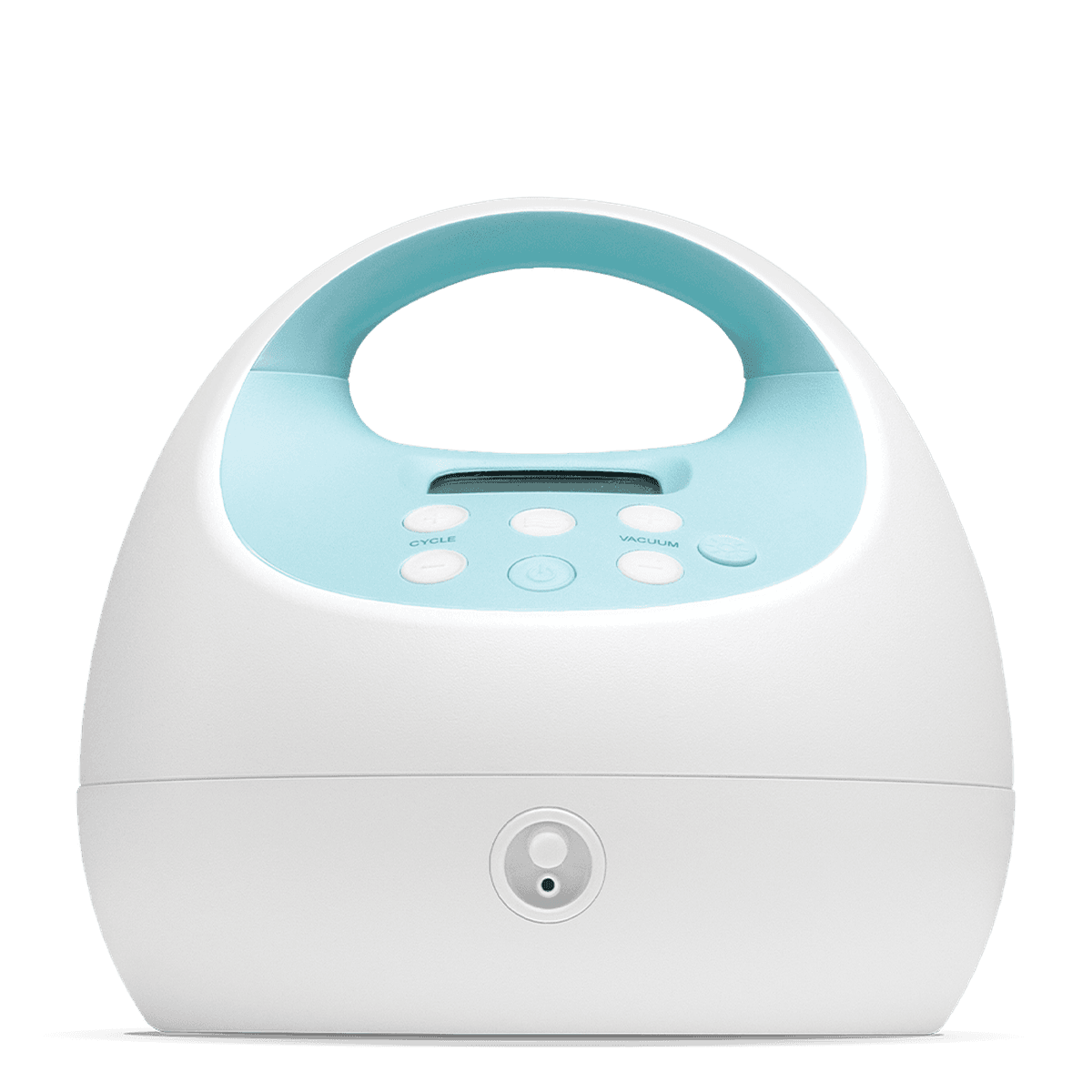
It's 2 AM. You're scrolling Amazon with one hand, flanges in the other, trying to figure out whether the blue Spectra or the pink one is worth your money. Every comparison article you find buries the answer under twelve paragraphs of filler. So here it is, up front.
The Spectra S1 vs S2 decision comes down to one thing: a rechargeable battery. Same motor, same suction, same controls. The S1 costs about $97 more for that battery. That's the whole comparison.
The Short Answer
Get the Spectra S2 through insurance for $0. Need portability? Buy a $20–$30 portable battery pack. You save $97+ and get a battery you can actually replace when it wears out — unlike the S1's built-in one, which degrades and can't be swapped.
The S1 earns its price in one scenario: you pump untethered for multiple sessions daily and don't want to fuss with an external pack. Real use case, narrower than most comparison articles suggest.
What Spectra S1 and S2 Actually Share
Short section. The overlap is almost total.
Uzinmedicare Co., Ltd — the Korean manufacturer behind the Spectra line — puts the same motor in both pumps. Identical max suction at 270 mmHg (independently verified by BabyGearLab), identical 12 intensity levels, identical adjustable cycle speed of 38–54 CPM. That cycle speed dial matters — Medela doesn't offer it. You can fine-tune the rhythm between letdown and expression phases, which helps with stubborn letdowns.
FDA Class II medical devices, both of them. Closed systems with a backflow protector. LCD display with session timer. Night light for 3 AM pumps. Same backlit controls.
Same flanges (24mm and 28mm), same tubing, same valves. Compatible with the same aftermarket parts — Maymom, Legendairy Baby, BeauGen inserts. Two-year warranty on both. Pumped blindfolded, you couldn't tell which one you were using.
Key Specs Side by Side
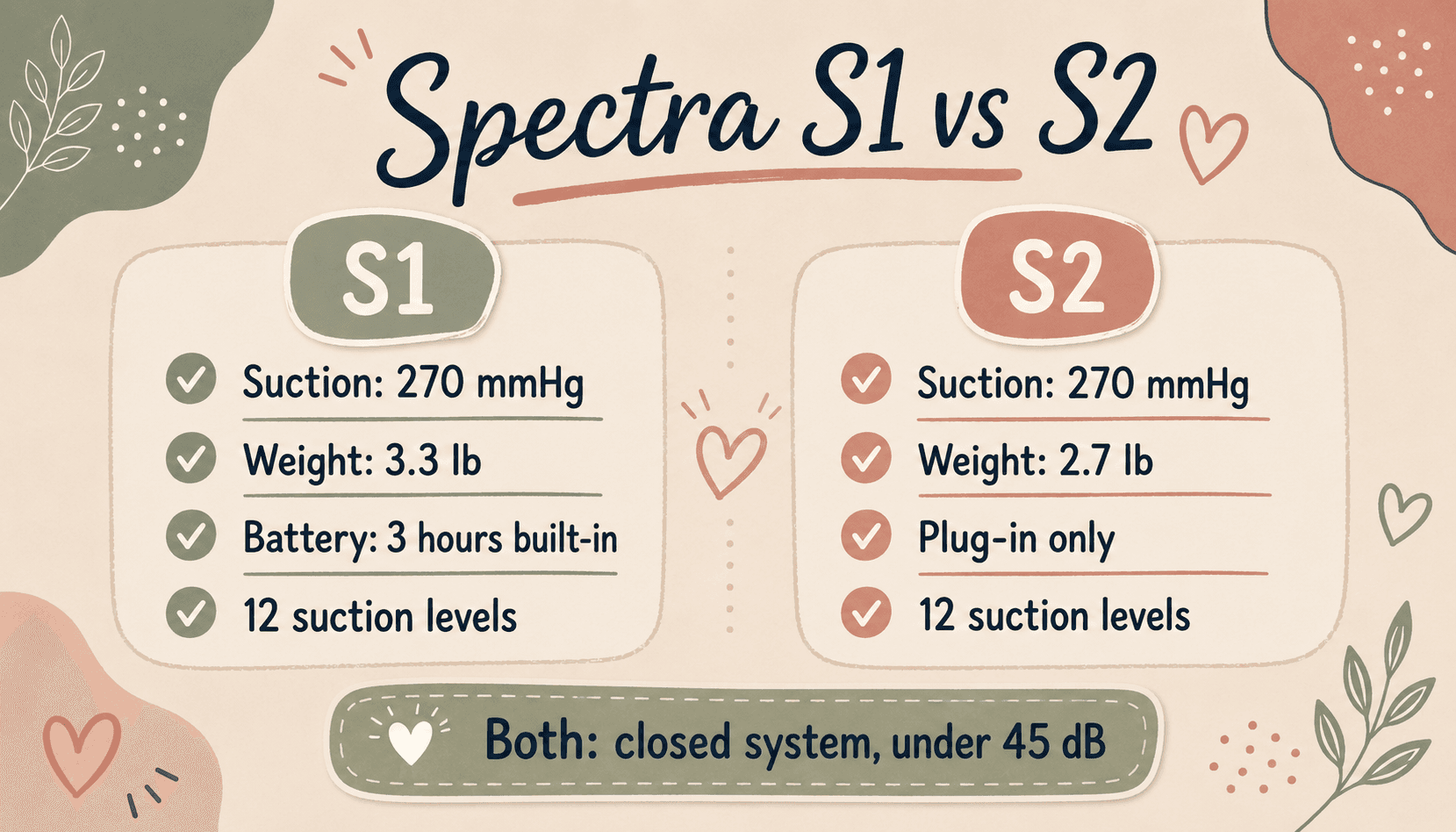
The last four rows are where the Spectra S1 vs S2 actually differ. Everything above them? Identical.
| Motor | Identical in both models |
|---|---|
| Max Suction | 270 mmHg (both) |
| Suction Levels | 12 (both) |
| Cycle Speed | Adjustable, 38–54 CPM (both) |
| Display | LCD with timer and night light (both) |
| System Type | Closed system with backflow protector (both) |
| Flanges Included | 24mm and 28mm (both) |
| Noise | <45 dB (both) |
| Warranty | 2 years (both) |
| FDA Status | Class II medical device (both) |
| Battery | S1: Rechargeable Li-ion (~3 hrs) | S2: AC power only |
| Weight | S1: ~3.3 lbs | S2: ~2.7 lbs |
| Retail Price | S1: $160–$225 | S2: $60–$100 |
| Insurance Cost | S1: $30–$80 upgrade fee | S2: Usually $0 |
Where the S1 Pulls Ahead
One advantage — the battery — but a real one in the right circumstances.
Middle-of-the-night pumps.Unplugging, carrying the S1 to the couch, and pumping without hunting for an outlet at 4 AM is genuinely nice. Small luxury, big quality of life when you're doing it nightly for months.
Room-to-room freedom.Kitchen while supervising a toddler's breakfast. Living room during a show. The S1 follows you without a cord trailing behind. For moms on a full exclusive pumping schedule, that flexibility across seven or eight daily sessions adds up.
Travel.One fewer thing to pack. Road trips, visiting family, pumping in the car at the pediatrician's parking lot — simpler with self-contained power. Three hours of battery covers roughly six sessions before you need to recharge.
Where the S2 Makes More Sense
For most pumping mothers, the S2 is the better buy.
Price — especially through insurance.Retail runs $60–$100, but under the ACA, most plans cover the Spectra S2 at $0 out of pocket. The S1 almost always carries an upgrade fee of $30–$80 — money better spent on correctly sized flanges or a portable battery pack.
No battery degradation.The S1's lithium-ion battery degrades with repeated charge cycles — same physics that makes your phone worse every year. EP moms charging daily report noticeable capacity loss after six to twelve months, and you can't replace the battery yourself. One mom on Reddit summed it up: “My S1 went from three hours to barely one hour after eight months of EP. It's basically an S2 now, except I paid double.”
Lighter and simpler.2.7 lbs vs 3.3 lbs won't change your life, but fewer components means fewer failure points. No battery means nothing to degrade independently of the motor. (Neither is truly portable the way a BabyBuddha or Elvie Strideis — both Spectras live on a table.)

Real-World Pumping Performance
Same motor means everything here applies to both the S1 and S2.
At 270 mmHg, both Spectras rank among the strongest tabletop pumps you can buy. The Medela Pump In Style MaxFlow tops out around 160–230 mmHg; most wearables cap at 200–250. You'll rarely crank the Spectra to max — levels 5 through 9 is where most moms land — but the headroom matters during power pumping sessions when you need aggressive emptying.
The adjustable cycle speed gets overlooked. At 54 CPM, you mimic the fast, fluttery suck that triggers letdown. Drop to 38 CPM and you're matching the slower, deeper rhythm of active feeding. Shifting between these with a dial — no mode switching — gives you more control than any competitor in this price range. Research on vacuum patterns and milk flow backs up the idea that matching cycle to your body's response improves output.
Sessions run 15–25 minutes per side. A combined breastfeeding and pumping schedule works well with either Spectra breast pump since both drain effectively in a predictable window.
Comfort-wise, the suction ramp is gentle. Unlike pumps that hit hard from level 1 (looking at you, BabyBuddha), the Spectra builds gradually. Early postpartum moms consistently rate it among the most comfortable in its class — and that's not a small thing. Pain during pumping inhibits the oxytocin reflex and directly reduces milk output.
The $20 Battery Pack Hack
This community tip makes most Spectra S1 vs S2 articles irrelevant.
Your S2 runs on a standard 12V DC adapter. A portable 12V battery pack — the kind sold for camping or CPAP machines — powers it wirelessly for $20–$30. Maymom and other aftermarket brands sell Spectra-specific batteries in the same range.
The math: S2 through insurance ($0) + battery pack ($25) = $25 total. S1 through insurance = $30–$80. S1 retail = $160–$225. Not a close race.
Better yet, the battery pack is replaceable. When it loses capacity after a year, you grab another $25 pack. The S1's sealed battery? You live with it. As one EP mom in r/ExclusivelyPumping put it: “I wish someone had told me about the battery pack before I spent $180 on the S1. My S2 with the pack outlasted my friend's S1 by six months.”
Fair trade-off: an external battery is one more thing to carry. Not as elegant. If seamlessness matters more than cost, the S1 is cleaner. For everyone else on a budget, the S2-plus-battery combo wins.
Spectra vs Medela Pump In Style
If you're comparing Spectras, Medela is probably the other pump on your list.
| Feature | Spectra S1 PlusBest for: cord-free home use | Spectra S2 PlusBest for: value ($0 insurance) | Medela Pump In Style MaxFlowBest for: flange selection |
|---|---|---|---|
| Price | $160–$225 | $60–$100 | $118–$180 |
| Weight | 3.3 lbs | 2.7 lbs | ~3.5 lbs |
| Max Suction | 270 mmHg | 270 mmHg | 160–230 mmHg |
| Noise | <45 dB | <45 dB | 58–59 dB |
| Battery | ~3 hours rechargeable | None (AC only) | Optional battery pack |
| Flange Range | 24–28mm (aftermarket down to 13mm) | 24–28mm (aftermarket down to 13mm) | 21–30mm (PersonalFit Flex) |
| System Type | Closed | Closed | Closed |
| Best For | Untethered home + travel pumping | Best value tabletop pump | Brand familiarity + hospital network |
Spectra wins on suction power, noise, warranty length, adjustable cycle speed, and price. Performance per dollar, the Spectra S2 is hard to beat.
Medela wins on brand familiarity and hospital partnerships. Many hospitals send moms home with Medela samples, and the PersonalFit Flex flanges have an angled design some women prefer. If your LC is Medela-trained, her troubleshooting advice will be more pump-specific.
Noise gap is real: under 45 dB (Spectra) vs 58–59 dB (Medela). That's a quiet library vs a normal conversation. For pumping at work in a shared space, the Spectra is noticeably more discreet.
And Medela still doesn't offer cycle speed adjustment. Once you've used the Spectra's 38–54 CPM dial, fixed-speed pumps feel like driving without a gear shift.
Getting Either Spectra Through Insurance
The ACA requires most health plans to cover a breast pump at no cost. Both Spectra models are available through DME suppliers like Aeroflow, Edgepark, 1 Natural Way, and Byram Healthcare.
The S2 is one of the most universally covered pumps in the country — expect $0 out of pocket. The S1 is classified as an upgrade, meaning a copay of $30–$80.
Timing tip:Order during your third trimester. Some insurers need a prescription; others don't. DME suppliers handle the paperwork — they verify coverage, submit the claim, and ship to you. Both models are HSA/FSA eligible, which brings any out-of-pocket cost down 20–30% depending on your bracket.
Common Problems and Fixes
These apply to both S1 and S2 since — you guessed it — same pump.
Flanges are too big out of the box. The included 24mm and 28mm flanges are too large for most women. Research shows breast shield fit significantly affects milk output. Measure your nipple diameter and order the right size from Maymom or Legendairy Baby before your pump arrives. Your areola shouldn't be pulled into the tunnel.
Suction feels weak after a few weeks.Swap your duckbill valves. They wear out every four to six weeks with daily use and account for the vast majority of “my pump stopped working” posts. Spectra-compatible duckbills cost under $10 for a multi-pack. Keep spares in your pump bag. (Your future 2 AM self will thank you.)
S1 battery draining fast.Under a year old with rapid capacity loss? Could be defective — file a warranty claim. Over six months of heavy daily use? That's normal lithium-ion behavior. The fundamental trade-off of a sealed battery.
Backflow protector gets wet inside.Disassemble and dry completely after every session. Check the white silicone diaphragm for tears or incorrect seating — moisture means the membrane seal is compromised, and a compromised protector introduces mold risk.
Night light drama.Not adjustable. Some moms tape over it. Others call it Spectra's best feature. No middle ground. (Much like pineapple on pizza, you pick a side and defend it fiercely.)
Which Spectra Should You Buy?
Spectra S1 — 8.5/10
Read our full Spectra S1 review for settings, parts guide, and six-month battery data.
Overall score
out of 10
What we like
- Built-in rechargeable battery — true cord-free pumping
- ~3 hours battery life covers a full day of sessions
- Same 270 mmHg suction as the S2
- Adjustable cycle speed (38–54 CPM) — rare at any price
- Gentle suction ramp ideal for early postpartum
- 2-year warranty, closed system, FDA Class II
What could be better
- Costs $97+ more than S2 for only a battery difference
- Battery degrades after 6–12 months of heavy EP use
- Non-replaceable internal battery
- Insurance usually requires $30–$80 upgrade fee
- Ships with oversized flanges (24mm/28mm) — most moms need smaller
- 3.3 lbs is not truly portable — still a tabletop pump
Read our full Spectra S2 review for the $0 insurance play, the battery pack hack, and why this free pump embarrasses $200 competitors.
Spectra S2 — 9/10
Overall score
out of 10
What we like
- Usually $0 through insurance — best value pump available
- Same motor, same 270 mmHg suction as the S1
- No battery to degrade over time
- Lighter at 2.7 lbs
- Same adjustable cycle speed, LCD timer, night light
- Portable with a $20–$30 aftermarket battery pack
What could be better
- Must be plugged in — zero portability without aftermarket battery
- Cord limits your range during sessions
- Ships with same oversized flanges (24mm/28mm)
- External battery pack is less elegant than built-in
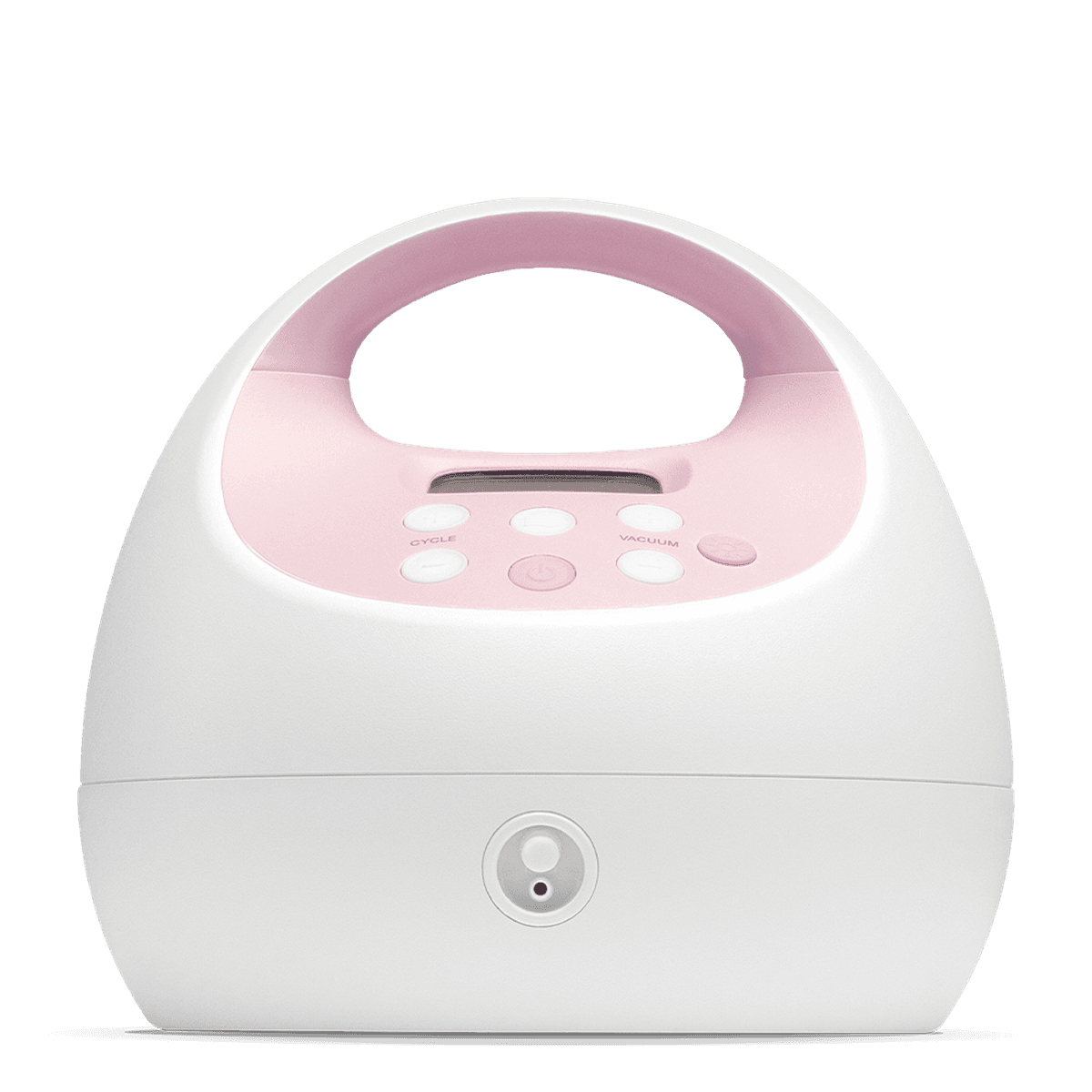
- Pink color only (aesthetic, not functional — but moms have opinions)
Related Reading
- Spectra S1 Plus Review — Real Suction, Battery & Parts Data
- Spectra S2 Plus Review — The Best $0 Insurance Pump, Tested
- Exclusive Pumping Schedule — Complete Guide by Baby's Age
- Pumping at Work — Your Rights and Setup Guide
- Pumping Schedule by Age — Month-by-Month Breakdown
- Power Pumping Schedule — How to Boost Your Supply
- Best Hospital Grade Breast Pumps (2026) — Spectra vs Medela
- Best Breast Pumps (2026) — 6 Pumps Ranked