You're in your company's “wellness room” — which is really a repurposed supply closet with a folding chair and a lock that sticks. You have 22 minutes before your next call. The Medela you borrowed from your sister sounds like a small farm animal, and last week your coworker asked if something was broken in the back hallway. So you started researching wearable pumps. And now you're staring at the Elvie Stride, wondering if the marketing copy is real or aspirational.
This Elvie Stride review is the one we wish we'd had during that search. Real suction measurements (the gap between claimed and actual is... notable), honest battery and comfort data, a full insurance walkthrough, and a clear breakdown of who this pump genuinely works for. If you're building your pumping schedule, your pump choice shapes session length and daily frequency — so getting this right matters.
What Is the Elvie Stride?
Elvie launched the original Elvie Pump in 2018 and basically invented the “discreet wearable breast pump” category. The Elvie Stride is their insurance-friendly follow-up — built to land at the price point DME suppliers will actually cover under the ACA.
It's FDA Class II, cleared under 510(k) number K210936. Same regulatory pathway as hospital-grade pumps like the Medela Symphony. “Cleared,” though, is not the same as “equivalent suction” — a distinction Elvie's marketing department would prefer you not think too hard about.
Four models exist now. Here's the quick map:
- Elvie Pump— fully wireless, pricier, rarely insurance-covered
- Elvie Stride— tubed, insurance-eligible, the one reviewed here
- Elvie Stride Plus— better motor, slightly higher price
- Elvie Stride 2— newest generation, redesigned cups, strongest suction in the lineup
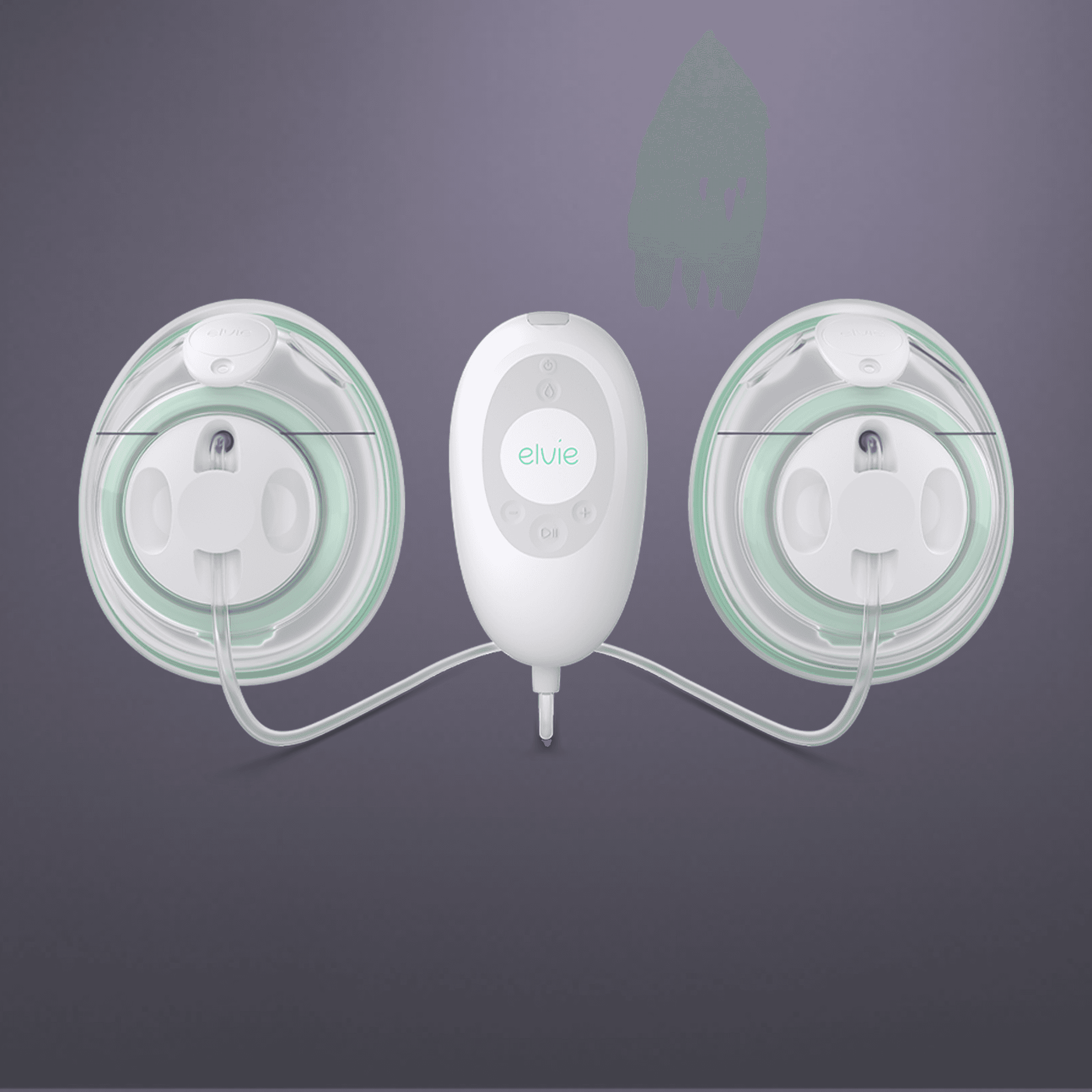
The Stride's design: a small hub clips to your waistband, thin tubes run to collection cups inside your bra. Closed system — milk never touches tubing or motor. Only the cup parts need washing.
Key Specs and What You Get in the Box
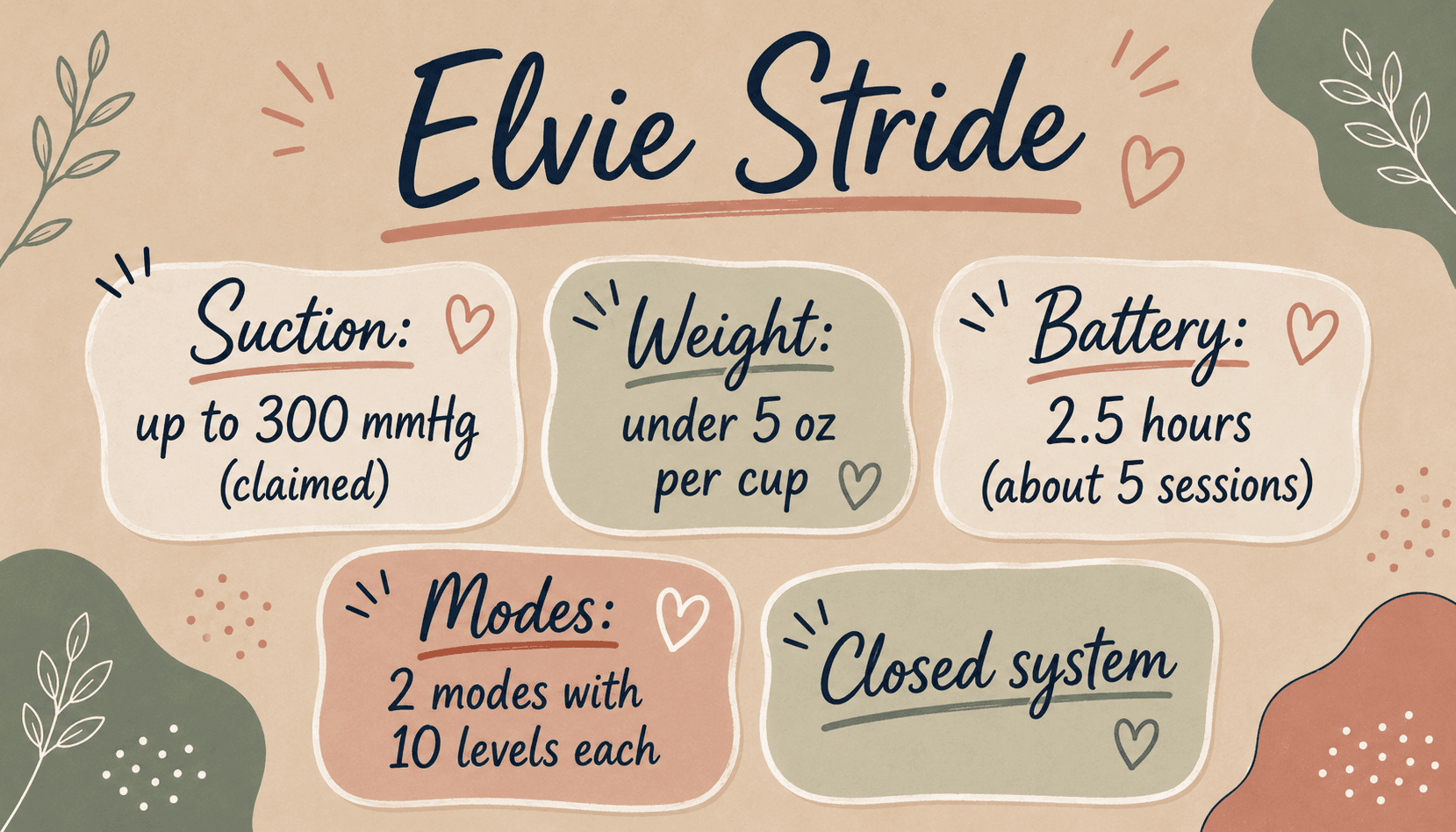
| FDA Status | Class II, 510(k) cleared (K210936) |
|---|---|
| Price | $199.99 retail (often ~$139.99 on sale; frequently free through insurance) |
| Weight | <5 oz per cup |
| Bottle Capacity | 5 oz per cup |
| Max Suction (claimed) | -300 mmHg |
| Max Suction (independently tested) | ~170 mmHg |
| Modes | 2 (Stimulation + Expression) |
| Intensity Levels | 10 per mode (20 total settings) |
| Battery Life | ~2–2.5 hours (~5 sessions per charge) |
| Noise | Ultra-quiet |
| Flange Sizes | 21mm, 24mm, 28mm shields + 15mm, 17mm, 19mm cushion inserts (24mm included) |
| System Type | Closed system, BPA-free |
| App | Pump with Elvie (iOS / Android) |
| Warranty | 2 years |
| Parts to Clean | 4 per side |
The box includes the motor hub, two cups with 24mm shields, tubing, two 5 oz bottles, extra valves, USB-C cable, and a carrying pouch. You do not get the 21mm or 28mm shields, or the smaller cushion inserts (15mm, 17mm, 19mm) — those are sold separately.
That matters more than you'd think. Roughly half of women need a size other than the included 24mm. Wrong flange size is the top reason for low output and nipple pain — ahead of suction strength, session length, or anything else. Before you decide the Elvie Stride's suction is weak, check flange fit first. Our flange size guide helps you measure, and our how long to pump guide covers how sizing affects session efficiency.
Setting Up and Using the Elvie Stride
Unbox to first letdown: about 15 minutes if you charge the hub first.
Assembly:four parts per side — shield, valve, diaphragm, bottle. They snap together without tools. If you've dealt with a Spectra S1 or Medela Pump In Style, this feels simpler. New to pumps entirely? The app has short assembly videos.
App pairing(Bluetooth): download “Pump with Elvie,” create an account, hold the hub near your phone. Pairs on the first try in most cases. From the app you can start/stop, adjust suction, switch modes, and track output over time.
Session steps:
- Charge the hub (first charge: ~2 hours).
- Assemble cups — shield, valve, diaphragm, bottle.
- Place cups in your nursing bra, shields centered on your nipple.
- Clip hub to your waistband, connect tubing to both cups.
- Press the hub button or tap “Start” in the app.
- Stimulation mode kicks in — fast, light cycles to trigger letdown.
- Switch to expression mode once milk flows. (Auto-detect exists but is hit-or-miss.)
- Ramp intensity through 10 levels to your comfortable max.
- Pump 15–25 minutes, or until flow stops plus two more minutes.
One detail the manual buries: suction and cycle speed are inversely linked. Higher suction = slower cycles. Lower suction = faster pulses. That's by design — mimicking how a baby nurses. Cranking suction to 10 and expecting more milk is the Elvie Stride equivalent of flooring the gas in first gear. Find your “firm but not painful” setting and let the rhythm do its job.

Real-World Pumping Performance
Elvie claims the Stride pulls up to -300 mmHg of suction. Independent testing consistently lands around 170 mmHg at max settings. That's 43% less than advertised. Not a typo.
For context: the Medela Symphony (actual hospital-grade) hits 250–270 mmHg. The Spectra S1 reaches 220–250 mmHg. The BabyBuddha, another wearable, tests around 220 mmHg. The Elvie Stride sits below all of them. One mom on r/ExclusivelyPumping put it bluntly: “The Stride is my going-out pump. My Spectra is my getting-things-done pump.”
That 170 mmHg is perfectly adequate if your baby nurses at the breast and you're pumping to stash or cover daycare bottles. You're supplementing a baby's suction, not replacing it.
For exclusive pumpers: different story. The CDC notes that pumping should mimic your baby's feeding frequency to maintain supply. On an exclusive pumping schedule with 7–8 daily sessions, the Stride may leave milk behind — especially in the first 12 weeks while your body is still calibrating. Expect 25–30 minute sessions versus 15–20 on a Spectra S1 or BabyBuddha. Many EP moms use the Stride for work or travel and a stronger pump at home.
Overall, plan 20–25 minutes per session. That's 5–10 minutes longer than a traditional pump for similar output — the trade-off for pumping hands-free while you answer emails or fold laundry. Factor that into your daily pumping routine.
Comfort, Noise, and Wearability
This is where the Elvie Stride earns its price tag.
Under 5 ounces per cup. Lighter than a full coffee mug. After your first session, you genuinely forget the cups are there. The hub clips to your waistband and weighs about as much as a car key fob.
Noiseis the Stride's superpower. With any ambient sound — office HVAC, a white noise machine, the TV — it's inaudible past a few feet. One mom on r/ExclusivelyPumping described pumping during a video call with her camera on and nobody catching on. Your results depend on bra fit and tubing placement, but the motor itself is remarkably quiet.
That matters for pumping at work. The PUMP Act guarantees you a private space. “Private,” in practice, often means a converted conference room where people can hear you sneeze. A quiet pump removes an entire layer of workplace stress.
Bra fit caveat:the cups need a structured, snug nursing bra. Loose bralettes let the cups shift, the seal breaks, suction dies. If you're between sizes, size down. Many moms grab a $12 pumping bra one size smaller specifically for the Stride. (Your regular nursing bra has been through enough.)
Battery:2–2.5 hours active pumping, roughly 5 sessions of 25 minutes. USB-C charging, about 2 hours to full. Realistically, once-a-day charging. The app's battery indicator is trustworthy — 20% means one more session.
Elvie Stride vs Elvie Pump vs Stride 2
Elvie's naming convention is... not their strongest product decision. Here's what actually differs.
| Feature | Elvie StrideBest for: budget wearable | Elvie PumpBest for: tubeless freedom | Elvie Stride 2Best for: upgraded suction |
|---|---|---|---|
| Suction | ~170 mmHg (tested) | ~160 mmHg (tested) | ~200 mmHg (estimated) |
| Design | Tubed (hub + cups) | Fully wireless (no tubes) | Tubed (redesigned cups) |
| Motor | Single hub, tube splitter | In-cup motor (each side) | Improved single hub |
| Battery Life | ~2.5 hours | ~2.5 hours | ~3 hours |
| Price | $199.99 | $279.99 | $229.99 |
| Insurance | Widely covered | Rarely covered | Growing coverage |
| Noise | Ultra-quiet | Very quiet | Quieter than Stride |
| Flange Options | 6 sizes (shields + cushions) | 4 sizes | 6 sizes (shields + cushions) |
If your insurance covers the Stride 2, get that. Stronger suction, redesigned cups, same insurance eligibility. If your plan only covers the original Stride (still common with many DME providers as of mid-2026), you're not settling — you're getting the prior generation at zero cost.
Paying retail? The Elvie Pump's no-tube design is genuinely more convenient for portability. But $280+ versus the Stride's frequent $139.99 sale price is a steep premium for ditching two thin tubes.
Getting the Elvie Stride Through Insurance
The Stride is one of the most commonly covered wearable pumps under insurance — honestly the best single reason to pick it. The ACA requires most plans to cover breast pumps as preventive care at no out-of-pocket cost. At $199.99 retail, the Stride falls within most DME suppliers' coverage range. Many plans cover it fully. Some cover a base amount and charge the difference.
How to get yours:
- Check your plan's benefits portal for “breast pump coverage” or “DME benefits.”
- Ask: “Is the Elvie Stride covered? Which DME suppliers do you work with?”
- Visit your approved DME supplier (Aeroflow, Edgepark, Byram, or 1 Natural Way are the big four). Enter your insurance info.
- Supplier verifies coverage and shows your eligible pumps.
- Select the Elvie Stride. Fully covered = $0. Upgrade fee, if any, is shown before you confirm.
- Ships to your door in 1–2 weeks.
Start around week 30 of pregnancy. DME processing takes time, and ordering while sleep-deprived with a newborn is nobody's idea of fun.
If insurance doesn't fully cover it, the Stride qualifies for HSA and FSA — including replacement parts. See our pumping at work guide for more on workplace pumping rights and insurance navigation.
Common Elvie Stride Problems and How to Fix Them
Suction loss mid-session.The top complaint. Check the valve first — remove, rinse, dry fully, reseat. If it's wrinkled or warped, replace it (~$8). Next suspect: bra shifted and broke the seal. Third: diaphragm micro-tears after 2–3 months of daily use.
Bluetooth drops.Close the app, reopen. Still dropping? “Forget” the device in your phone's Bluetooth settings and re-pair. Keep the hub within 3 feet. Annoying, but not critical — the physical button on the hub controls everything the app does.
Battery draining fast.After 12–18 months of daily use, capacity drops naturally. Elvie's 2-year warranty covers defective batteries but not normal degradation. If your hub barely manages 3 sessions, it's warranty claim time.
Valve and diaphragm wear.Consumable parts. Budget $30–40 per replacement cycle: valves every 4–8 weeks, diaphragms every 2–3 months if pumping 5+ daily. Yellowing or warping = overdue.
Tubing condensation.Normal — temperature difference between your body and the room. Run the pump 30 seconds after removing cups to clear moisture. If actual milk enters the tubing, the diaphragm seal has failed. Replace immediately. (Closed system means closed. Milk in the tubes means it's not.)
Low output.Flange size first, pump settings second. A surprising number of moms plateau at level 5–6 when their comfortable max is actually 7–8. Too low = milk left behind. Too high = pain, tension, inhibited letdown. Still struggling? Our how to increase milk supply while pumping guide walks through the full troubleshooting path.
Who Should (and Shouldn't) Buy the Elvie Stride
Overall score
out of 10
No wearable breast pump works for everyone. Here's who the Elvie Stride actually fits — and who should keep shopping.
What we like
- Ultra-quiet — pump at your desk without anyone noticing
- Insurance-eligible through most plans (often free)
- Lightweight and truly wearable (<5 oz per cup)
- Simple 4-part design makes cleaning fast
- App tracks sessions and lets you adjust settings remotely
- Comfortable closed system with multiple flange sizes
What could be better
- Real suction weaker than claimed (~170 vs 300 mmHg)
- 5 oz capacity fills fast during longer sessions
- Single motor means both cups run at the same speed
- Tubing adds bulk compared to fully wireless options
- Parts need replacing every 6 months (~$30–40/cycle)
- Bluetooth connection drops occasionally
Best candidates:
- Working moms pumping at the office. The noise level alone justifies it. Pump during a meeting (camera off, ideally) or at your desk without the rhythmic whoosh that traditional pumps broadcast. If your workplace pumping setup has thin walls, the Stride compensates.
- Combo feeders building a stash.Baby handles most feeds, you pump 2–4 times daily to stockpile. 170 mmHg is more than enough.
- Multitasking moms.Chasing a toddler, cooking dinner, handling school drop-off — the wearable design pays for itself when sitting still for 20 minutes is a fantasy.
- Insurance shoppers. Free through your plan? Easy yes, even as a secondary pump.
Not ideal for:
- Exclusive pumpers as a sole pump.When the pump is your baby's only food source, the suction gap matters. Pair it with a Spectra S1 or BabyBuddha at home. Our exclusive pumping schedule has EP-specific pump recommendations.
- Low or struggling supply.When every ounce matters and you're already running power pumping sessions, you need every mmHg you can get.
- The first 2–4 weeks postpartum. Early supply depends on thorough emptying. A newborn pumping schedule needs a pump that drains completely. Add the Stride to your rotation once supply is established — around week 6–8 for most moms.
Related Reading
- Exclusive Pumping Schedule — Complete Guide by Baby's Age
- How Long Should You Pump? Session Length Guide
- Pumping at Work — Your Rights and Setup Guide
- Breast Milk Storage Guidelines
- Best Wearable Breast Pumps (2026) — Top 4 Compared
- Best Hands-Free Breast Pumps (2026) — 4 Pumps Tested
- Eufy S1 Pro Review — Heated Wearable With ~260 mmHg Suction