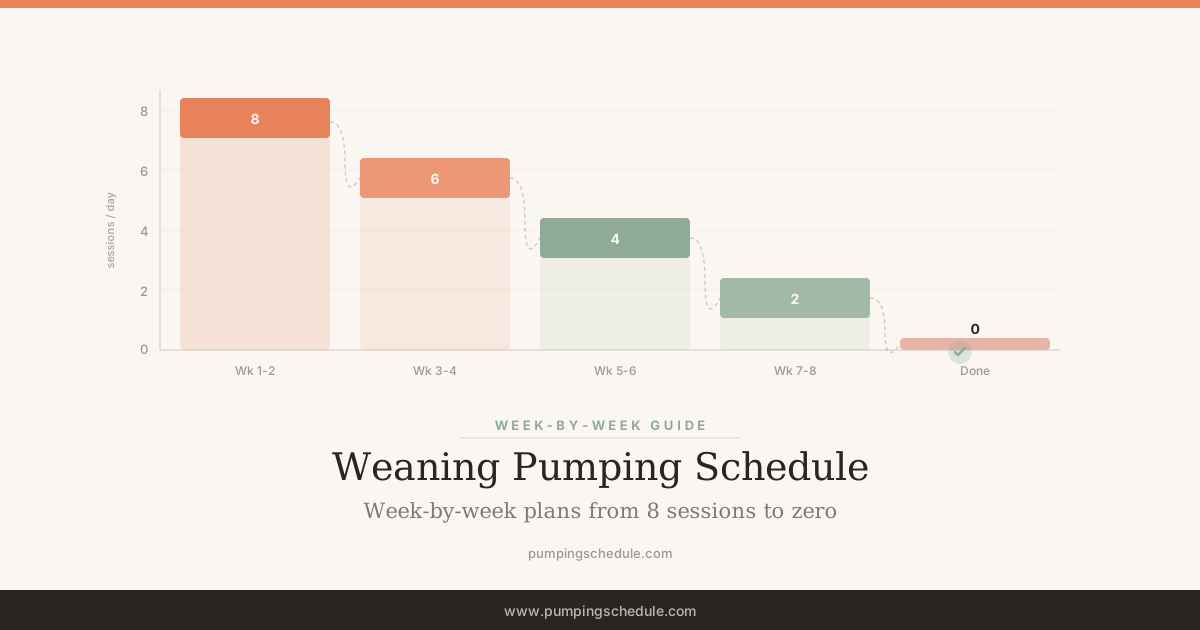
Sarah had 847 ounces frozen, a baby who had just discovered mashed avocado, and a Medela Pump In Style she was genuinely sick of looking at. She texted her partner at 2 AM: “I think I'm done.” Then she Googled “weaning pumping schedule” and panicked, because every result said something different about how fast you could actually stop.
This is the full weaning from pump schedule — your route from wherever you are now to done, week by week. Not the same as dropping a pumping session to maintain supply. This is the whole exit: zero sessions, no mastitis, no accidental supply crash.
When Is the Right Time to Stop Pumping?
There is no universal right time. The AAP recommends breastfeeding for at least two years but acknowledges that your circumstances determine the right timeline.
Physical signs you may be ready: Stable output for two-plus weeks. Baby eating solids and no longer entirely dependent on breast milk for calories. Freezer stash covering several weeks of intake.
Practical signs:You are returning to work without room for pump breaks. Your baby is thriving on formula or cow's milk. You are past 12 months, where continued breastfeeding is encouraged but no longer nutritionally essential per WHO breastfeeding guidelines. Or you are just done — and that is a valid reason by itself.
When NOT to wean yet: Baby under 6 months with no formula access. Unresolved mastitis or plugged duct — wean after the acute issue clears, not during. ACOG emphasizes resolving breast infections before any supply changes.
How Long Does It Take to Wean Off Pumping?
Most moms finish their weaning off pumping schedule in 2-6 weeks. Two variables control the timeline: how many sessions you start from, and how quickly your body adjusts. Some moms feel fine 48 hours after dropping a session. Others need the full 7 days.
- 8 sessions/day: 5-6 weeks.
- 6 sessions/day: 4-5 weeks.
- 4-5 sessions/day: 2-3 weeks.
- 2-3 sessions/day: 1-2 weeks.
Going faster raises your risk of engorgement and mastitis. Going slower is always safe. If you have 6 weeks, use them.
Three Methods to Wean Off Pumping
How do you wean off pumping without landing in urgent care? Three strategies, typically combined in stages, per La Leche League.
- Drop sessions. Cut one full session every 5-7 days. Start with your lowest-yield pump — usually late evening. Your morning session (typically the biggest producer) goes last. This is the backbone of the wean.
- Shorten duration. Reduce a session by 3-5 minutes every 2 days until you are under 5 minutes. Once output drops below half an ounce, stop that session entirely. Gentler on your body, and especially useful for your last 1-2 sessions. (Our how often to pump guide has more on length vs. frequency trade-offs.)
- Extend intervals. Push each session 30-60 minutes later every 2-3 days. Neighboring sessions absorb the extra milk. Works best early, when you have 5+ sessions and want to redistribute before cutting.
Most comfortable combo: extend intervals to get from 8 down to 4 sessions, then shorten duration for the final stretch. One dropped session per week, max. Your body is not on a deadline — even if your patience is.
Week-by-Week Weaning Schedules
Three weaning off pumping schedules, by starting session count. These are frameworks — adjust based on how your body responds.
Plan A: From 8 Sessions/Day (6-Week Wean)
For exclusive pumping moms starting from a full newborn-phase load. High volume means a slower pace protects you from engorgement.
| Week | Sessions/Day | Duration (min) | Approx. Spacing | Notes |
|---|---|---|---|---|
| Week 1 | 7 | 20 | Every 3-3.5 hrs | Drop lowest-yield evening session first |
| Week 2 | 6 | 18 | Every 3.5-4 hrs | Drop one daytime session; keep morning + MOTN |
| Week 3 | 5 | 15 | Every 4-4.5 hrs | Begin dropping middle-of-night pump |
| Week 4 | 4 | 12 | Every 5-6 hrs | Drop MOTN; shift to morning, midday, afternoon, evening |
| Week 5 | 2 | 10 | Morning + evening | Drop 2 sessions this week if body tolerates; shorten durations |
| Week 6 | 0 | 5 (comfort only) | As needed | Hand express to comfort, not to empty; stop when fullness resolves |
Plan B: From 6 Sessions/Day (4-Week Wean)
Already dropped from 8 to 6? This weaning pumping schedule picks up where you left off. Supply is regulated and your body adapts faster at this stage.
| Week | Sessions/Day | Duration (min) | Approx. Spacing | Notes |
|---|---|---|---|---|
| Week 1 | 5 | 18 | Every 4 hrs | Drop evening session; extend morning pump to capture overnight output |
| Week 2 | 4 | 15 | Every 5 hrs | Drop one midday session; move remaining sessions to natural feed windows |
| Week 3 | 2 | 10 | Morning + evening | Shorten both sessions; skip if only slight fullness present |
| Week 4 | 0 | 5 (comfort only) | As needed | Hand express only; cold compresses as needed for fullness |
Plan C: From 4 Sessions/Day (2-3 Week Wean)
Already at 4? You can move faster. A lot of working moms land here when their baby starts cow's milk or formula and the office Spectra sessions feel like diminishing returns.
| Week | Sessions/Day | Duration (min) | Approx. Spacing | Notes |
|---|---|---|---|---|
| Week 1 | 3 | 12 | Every 6 hrs | Drop lowest-yield session; shorten remaining sessions by 5 min each |
| Week 2 | 1-2 | 8 | Morning only (or morning + evening) | Drop to 1 session if fullness allows; otherwise keep 2 short sessions |
| Week 3 | 0 | 5 (comfort only) | As needed | Hand express sparingly; discontinue when breast stays comfortable |
For any plan: slow down if you feel significant discomfort. There is no trophy for finishing early. Your pumping schedule hubhas session-count references by age if you need to cross-check your baby's intake needs.
How to Handle Engorgement and Prevent Mastitis
Some fullness during weaning is unavoidable. Engorgement that does not resolve, or that turns red and hot, is a warning sign per ACOG.
Hand express for comfort, not to empty. Fully draining tells your body to keep producing. Express just enough to take the edge off — a minute or two, a few drops — then stop.
Cold compresses. Frozen peas in a dish towel, 15-20 minutes on each side, several times a day. (Yes, you will sacrifice a bag of peas to the cause. Consider it the cheapest medical device you own.) Cold constricts blood vessels and reduces swelling without triggering letdown. The Office on Women's Health recommends cold packs for engorgement relief.
Cabbage leaves. Chilled, tucked inside your bra. The clinical evidence is modest, but decades of EP community experience say they work. Replace when wilted. Our cabbage leaves for engorgement guide has the full step-by-step method and research breakdown.
Sunflower lecithin. If you are clog-prone, 1,200 mg 3-4 times daily during weaning reduces milk viscosity. Check with your provider first. More on the supply-and-demand biology in our breast milk replenishment guide.
Call your doctor if: fever above 101 degrees F (38.3 degrees C), flu-like body aches, or a hard red area that will not resolve. That is mastitis, and it needs antibiotics — do not try to wait it out. ACOG advises prompt treatment to prevent abscess.
Weaning from the Pump at Work
Your work pumping schedule is tied to booked rooms, blocked meetings, and a body that has adapted to those exact time slots. Weaning adds logistics.
Drop home sessions first. Work sessions are your most constrained — a Haakaa in a bathroom stall is not the same as your setup at home. Cutting home sessions gives your body time to adjust before you change the work routine.
Give HR a heads-up. Not for permission — so the lactation room can be reassigned and you avoid awkward scheduling conflicts mid-wean. Your PUMP Act protections still apply until baby turns one, even while weaning. See our pumping at work guide for session strategies you can reverse-engineer for weaning.
Time your last work pump deliberately. Many moms drop remaining work sessions the same week they hit 1-2 total. Your final pump ends up at home — quieter, on your terms. Keep a manual pump in your bag during the transition for comfort expression if unexpected fullness hits mid-shift. Five minutes in the restroom handles it without stimulating new supply. The CDC's storage guidelines apply to any milk you express during the process.
The Emotional Side of Weaning
Nobody puts this in the pamphlet. The emotional experience of stopping pumping is real, varied, and sometimes intense. Relief and grief show up in the same hour.
The hormone shift is physical. Prolactin and oxytocin drop significantly when you stop pumping. Oxytocin is a bonding hormone. Prolactin has mood-regulating effects. Their decline is a biological event, not a psychological one — feeling sad, flat, or weepy in the weeks after your last session is common and does not mean you made the wrong call, per the AAP.
One mom on r/ExclusivelyPumping described it: “I was so ready to be done and then I cried for three days straight. I think I was grieving the version of me who had done this hard thing, not the pumping itself” (paraphrased).
You may feel guilty for stopping before your original goal, or guilty for feeling relieved about stopping. Guilt is not evidence that you did something wrong. The AAP emphasizes that breastfeeding decisions should support maternal wellbeing — a goal you met regardless of when you stop. AAP
La Leche League calls the end of a breastfeeding relationship — however it happens — a genuine transition that deserves acknowledgment. That applies to pumping too.
When sadness could be something more. If you have experienced Dysphoric Milk Ejection Reflex (D-MER), those symptoms often resolve after weaning. But if low mood, anxiety, or numbness persist beyond 2-3 weeks after your last pump, or feel severe, talk to your OB or midwife. Postpartum mood disorders can emerge or worsen during hormonal transitions — including weaning.
Another r/ExclusivelyPumping mom: “Weaning felt like closing a chapter I had rewritten a hundred times. Messy ending, but still my ending” (paraphrased).
What Happens to Your Body After You Stop Pumping
Your body does not get the memo immediately. Expect a few weeks of transition, not a clean off switch.
Residual milk hangs around. You may be able to hand express a few drops for weeks — even months — after your last session. Not a problem. Just residual milk in the ductal system, and it stops on its own. Do not pump to check — any stimulation signals your body to produce more.
Breast shape changes. Milk-producing tissue shrinks and remodels over 3-6 months. Some women end up smaller than pre-pregnancy; others return close to baseline. (Spectra and Elvie sell the pumps. They do not tell you about this part.)
Your period returns. Usually 4-8 weeks after your last session. Prolactin suppresses ovulation, so as levels fall, your cycle resumes. First cycles can be irregular, heavier, or crampier than normal — typically settling within 2-3 cycles, per ACOG.
Calorie math shifts. Lactation burns roughly 300-500 calories a day. After weaning, that expenditure disappears. Weight changes in the following weeks are normal metabolic adjustment.
Managing Your Milk Stash During Weaning
Your freezer stash is an asset. Use it strategically, following the CDC's breast milk storage guidelines.
Oldest bags first. Frozen milk lasts 6-12 months in a standard freezer, up to 12 months in a deep freezer. Label with pump date and rotate. Our breast milk storage guide covers spoilage signs and labeling in detail, and our thawing guide compares all three safe defrosting methods.
Mix with formula. Prepare formula per its own directions first, then add breast milk — this stretches the stash while maintaining nutrition. (Your baby will not care which ounces are which. Promise.)
Donate if you have excess. HMBANA member banks screen donor milk for NICU use with premature or medically fragile infants. Requires a health screening — contact a bank directly. Peer sharing through EP communities is also common, with different screening norms.
And if some bags expire before you use them? That milk still served its purpose. It kept you producing when you needed a buffer. An unused stash is insurance that was not needed — not a failure.
Last reviewed: June 2026 by the Pumping Schedule Editorial Team. Read our editorial standards.
Related Reading
- When to Drop a Pumping Session — dropping individual sessions while maintaining supply
- Exclusive Pumping Schedule — session-count and timing reference for EP moms
- How Often to Pump — frequency guidance for reverse-engineering your weaning pace
- Pumping at Work — session strategies and PUMP Act rights
- Breast Milk Storage Guide — shelf life, labeling, and thawing for your remaining stash
- Pumping at Night — the overnight session, usually last to drop before final weaning
- How Long Does Breast Milk Take to Replenish? — production biology during weaning
- Pumping Schedule Hub — age-by-age pumping schedule reference