What Is the BabyBuddha?
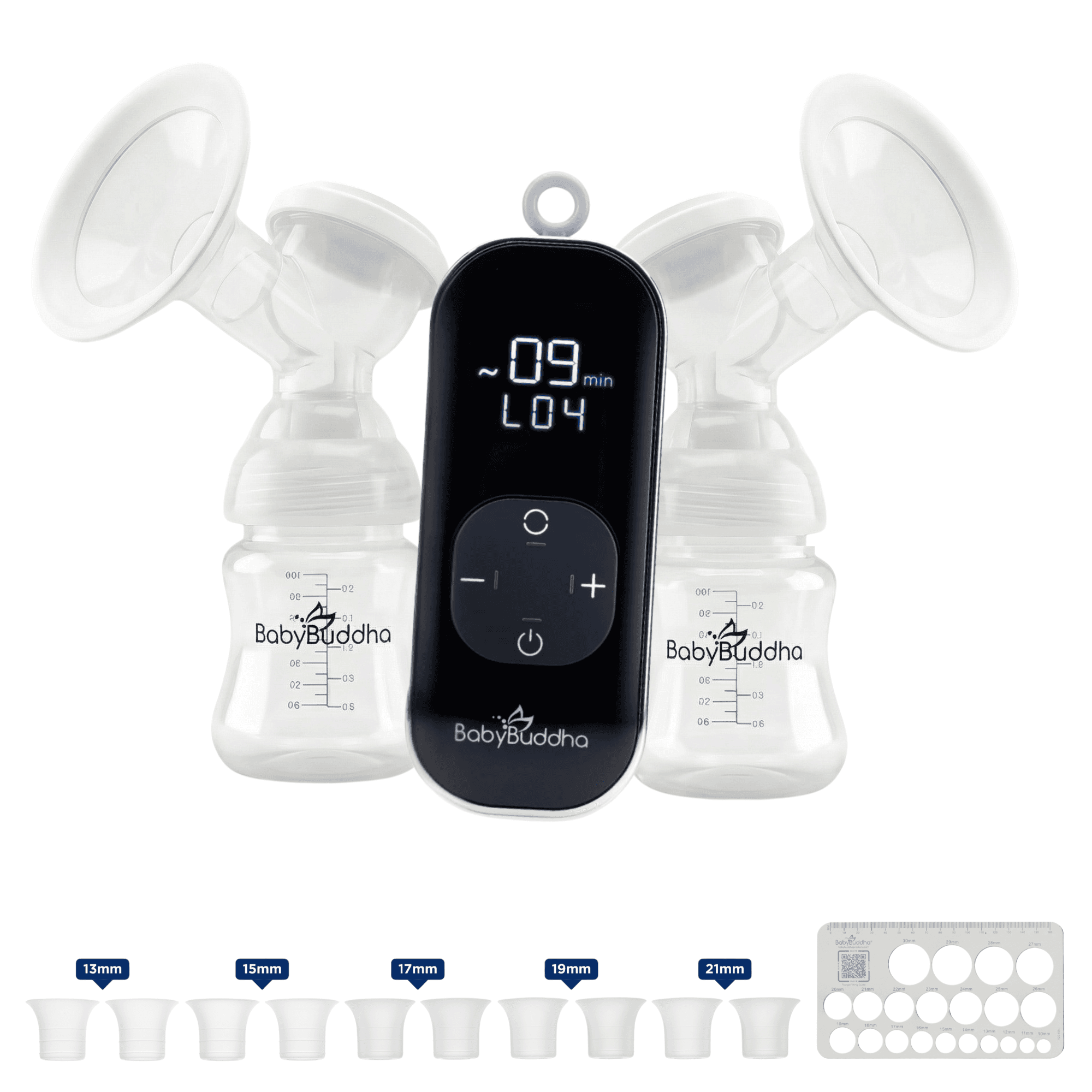
The BabyBuddha is a portable, closed-system breast pump that packs hospital-grade suction into 6.8 ounces. A small US-based company built it around one promise: real pumping power you can actually carry around.
The original BabyBuddha earned FDA Class II clearance (510(k) K151284) and quickly became the go-to recommendation in exclusive pumping communities. The updated BabyBuddha 2.0 kept the core motor but added a Soft Stimulation mode, USB-C charging, and refined controls — all responses to feedback from the EP community.
Where does it fit in the market? Think of it as the opposite of wearable pumps like the Elvie or Willow. Those prioritize discretion. The BabyBuddha prioritizes output. It's a traditional flanged pump shrunk down to pocket size, with suction that rivals tabletop models three times its weight.
If you've tried a wearable, gotten disappointing output, and resigned yourself to being tethered to a wall outlet again — the BabyBuddha is the middle path. Portable enough for your diaper bag. Powerful enough to be your only pump.
Key Specs and What You Get in the Box
Numbers first, then what they actually mean when you're half-asleep at 3 AM.
| FDA Status | Class II, 510(k) cleared (K151284) |
|---|---|
| Price | $204.99 sale / $229.99 retail (insurance coverage available; HSA/FSA eligible) |
| Weight | 6.8 oz (motor unit) |
| Bottle Capacity | Standard narrow-neck bottles included |
| Max Suction (claimed) | 315–320 mmHg |
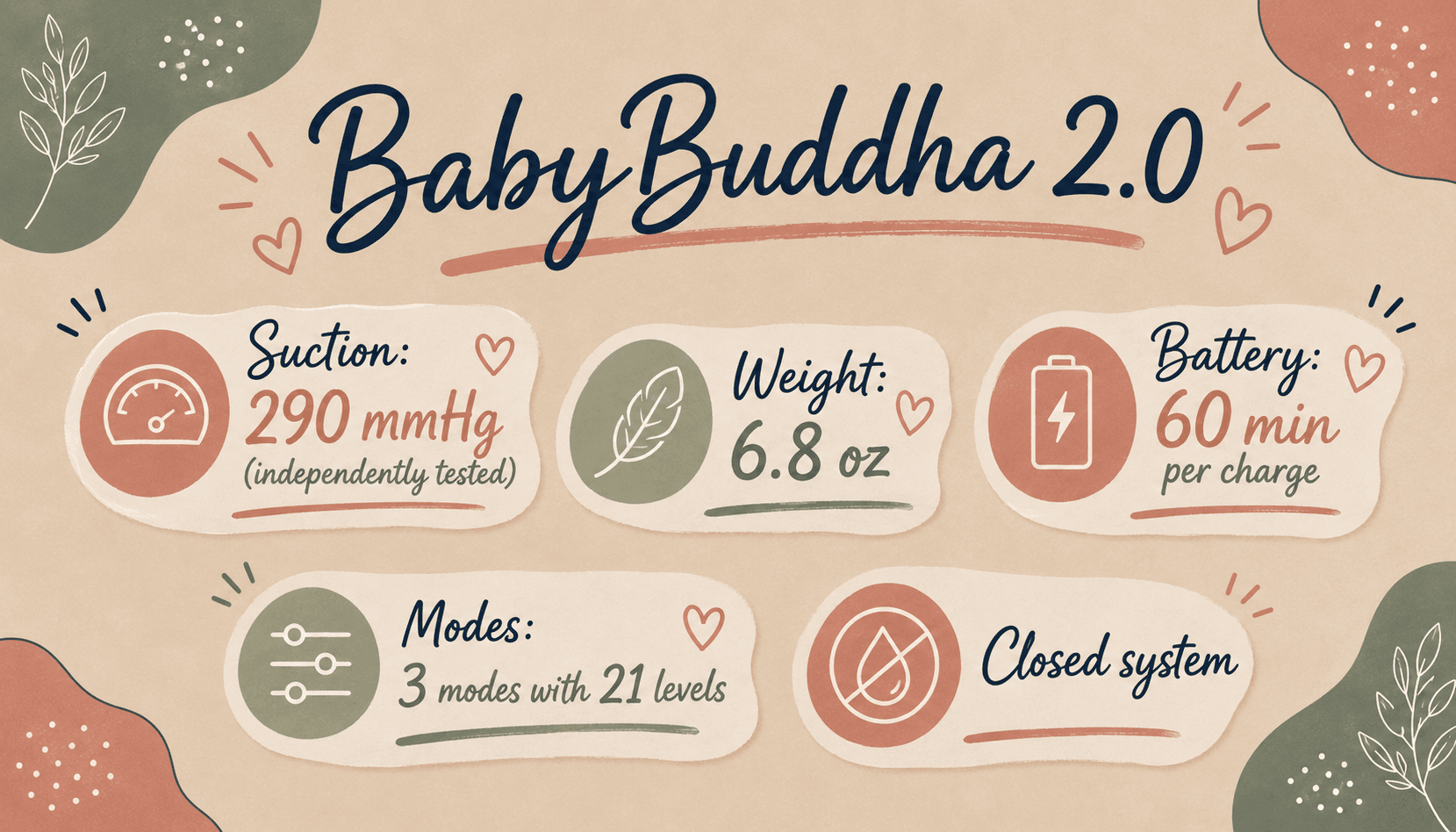
| Max Suction (independently tested) | ~290 mmHg (BabyGearLab) |
| Modes | 3 (Soft Stimulation + Classic Stimulation + Expression) |
| Intensity Levels | 21 total across all modes |
| Battery Life | ~60 minutes (~3–4 sessions per charge) |
| Charge Time | ~4 hours via USB-C |
| Noise | 42 dB claimed |
| Flange Sizes | 24mm flanges + EasyFit Kit (10 inserts: 13mm, 15mm, 17mm, 19mm, 21mm) |
| System Type | Closed system, BPA-free |
| Connectivity | None (no app or Bluetooth) |
| Warranty | 2 years / 600 pumping hours |
The box includes the motor unit, two sets of flanges with backflow protectors, duckbill valves, silicone diaphragms, tubing with a T-connector (for single or double pumping), two collection bottles, USB-C cable, a lanyard, and the EasyFit Kit. That kit deserves a callout — it includes 10 silicone sizing inserts across five sizes (13mm to 21mm), so you can dial in flange fit without ordering third-party inserts. Given that breast shield geometry significantly affects milk flow rate and volume expressed, this inclusion is genuinely useful. (Not sure where to start? Our flange size guide has a printable measurement method.)
No app. No Bluetooth. Just a pump. You either find that refreshingly simple or mildly annoying — there's no middle ground here.
Setting Up and Using the BabyBuddha
Assembly is intuitive once you've done it twice. The first time? You'll stare at the parts like a jigsaw puzzle missing its box lid. Here's the order:
- Attach the silicone diaphragmto the backflow protector cup. Make sure it sits flat with no wrinkles — a folded diaphragm kills suction.
- Press the duckbill valve into the bottom of the backflow protector. It should click into place firmly.
- Slide the flange (with your chosen EasyFit insert, if using one) onto the backflow protector cup.
- Connect tubing from the backflow protector to the motor unit. Use the T-connector if double pumping.
- Screw the collection bottle onto the bottom of the flange assembly.
- Power on by holding the button on top of the motor.
The trackball control sits on the front of the motor — roll up for more suction, down for less, click to switch modes. Fair warning: you will overshoot the intensity your first session. Everyone does. The trackball is touchy. Give it two or three sessions before you judge it.
A tip that saves new users frustration:Skip letdown mode if it feels too aggressive. The BabyBuddha's letdown cycle is faster and stronger than most pumps. Many experienced users go straight to expression mode at a low setting, then gradually increase. The 2.0's Soft Stimulation mode was designed for exactly this scenario — it offers a gentler start that works better for early postpartum sessions and sensitive tissue.

Real-World Pumping Performance
This is where the BabyBuddha breast pump earns its reputation — and where the numbers get interesting.
BabyBuddha claims 315–320 mmHg of suction. Independent testing by BabyGearLab measured closer to 290 mmHg. A 30 mmHg gap sounds concerning until you see what everything else pulls.
At 290 mmHg, the BabyBuddha is still the strongest portable breast pump on the market. The Spectra S1 — the gold standard for at-home pumping — tops out around 270 mmHg. Most wearable pumps max at 200–250 mmHg. So even at its independently measured number, the BabyBuddha outpulls everything in its weight class and most things outside it.
In community reports and independent reviews, the BabyBuddha averages about 0.45 oz per minute, with sessions wrapping in 10–13 minutes. If you're used to 20-minute Spectra sessions, do that math — you get roughly half your pumping time back. One EP mom in a popular pumping community nailed it: “Getting an extra hour of my day back felt like a bigger deal than I expected.” When you're spending three-plus hours daily attached to flanges, that's a sanity win as much as a practical one.
The pump uses a distinctive suction pattern — roughly 10 short bursts followed by one sustained, longer pull. This “long pull” pattern mimics a baby's natural suck-swallow rhythm more closely than the steady cycling of most electric pumps. Some moms find it triggers letdown faster. Others need a session or two to adjust.
For exclusive pumping specifically:Yes, the BabyBuddha works as your only pump. Plenty of EP moms do exactly that. The catch is battery life — roughly 60 minutes per charge gives you three to four sessions before you're hunting for an outlet. With a full exclusive pumping schedule of seven to eight sessions daily, charging between sessions becomes part of your routine. Not a dealbreaker, but worth knowing upfront. You can also pump while plugged into USB-C, which sidesteps the issue entirely for home sessions.
Comfort, Noise, and Portability
Portabilityis the BabyBuddha's party trick. At 6.8 ounces, it weighs less than most smartphones. The included lanyard lets you wear it around your neck, and the motor genuinely fits in a pants pocket. For moms pumping at work, the appeal is obvious — your entire pump setup fits in a small pouch instead of a dedicated bag.
Noiseis more nuanced. BabyBuddha claims 42 dB, which would be whisper-quiet. At lower settings, that checks out. Crank it past intensity 12, though, and real-world noise climbs to 45–60 dB. Translation: nobody will hear it through a closed door, but you're not taking a Zoom call while pumping on high unless you enjoy explaining that sound to your coworkers.
Comfortis the most honest conversation to have. The BabyBuddha's lowest setting is still stronger than many pumps' mid-range. Fresh postpartum tissue — engorged, possibly cracked, definitely sensitive — can find even setting 1 intense. The 2.0's Soft Stimulation mode helps: moms report comfortable sessions within the first few days post-delivery using it. But compared to the gentle ramp of a Spectra S1, the BabyBuddha runs hotter at every level.
One clarification that trips up first-time buyers:The BabyBuddha is NOT a wearable pump. The motor sits outside your bra, connected via tubing. You need a pumping bra or hands-free setup. Marketing photos sometimes imply otherwise, but this is a portable traditional pump — not an in-bra wearable like the Elvie or Willow.
BabyBuddha vs Elvie Stride vs Spectra S1
Three pumps, three philosophies. Here's how they compare:
| Feature | BabyBuddha 2.0Best for: portable suction | Elvie StrideBest for: discreet pumping | Spectra S1Best for: home use |
|---|---|---|---|
| Price | $205–$230 | $149–$199 | $160–$225 |
| Weight | 6.8 oz | ~5 oz per cup | 3.3 lbs |
| Max Suction | ~290 mmHg (independent) | ~170 mmHg (independent) | ~270 mmHg |
| Noise | 42–60 dB | Ultra-quiet | 45–55 dB |
| Battery Life | ~60 min | ~2.5 hours | ~3 hours |
| Flange Range | 13–24mm (with inserts) | 21–28mm | 24–28mm (inserts available) |
| System Type | Closed, traditional | Closed, in-bra wearable | Closed, tabletop |
| Best For | Maximum portable suction | Discreet in-bra pumping | Comfortable all-day home use |
BabyBuddha winson raw suction and portability-to-performance ratio. If output and speed are your priorities, it's the clear choice.
Elvie Stride winson discretion. Fully inside your bra, no tubes, no external motor — you can pump during a meeting and nobody knows. See our Elvie Stride review for the full breakdown. But the suction ceiling is significantly lower, which matters if supply is a concern.
Spectra S1 winson comfort and battery endurance. Three hours of battery means you forget charging exists. The gentle ramp is forgiving early postpartum. But at 3.3 pounds, it lives on your nightstand — nobody's slipping it into a pocket.
The community observation that keeps coming up: the BabyBuddha is the most hackable portable pump you can buy. It plays nicely with Legendairy Baby flanges, Freemie cups, Spectra parts, and Medela accessories. That kind of cross-compatibility gives you options no wearable pump can touch.
Getting the BabyBuddha Through Insurance
The Affordable Care Act requires most insurance plans to cover a breast pump as preventive care. The BabyBuddha is available through several major DME (durable medical equipment) suppliers:
- Aeroflow Breastpumps
- Edgepark
- 1 Natural Way
- Byram Healthcare
- Storkpump
Coverage varies. Some plans cover it fully; others classify it as an upgrade with a $50–$200 out-of-pocket difference. Use your supplier's online eligibility checker before assuming you'll pay retail.
BabyBuddha also processes insurance claims directly through their website — you can submit your insurance details and they'll check coverage for you.
It's HSA and FSA eligible regardless of insurance coverage — so if your plan won't cover it, pre-tax health savings dollars soften the cost. For a broader look at workplace pumping rights and coverage, see our pumping at work breakdown.
Common Problems and How to Fix Them
Every pump has its thing. Here are the BabyBuddha's quirks and how to handle them:
Suction feels too strong, even on the lowest setting. Start in Soft Stimulation mode (2.0 only). If you have the original, begin at intensity 1 in expression mode and increase only after letdown. Your tissue will adjust over the first week or two, but don't push through pain — pain inhibits the oxytocin reflex and reduces milk flow.
Battery dies mid-session.The roughly 60-minute battery is the BabyBuddha's most common complaint. Charge between every session if you're going more than three rounds on battery. Better yet: plug in at home, save the battery for when you actually need portability. Understanding how long each session should last helps you plan charging around your schedule.
Duckbill valves lose suction after a few weeks.This is normal — duckbill valves are consumables. Replace them every four to five weeks with regular use. You'll notice suction weakening before the valve visibly wears out. Keep spares on hand. Generic duckbill valves work fine and cost less than BabyBuddha-branded replacements.
Trackball feels imprecise.Roll slowly. Quick flicks overshoot. Some moms set their intensity before attaching flanges so they're not fumbling while latched — a trick worth stealing.
Diaphragm gets milky or stiff.The silicone diaphragm needs to stay dry. Separate it after every session, rinse, and air-dry completely before reassembling. A damp diaphragm kills suction and develops an odor you won't forget. Replace every eight weeks.
Not hands-free without a pumping bra.This surprises first-time buyers. Budget $15–$30 for a hands-free pumping bra if you don't already own one — Simple Wishes and Kindred Bravely are popular pairings.
Who Should (and Shouldn't) Buy the BabyBuddha
Overall score
out of 10
What we like
- Strongest suction of any portable pump (~290 mmHg independent)
- Pocket-sized at 6.8 oz — lighter than most smartphones
- 10–13 minute sessions cut pumping time roughly in half
- EasyFit Kit with 10 sizing inserts included (13–21mm)
- Cross-compatible with Spectra, Medela, and Legendairy parts
- 2-year warranty — double the industry standard
What could be better
- 60-minute battery requires charging between sessions for EP moms
- Even lowest setting is strong — can overwhelm new postpartum tissue
- Not a true in-bra wearable — motor + tubes sit outside your bra
- Trackball controls have a learning curve
- No app or Bluetooth connectivity
- 42 dB claimed but louder at higher settings (45–60 dB real-world)
Best candidates:
- Exclusive pumpers who want portability.The BabyBuddha handles a full EP schedule when paired with a charging routine. If you're trying to increase your milk supply, the strong suction and efficient emptying help.
- Working moms who need fast pump breaks. Ten-to-thirteen-minute sessions mean shorter time away from your desk.
- Moms upgrading from a weak wearable. If your Elvie or Willow Goisn't emptying you fully, the BabyBuddha will feel like a revelation.
- Anyone who wants pump part flexibility. Cross-compatibility with Spectra, Medela, and Legendairy parts means you're never locked into one ecosystem.
Not ideal for:
- Brand-new postpartum moms (first 2–4 weeks). Even seasoned EP moms advise waiting past the initial engorgement phase. The suction is a lot for fresh tissue. A newborn pumping schedule calls for a gentler pump in those early weeks.
- Moms who need truly discreet, in-bra pumping. Motor outside your bra, tubes visible. If pumping invisibly during meetings is the goal, a wearable fits that need better.
- Anyone who needs all-day battery.Sixty minutes per charge, four hours to refill. If you want to grab your pump and disappear for the day without thinking about outlets, the Spectra S1's three-hour battery is a better match.
For moms doing power pumpingsessions, the BabyBuddha handles the protocol well — just make sure you start with a full charge, since a power pumping cycle stimulates increased demand through frequent emptying and runs about 60 minutes total.
Related Reading
- Exclusive Pumping Schedule — Complete Guide by Baby's Age
- How to Increase Milk Supply While Pumping
- Pumping at Work — Your Rights and Setup Guide
- Breast Milk Storage Guidelines
- Best Hands-Free Breast Pumps (2026) — 4 Pumps Tested
- Best Breast Pumps (2026) — 6 Pumps Ranked