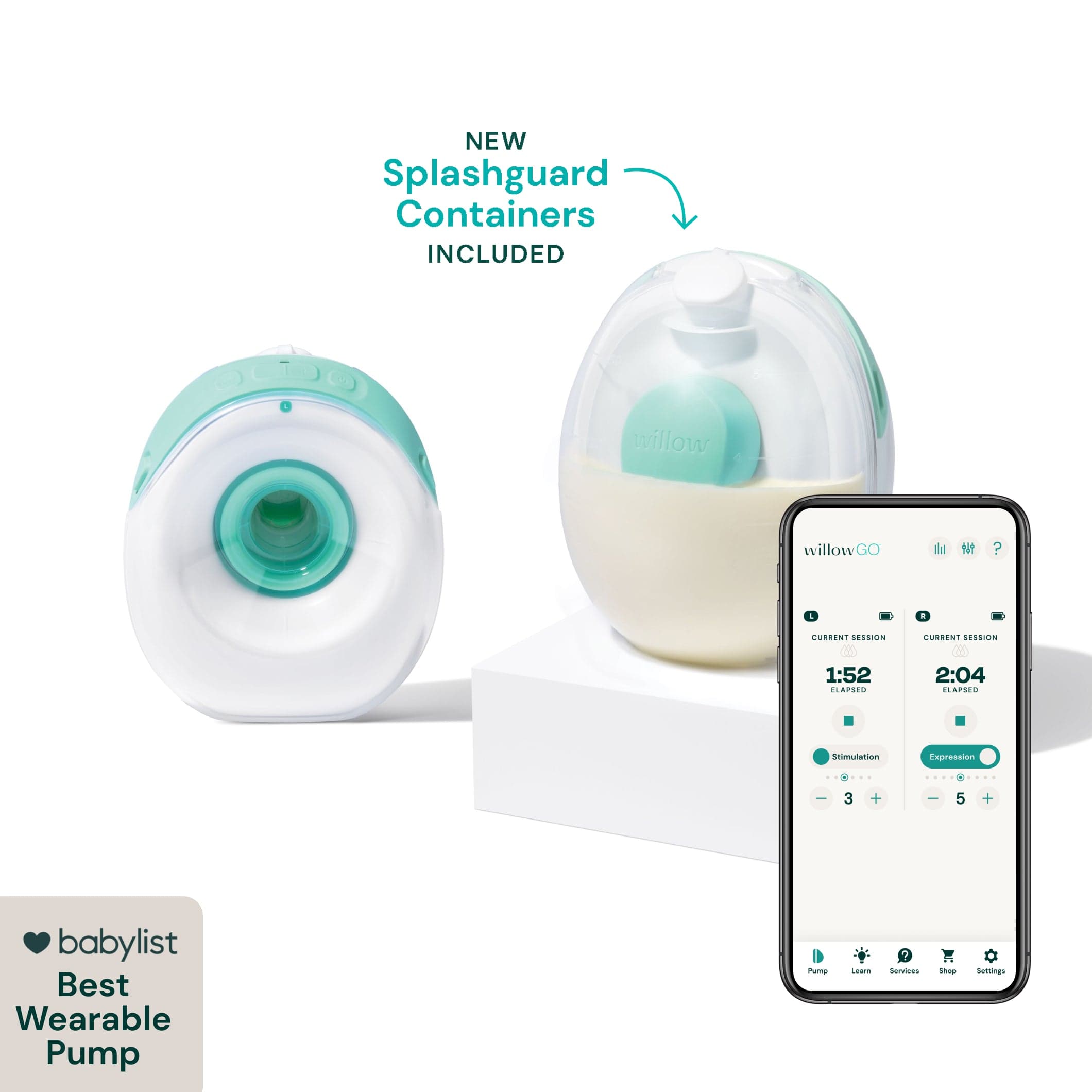
You're holding your phone in one hand, a baby in the other, and somewhere in the background a Spectra is rhythmically announcing to everyone in the house that you're pumping. Again. The Willow Go promises to replace that scene: slide two cups into your bra, tap the app, and walk away. No tubes. No cords. No audible confession to anyone within earshot.
This Willow Go review covers real suction measurements versus marketing claims, the common problems you'll hit (and how to fix them), how this wearable breast pump stacks up against the Elvie Strideand the pricier Willow 360, and who it genuinely works for. If you're building your pumping schedule, knowing your pump's actual output ceiling shapes how many sessions you need and how long each one runs.
What Is the Willow Go?
The Willow Go is a fully in-bra, wireless, app-controlled double electric breast pump from Willow. Launched in 2022 as the cheaper sibling to the Willow 360, it swaps spill-proof milk bags for reusable containers and retails at $299.99 — roughly $150 less for stronger suction but less leak protection.
FDA-cleared as a Class II device, BPA-free, closed system — milk never contacts the motor or internal components, per FDA breast pump safety guidelines.
Where it sits in Willow's lineup:
- Willow 360 (Gen 3)— spill-proof bags, leak-proof any position, Apple Watch control, $499
- Willow Go— reusable containers, stronger suction, leak-proof to ~45°, $299 (reviewed here)
- Willow Sync— insurance-tier model built to hit coverage price points
No tubes, no waistband hub, no cords under your shirt. Each cup holds its own motor. You slide them into a nursing bra and they sit there, quietly doing their thing.
Key Specs and What You Get in the Box
The fine print matters more than the headline numbers on this one.
| FDA Status | Class II, 510(k) cleared |
|---|---|
| Price | $299.99 retail (frequently on sale ~$250; partial insurance coverage common) |
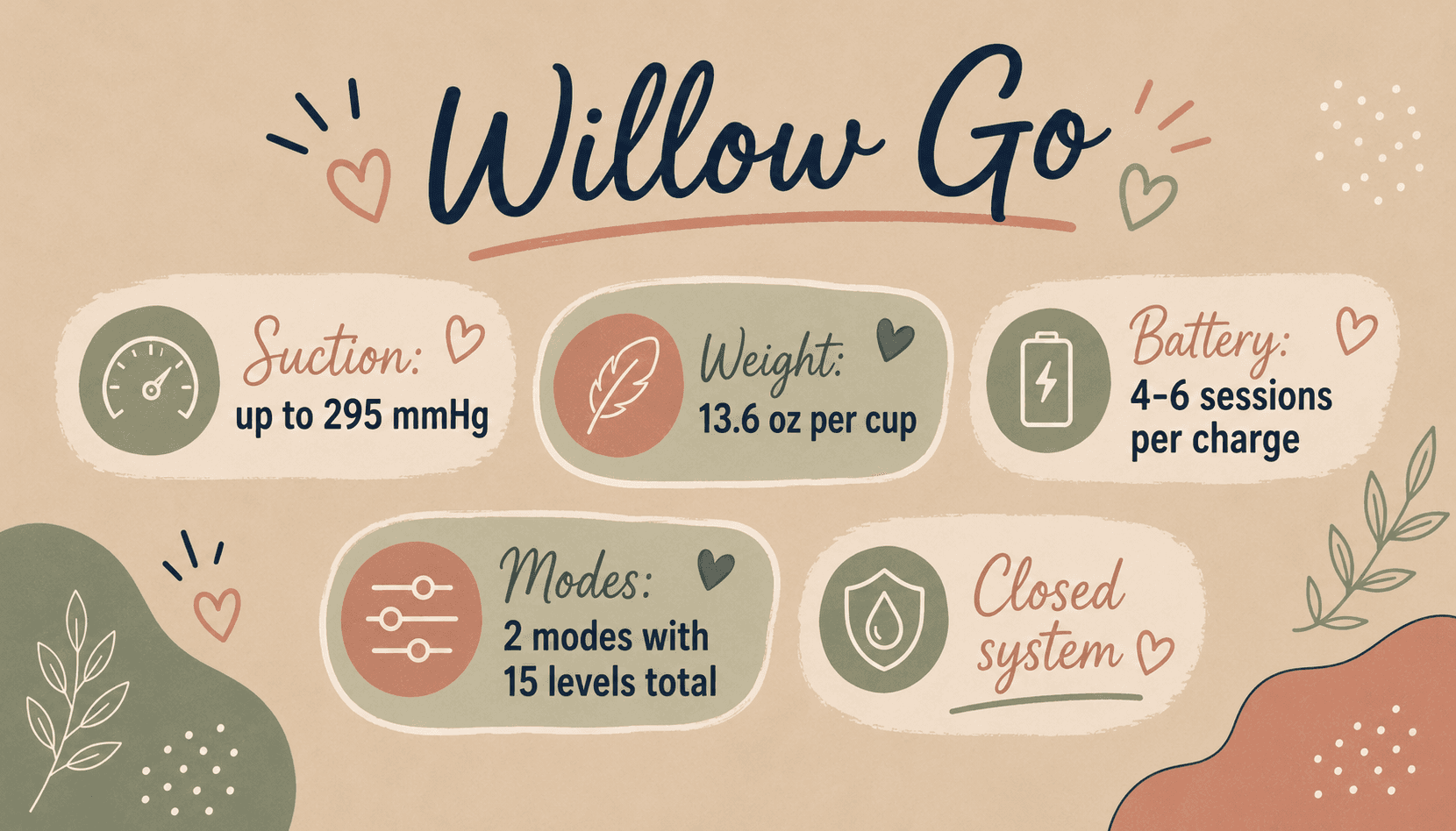
| Weight | ~385g per cup (~13.6 oz assembled) |
| Container Capacity | 5 oz per side (7 oz containers sold separately) |
| Max Suction (claimed) | Up to 295 mmHg |
| Max Suction (real-world reports) | ~240–280 mmHg |
| Modes | 2 (Stimulation + Expression) |
| Intensity Levels | 6 Stimulation + 9 Expression (15 total) |
| Battery Life | 4–6 sessions per charge (claimed up to 8) |
| Flange Angle | 105 degrees (wider than standard) |
| Noise | Very quiet (near-silent at lower settings) |
| Flange Sizes | 21mm insert + 24mm flange included; 27mm sold separately |
| System Type | Closed system, BPA-free |
| App | Willow app (iOS / Android) — manual volume entry |
| Warranty | 12 months (pump), 90 days (accessories) |
| Parts to Clean | 5 per side (dishwasher-safe) |
In the box: 2 pump units, 2 flanges (24mm), 2 sizing inserts (21mm), 2 reusable containers (5 oz), 2 container backs, 2 splashguards, 2 diaphragms, 2 duckbill valves, 2 USB cables. No wall adapter — grab a phone charger.
Worth noting: Willow's 105-degree flange angle uses a wider, curved tunnel versus the straight design on a Spectra or Medela. Clinical backing for their “more milk” claim is thin, but moms who found traditional flanges uncomfortable sometimes prefer the shape.
Setting Up and Using the Willow Go
The Willow Go's reputation for finicky setup is earned — but front-loaded. After three or four assemblies, muscle memory takes over.
Assembly (5 parts per side):Container back snaps onto the container. Duckbill valve seats into the white housing — this single step causes roughly 80% of reported problems (see troubleshooting below). Diaphragm stretches over the housing, flange attaches, and the whole thing clicks into the motor unit. As one r/ExclusivelyPumping member put it: “My first time assembling the duckbill valve took 20 minutes and a YouTube tutorial. My 50th took 10 seconds.”
App setup:Download the Willow app, pair via Bluetooth, and you can start/stop sessions, toggle modes, and adjust suction (6 stimulation levels + 9 expression levels) from your phone. Unlike the 360, the Go doesn't track volume in real time — you pour milk into a measured container and enter the number yourself.
FlexGear flanges:Ships with 24mm flanges and 21mm inserts. About half of women need something other than 24mm, and with the Willow Go, wrong sizing doesn't just reduce output — it breaks the seal that keeps the whole system working. The 27mm flange is sold separately.
First-session checklist:
- Watch Willow's official assembly video first. The manual alone doesn't capture the duckbill seating technique.
- Dry every part completely. The suction system despises moisture — a few drops on the diaphragm can kill the seal.
- Wear a bra one size tighter than your everyday nursing bra. The cups need steady compression.
- Do a dry run: assemble, insert, turn on, confirm suction. Better now than at 2 AM with a screaming baby and no patience left.
- Start at low suction and work up. Level 9 is aggressive — your nipples will thank you for the ramp-up time.

Real-World Pumping Performance
Willow advertises up to 295 mmHg of suction. Independent testers and lactation professionals measure closer to 240–280 mmHg — still strong for a wearable, and meaningfully above the Elvie Stride's ~170 mmHg. One LC noted that firmware updates in late 2024 may have dialed peak suction down to 240–250 mmHg on some units. Willow hasn't confirmed this.
For exclusive pumpers:The Willow Go lands in viable EP territory — closer to a Spectra S1 than most wearables get. The AAP recommends complete breast emptying at each session to maintain supply long-term. On an exclusive pumping schedule with 7–8 daily sessions, many moms use the Go as a primary pump. The caveat: several EP moms on r/ExclusivelyPumping report the Go doesn't fully empty them the way a Spectra or BabyBuddha does — it gets most of the milk but misses that last half-ounce per side. Over weeks, that gap can nudge supply downward.
For combo feeders:This is the Willow Go's sweet spot. Two to four daily sessions, 240+ mmHg, 15–20 minutes, done.
Each breast gets independent suction from its own motor (unlike the Elvie Stride's single-motor splitter), which helps with more even emptying. More on session timing in our how long to pump guide.
Parts wear matters.Fresh parts pump well. After 6–8 weeks of daily use, diaphragms and duckbill valves stretch and suction drops noticeably. Hot-washing restores some springiness temporarily. Budget $20–30 every 60–90 days for replacements — it's the cost of keeping the Go performing like you remember from week one.
Comfort, Noise, and Wearability
At ~385 grams per assembled cup (13.6 oz), the Willow Go is heavier than the Elvie Stride's sub-5-oz cups. Add 5 oz of milk and you're carrying 18.5 oz per side — a full pint glass hanging from your bra. You adjust after a few sessions, but smaller-chested moms feel the weight.
Noise is the Willow Go's stealth advantage. Lower suction levels are barely audible. Higher levels produce a soft hum that doesn't carry through walls or announce itself in a meeting. If you're pumping at work, this pump keeps your secret.
Under a fitted tee, the cups are visible. Under a loose blouse, they disappear. (The “nobody can tell” marketing photos feature models in flowing tops for a reason.)
Battery life lands at 4–6 sessions per charge despite Willow's claimed 8. Higher suction drains faster. The app's battery indicator doesn't warn you before it dies — it just stops mid-session, which is exactly as fun as it sounds. Charge nightly if you pump 5+ times.
Walk around, cook dinner, chase a toddler — all fine. Bend past 45 degrees and you'll learn about the leak-proof limit the hard way. The Go's containers don't seal at the top, unlike the Willow 360's bags. Keep that in mind during newborn pumping sessions when you're inevitably reaching for something you dropped.
Willow Go vs Willow 360 vs Elvie Stride
| Feature | Willow GoBest for: in-bra pumping | Willow 360Best for: leak-proof any position | Elvie StrideBest for: insurance coverage |
|---|---|---|---|
| Suction | ~240–280 mmHg | ~245 mmHg | ~170 mmHg (tested) |
| Design | Fully in-bra (no tubes) | Fully in-bra (no tubes) | Tubed (hub + cups) |
| Motor | In-cup motor (each side) | In-cup motor (each side) | Single hub, tube splitter |
| Battery Life | ~4–6 sessions | ~5 sessions + quick-charge | ~5 sessions (~2.5 hrs) |
| Price | $299.99 | $499.99 | $199.99 |
| Insurance | Partial coverage common | Limited coverage | Widely covered (often free) |
| Noise | Very quiet | Very quiet | Ultra-quiet |
| Flange Options | 3 sizes (21mm, 24mm, 27mm) | 3 sizes (21mm, 24mm, 27mm) | 6 sizes (shields + cushions) |
Willow Go vs Willow 360: The Go pumps harder and costs $150 less. The 360 is fully leak-proof and auto-tracks volume. Sitting or standing most of the time? Go wins on value. Need to pump lying down or move in any direction without thinking? The 360 earns its premium.
Willow Go vs Elvie Stride:The Go pulls ~240–280 mmHg versus the Stride's ~170 mmHg — a meaningful gap for EP moms. The Stride is lighter, cheaper, whisper-quiet, and far easier to get fully covered by insurance. Suction your top priority? Go. Budget and coverage? Elvie Stride. Our full Stride review digs deeper.
No wearable matches a hospital-grade Medela Symphony for raw extraction. The Willow Go comes closest in its category — but “strongest wearable” and “strong enough as your only pump” aren't the same thing, especially in the first 12 weeks.
Getting the Willow Go Through Insurance
The ACA requires most plans to cover one breast pump per pregnancy at no cost, but “no cost” typically means a base-tier electric pump. The Willow Go's $299.99 price usually exceeds that tier, so expect an “upgrade” copay — often $50–$150 depending on your plan.
The DME process in four steps:
- Check your benefits portal or call your insurer. Ask whether the Willow Go is a covered DME option.
- Get a prescription from your OB-GYN (most plans require one).
- Order through an approved DME supplier — Aeroflow, Byram Healthcare, or 1 Natural Way all carry the Willow Go and will verify coverage for you.
- Start around week 30 of pregnancy. Verification takes 1–5 business days, shipping another 1–5.
Any out-of-pocket difference is HSA/FSA eligible, including replacement parts like duckbill valves and diaphragms. (Your future self will appreciate knowing this when she's replacing parts for the third time.)
Medicaid:Coverage varies significantly by state. Some state Medicaid plans cover wearable pumps; others only approve manual or basic electric models. Check with your state's Medicaid provider directly.
Common Willow Go Problems and How to Fix Them
Steep learning curve, but the problems are predictable — and fixable.
Leaking.The number-one complaint. Usual culprits: (1) bra too loose — the cup needs firm compression to seal, (2) duckbill valve not fully seated (see next), (3) you leaned past 45 degrees. The Go's containers are open at the top. Gravity is not your friend here.
Duckbill valve drama.The duckbill is this pump's Achilles' heel. It must seat perfectly on the white housing or suction fails silently — you sit there thinking you're pumping while collecting nothing. Wash in hot water, dry completely, and reseat firmly. Never refrigerate assembled cups; cold unseats the valve. The popular fridge hackworks with other pumps but is unreliable here. Replace duckbills every 4–6 weeks. (Yes, the tiny $8 valve has an outsized role. It knows this and behaves accordingly.)
Suction fading between washes.Diaphragm and duckbill lose tension as they warm and stretch during use. Hot-washing between sessions restores springiness. These are consumable parts by design — budget for replacements every 60–90 days.
Battery dying mid-session.No advance warning from the app — it just stops. Charge nightly if you pump 4+ times daily.
Bluetooth drops.Keep your phone within arm's reach. If pairing fails, forget the device in Bluetooth settings and re-pair. The pump keeps running even without the app connected — you just lose remote control.
Flange fit.Pain, tunnel-wall rubbing, or a red ring post-session all signal wrong sizing. The 105-degree angle means standard sizing charts don't translate perfectly — measure your flange size properly and try one size up or down. A lactation consultant fitting saves weeks of frustration and protects your milk supply.
Motor overheating. Sessions over 30 minutes can overheat the compact in-cup motor. Cap sessions at 25 minutes; if you need longer, take a 2-minute break at the 25-minute mark to let it cool.
Who Should (and Shouldn't) Buy the Willow Go
Overall score
out of 10
What we like
- Strongest suction in the wearable category (~240–280 mmHg)
- Fully in-bra — no tubes, cords, or external motor
- Very quiet at all suction levels
- 15 customizable suction levels across 2 modes
- Closed system keeps milk separate from motor
- 5 oz and 7 oz container options for different needs
What could be better
- Duckbill valve requires precise seating — learning curve is real
- Heavier than tubed wearables (~385g per cup before adding milk)
- Leak-proof only to ~45 degrees (not for lying down)
- Short 12-month warranty vs 2 years on Elvie
- Replacement parts needed every 60–90 days ($20–30/cycle)
- App lacks real-time volume tracking (manual entry only)
Best for:
- EP moms who want a capable wearable. If you're exclusively pumping and need a wearable for daytime sessions while a Spectra or BabyBuddha anchors the home rotation, the Go's suction is the most viable in the wearable category. Some EP moms use it as their sole pump successfully, though monitoring supply closely matters.
- Working moms who need discretion. No tubes, near-silent motor, app control. Pump at your desk, in a car between appointments, or during a conference call (camera off, please). More tips in our pumping at work guide.
- Post-regulation portability.Once supply stabilizes around 8–12 weeks, the Go handles maintenance pumping well. Strong suction keeps sessions to 15–20 minutes.
Skip it if:
- You're in the first 2–4 weeks postpartum. Establishing supply demands reliable emptying every session. The Go's learning curve makes it risky as a first pump. Start with a Spectra or hospital rental, add the Go once supply is confident. Our newborn pumping schedule covers those early weeks.
- Budget is tight.At $299.99 plus recurring part replacements, 12-month cost of ownership hits $450–500+. The Elvie Stride at $199 (often free through insurance) is a better deal if suction power isn't make-or-break.
- You pump lying down.Night sessions, C-section recovery, bed rest — any reclined position rules out the Go. The Willow 360 or a traditional pump handles these.
- Fussy assembly drives you up the wall.If you need a pump you can slap together half-asleep at 3 AM, the Go's precision-seating requirements will not be your friend. The Elvie Stride's simpler assembly is far more forgiving.
Related Reading
- Elvie Stride Review — Real Suction Numbers and Who It Fits
- Exclusive Pumping Schedule — Complete Guide by Baby's Age
- How Long Should You Pump? Session Length Guide
- Pumping at Work — Your Rights and Setup Guide
- Best Wearable Breast Pumps (2026) — Top 3 Compared
- Best Hands-Free Breast Pumps (2026) — 4 Pumps Tested
- Power Pumping Schedule — How to Boost Supply
- Breast Milk Storage Guidelines
- Eufy S1 Pro Review — Heated Wearable With Real Suction