It is 2 AM. The pump is whirring. You are staring at the wall, half-asleep, holding flanges to your chest because the hands-free bra is in the wash. The baby is finally sleeping and you are not, because the machine needs you more than the baby does right now.
You Googled “i hate pumping” because you needed someone — anyone — to say what you already feel.
So here it is: you are not ungrateful. You are not weak. You are doing one of the most physically and emotionally demanding things a new parent can do, and the fact that you hate it does not mean you are failing. It means you are paying attention.
You Are Not Being Dramatic
Exclusive pumping asks more of you than most people realize. It is not “just like breastfeeding but with a machine.” It is breastfeeding plus bottle feeding plus cleaning plus storage plus scheduling, with none of the oxytocin-fueled bonding that direct nursing provides and all of the time commitment doubled.
One mom in r/ExclusivelyPumping described it: “Nursing moms feed the baby. I feed the pump, then feed the baby, then wash the parts, then do it all again three hours later. Nobody sees the middle step” (paraphrased).
That invisible labor is what makes EP burnout different. People around you see a fed baby and assume the system is working. They do not see the 45 minutes of infrastructure behind every bottle.
Why Exclusive Pumping Is Harder Than People Think
The physical demands alone would be enough. But EP stacks several burdens on top of each other, and the combination is what breaks people. (You have probably described it as “feeding the baby with extra steps.” It is feeding the baby with extra steps, a dishwasher full of flanges, and a freezer you have reorganized three times.)
- Time. Eight sessions per day at 20-30 minutes each, plus setup and cleanup, adds up to 4-5 hours daily spent tethered to a machine. That is a part-time job with no pay, no weekends off, and no sick days.
- Sleep deprivation. The middle-of-the-night pump exists because prolactin peaks between 1 and 5 AM. Skipping it before 12 weeks risks your long-term supply. So you set the alarm, knowing your baby might sleep through the night before you can.
- Isolation. Pumping locks you in place. You cannot hold your baby, walk around, or leave the house mid-session without wearable gear. Even with a portable pump, you are managing tubes and bottles in public restrooms.
- Physical pain. Cracked nipples, poor flange fit, clogged ducts, engorgement. Our guide on why pumping hurts covers the mechanical causes, but knowing the cause does not make 3 AM any less miserable.
- Guilt in every direction.Guilt for not nursing directly. Guilt for wanting to quit. Guilt for resenting something your baby needs. The guilt is relentless, and it comes from everywhere — social media, relatives, your own internal voice.
A poster in r/breastfeeding put it bluntly: “I did not expect to mourn the breastfeeding relationship I never had while simultaneously hating the replacement I built from scratch” (paraphrased). That grief-and-resentment cocktail is the emotional signature of EP burnout.
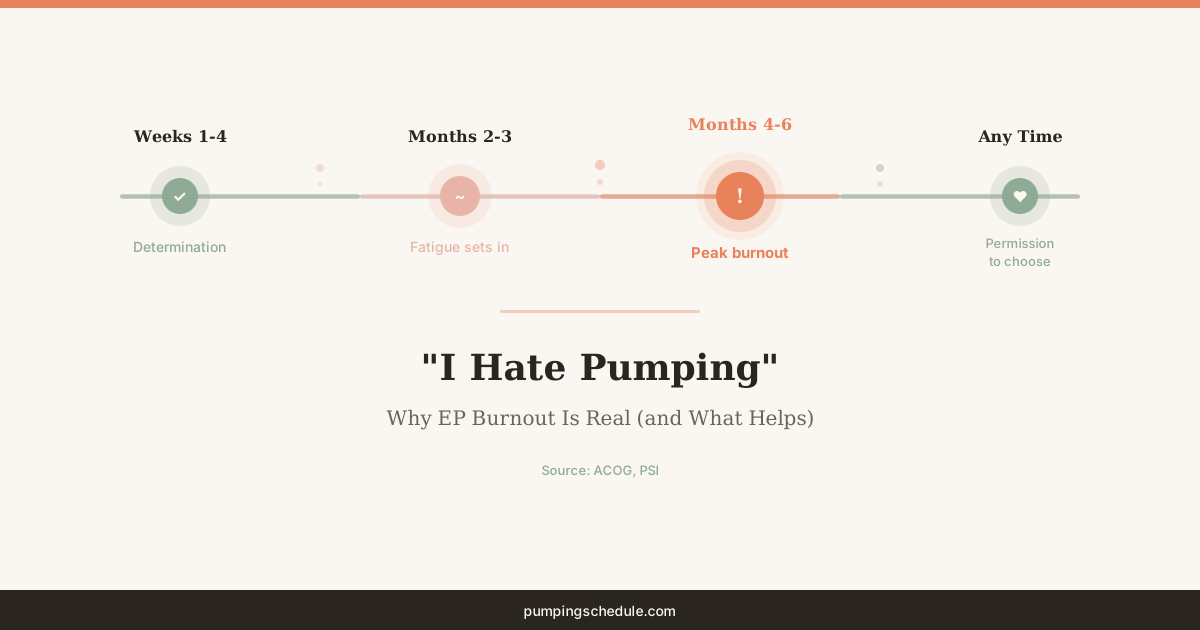
The EP Burnout Timeline
Burnout does not arrive on a fixed schedule, but certain phases carry more weight than others. Here is what the pattern looks like for many EP moms:
| Phase | Why It Hits | What Helps |
|---|---|---|
| Weeks 1-2 | Postpartum hormones, learning curve, colostrum-to-milk transition, possibly NICU trauma | Lower expectations. Survive, do not optimize. |
| Weeks 6-8 | Adrenaline fades. Sleep debt compounds. Partner returns to work. Reality of long-term EP sinks in. | Accept help. Consider a wearable pump for mobility. |
| Month 3 | Supply regulates (less reward per session). Return to work adds logistics. The novelty of “I can do this” wears off. | Drop a session if supply allows. |
| Months 4-6 | Cumulative fatigue. Seeing nursing moms feed effortlessly triggers comparison. Questioning whether it is worth it. | Set a new finish line. “I will reassess at 6 months” gives your brain an exit door. |
| Months 8-12 | Baby eating solids reduces the visible “need” for pumped milk. Motivation craters. | Start weaning if you are ready. The finish line is real. |
The 6-to-8-week mark is where most EP moms first think “I cannot keep doing this.” Maybe it hits during the 3 AM pump — the one where you are sitting on the bathroom floor because you did not want to wake anyone, scrolling through your phone with one hand and holding a flange with the other, seriously calculating whether your freezer stash covers two more weeks if you just stopped right now.
That thought is not a red flag. That is an accurate assessment of a situation that is objectively unsustainable without support.
D-MER: When the Problem Is Physiological
Some moms do not just dislike pumping — they feel a sudden, visceral wave of dread, sadness, or anxiety the moment milk starts flowing. If that sounds familiar, you may have dysphoric milk ejection reflex (D-MER).
D-MER is not psychological. It is a physiological condition caused by a sudden drop in dopamine at letdown. The negative feelings — which can range from mild unease to intense despair — last 30 seconds to a few minutes and then lift as abruptly as they arrived. It happens at every letdown, whether you are pumping or nursing.
Research suggests D-MER affects 9 to 15% of lactating parents, though the real number may be higher because most have never heard the term. Women with a history of panic attacks or mood disorders appear to be at greater risk.
D-MER is not PPD. The key difference: D-MER is tied precisely to letdown and resolves within minutes. PPD persists regardless of whether you are pumping. If you dread every session because of that wave of dysphoria, naming it — and knowing it is your dopamine, not your character — can be the difference between pushing through and quitting in despair.
When “I Hate Pumping” Is Actually PPD or PPA
Sometimes the hatred is not about the pump at all. It is the loudest symptom of something bigger.
CDC data shows that roughly 1 in 8 postpartum women (13.2%) experience depressive symptoms. That number likely underestimates EP moms specifically, because exclusively pumping adds sleep deprivation, isolation, and schedule rigidity — all established risk factors for postpartum depression.
Pay attention if pumping hatred comes with any of these:
- Persistent sadness or numbness that does not lift between sessions
- Difficulty bonding with your baby, even outside of pump time
- Intrusive thoughts about harming yourself or your baby
- Inability to sleep even when the baby is sleeping and no pump is due
- Feeling like your baby would be better off without you
- Rage that feels disproportionate to the situation
Those are not pumping problems. Those are postpartum depression or anxiety symptoms, and they need clinical attention. Your OB, midwife, or the Postpartum Support International helpline (1-800-944-4773) can connect you to a provider. You do not have to be in crisis to call.
The American College of Obstetricians and Gynecologists recommends screening for perinatal depression at least once during the postpartum period. If your 6-week checkup felt rushed, you can request screening at any visit.
Permission to Stop
You do not need anyone's permission. But since you are reading this at 2 AM and some part of your brain needs to hear it from outside your own head:
You are allowed to stop pumping.
Not “if it gets bad enough.” Not “after you hit six months.” Not “once you have tried everything else.” Now, if that is what you need.
The AAP's breastfeeding policy recommends breastfeeding for two years — and in the same document states that feeding decisions should support the health and wellbeing of both parent and child. “Both” is doing a lot of work in that sentence. Your mental health is not a footnote.
Formula is safe. Formula is complete nutrition. Switching does not undo the months of breast milk you already provided. And a parent who is mentally present, sleeping, and not white-knuckling through every day is giving their baby something no amount of pumped milk can replace.
If you decide to stop, do it gradually — our weaning pumping schedule walks you from 8 sessions down to zero without mastitis.
Guilt is not evidence that you are doing something wrong. It is evidence that you care deeply. Those are not the same thing.
If You Decide to Keep Going
Staying is also a legitimate choice. But staying while miserable is not sustainable. Something has to change:
- Drop a session. If your supply is regulated (past 12 weeks), you may be able to cut your lowest-yield pump without losing meaningful output. Going from 7 sessions to 6 gives you back 40 minutes. That matters.
- Set a finish line.Open-ended commitments are psychologically brutal. “I will pump until 6 months and then reassess” is easier to carry than “I will pump as long as possible.” You can always extend the deadline later.
- Fix the pain. If sessions physically hurt, something is mechanically wrong. Check your flange fit and suction settings before accepting discomfort as normal.
- Get a wearable pump for at least some sessions. Being able to walk, hold your baby, or eat dinner during a session changes the math. It is still pumping, but it is pumping while pretending you have a normal life. Close enough.
- Outsource the parts you can.Your partner can wash parts, label milk, handle nighttime bottles. If the labor split is “I pump and I do everything else too,” that is the real problem.
None of these fix the fundamental issue. But they can make it survivable long enough to reach whatever goal matters to you.
Crisis and Community Resources
You do not have to figure this out alone. And you do not have to be in crisis to reach out.
- Postpartum Support International Helpline: 1-800-944-4773 (call or text). Not a crisis line — messages are returned daily. They connect you with local providers and support groups.
- 988 Suicide and Crisis Lifeline: Call or text 988. Available 24/7 for anyone in emotional distress.
- Crisis Text Line: Text HOME to 741741.
- r/ExclusivelyPumping: The largest online community of EP parents. Thousands of moms who have been exactly where you are right now.
- r/breastfeeding: Broader community but welcoming to EP moms.
- La Leche League: Local group finder for in-person and virtual support.
If you are having thoughts of harming yourself or your baby, call 988 or go to your nearest emergency room. That is not pumping burnout. That is a medical emergency, and you deserve immediate help.
Related Reading
Related Reading
Last reviewed: October 2026 by the Pumping Schedule Editorial Team. This article is updated as new research becomes available.