You had a glass of wine at dinner. Maybe two. Now you are staring at your pump parts at 10 PM, wondering whether the milk you are about to express belongs in a bottle or down the drain.
Someone told you to pump and dump after drinking. A nurse, your mother-in-law, a stranger on the internet. It sounds cautious. Responsible, even.
The science says otherwise in almost every case.
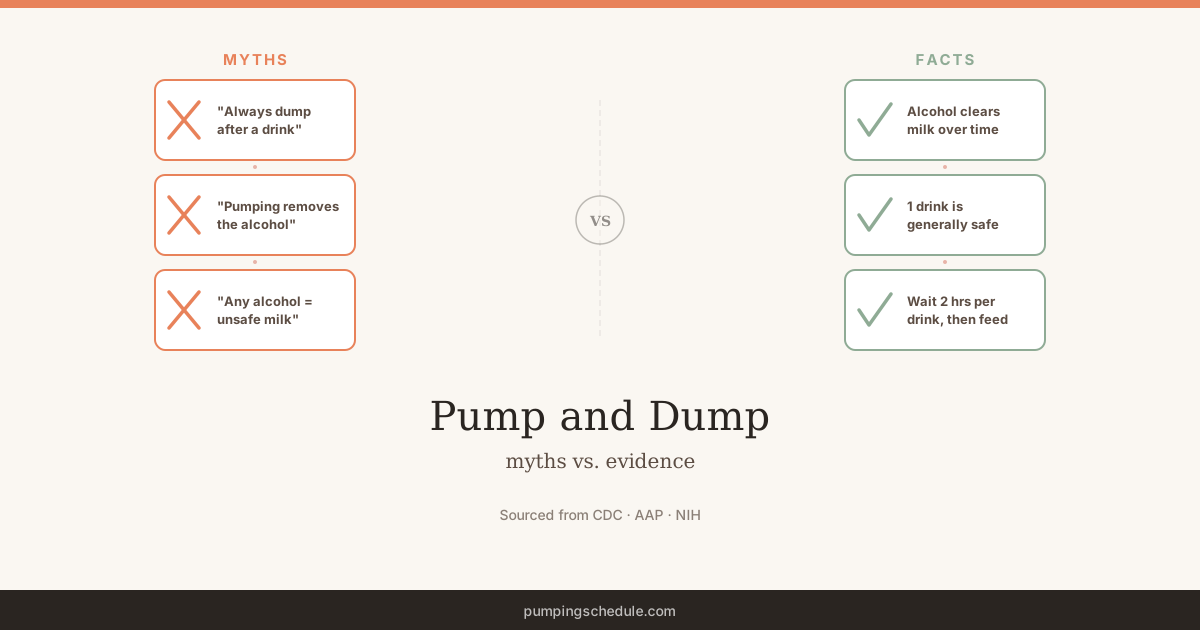
Pumping does not pull alcohol out of your milk any faster than time does. For the vast majority of situations where moms are told to dump, the milk was perfectly safe to feed. This article walks through when pump and dump actually applies (rarely), when it does not (almost always), and what to do instead of pouring liquid gold down the sink for no reason.
What Does “Pump and Dump” Actually Mean?
Pump and dump means expressing breast milk and throwing it away instead of feeding it to your baby. The idea: the milk is “contaminated” by alcohol or medication and unsafe.
The phrase caught on decades ago when doctors knew less about how substances pass into breast milk. The cautious move was to assume the worst — if you consumed anything questionable, trash the milk. A blunt instrument for a problem that deserved a scalpel. And updated CDC guidance on alcohol and breastfeeding now paints a more precise picture.
The advice stuck because it feelssafe. Nobody gets pushback for being too cautious. But “too cautious” has a real cost when you are an exhausted mom watching four ounces spiral down the drain at midnight — milk that was almost certainly fine to feed.
How Alcohol Actually Enters (and Leaves) Your Breast Milk
Alcohol moves into breast milk the same way it moves into every other body fluid — through your bloodstream. Your milk alcohol level roughly mirrors your blood alcohol level: LactMed's alcohol entry documents that levels rise and fall in parallel. When blood alcohol drops, so does the alcohol in your milk. No extraction needed.
Here is the part that trips people up: pumping does not remove alcohol from your milk. The alcohol is not trapped in there like a toxin. It flows freely between blood and milk. As your liver metabolizes the alcohol in your blood, the concentration in your milk drops on its own.
Peak levels hit about 30 to 60 minutes after drinking — or closer to 90 minutes if you drank with food. After that, levels decline steadily. One standard drink clears within two to three hours for most women.
Think of it this way: your breast milk is a river running alongside your bloodstream, not a storage tank that collects alcohol. When the alcohol leaves your blood, it leaves your milk at the same pace. This is why the old shorthand works: if you are sober enough to drive, you are sober enough to nurse.
Armed with that biology, here are the five myths that keep moms pouring good milk down the drain.
Myth vs. Evidence: 5 Pump-and-Dump Beliefs That Are Wrong
| Myth | What the Evidence Says |
|---|---|
| Pumping removes alcohol from your milk | Alcohol levels in milk drop as blood alcohol drops. Pumping has zero effect on clearance speed — the LactMed alcohol entry confirms levels parallel blood concentration regardless of milk removal. |
| You must dump after any amount of alcohol | One standard drink produces milk with roughly 0.03% alcohol — less than what occurs naturally in ripe fruit and bread. The CDC and AAP both say a single drink is compatible with breastfeeding after a two-hour wait. |
| Drinking water or coffee speeds up clearance | Neither water, coffee, nor exercise changes how fast your liver processes alcohol. NIAAA research on alcohol metabolism shows clearance is metabolic, not hydrational. Only time works. |
| Beer boosts milk supply | A polysaccharide in barley may trigger a small prolactin bump, but research published in Nutrients shows alcohol suppresses oxytocin, which drives letdown. Net effect on supply: negative. |
| You must dump after anesthesia | Modern anesthetics (propofol, sevoflurane, fentanyl) have short half-lives. A 2015 review in Translational Perioperative and Pain Medicine confirms breastfeeding is safe once you are awake and oriented. |
If your reason for dumping milk is on this table, you can stop.
When You Actually Need to Pump and Dump (The Short List)
True pump-and-dump scenarios exist. They are just rare — and they do not involve a glass of pinot noir.
- Certain chemotherapy drugs that stay in breast milk for days. Your oncologist specifies the exact window, which varies by drug — the LactMed entry on cyclophosphamide is one example.
- Radioactive contrast agents like iodine-131 for thyroid scans. Temporary cessation of 24 to 72 hours depending on the isotope, per published radiopharmaceutical guidelines. Your radiologist provides the specific timeline.
- Specific illicit substances — methamphetamine, PCP — that concentrate in milk and pose genuine infant risk, per AAP guidance on drug transfer into breast milk.
- A medication your doctor has specifically flagged as incompatible. This is rarer than most people think.
That is essentially the list. Notice what is not on it: a margarita, a dental procedure, Tylenol, your antidepressant, a beer at a barbecue. When you are unsure about a specific medication, the NIH LactMed database is free, searchable, and more current than most doctor's offices on this topic.
Alcohol and Breastfeeding: The Practical Timeline
Your body clears roughly one standard drink every two to three hours. “Standard drink” means 12 oz beer, 5 oz wine, or 1.5 oz liquor. Body weight matters — lighter women clear alcohol more slowly, as documented by the Koren et al. alcohol elimination study.
| Drinks | ~120 lbs | ~140 lbs | ~160 lbs | ~180 lbs |
|---|---|---|---|---|
| 1 drink | 2 hr 50 min | 2 hr 30 min | 2 hr 15 min | 2 hr |
| 2 drinks | 5 hr 40 min | 5 hr | 4 hr 30 min | 4 hr |
| 3 drinks | 8 hr 30 min | 7 hr 30 min | 6 hr 45 min | 6 hr |
Times are estimates. Individual metabolism varies.
One drink? Wait two hours, then nurse or pump as normal. No dumping. Two drinks? Four to five hours before milk clears. Plan your pump session timing accordingly. Three or more? You are into real planning territory — have a stash ready and consider pumping for comfort during the wait.
The “safe to drive, safe to nurse” rule is a decent real-world shortcut, but not perfect for everyone. If you are 110 pounds and had two cocktails, you might technically pass a breathalyzer before your milk fully clears. When in doubt, add an hour. (Your Spectra or Medela does not care about your social plans — but your supply does care about skipped sessions.)
Medications, Surgery, and Anesthesia: What the Research Says
Here is a number that surprises most moms: the vast majority of common medications are compatible with breastfeeding. The 2022 AAP policy statement on breastfeeding addresses this directly. The problem is that many drug labels carry a blanket “consult your doctor before breastfeeding” warning — not because the drug is dangerous in milk, but because the manufacturer never studied it in lactating women. Defensive labeling is not evidence of harm.
Medications that are generally safe while breastfeeding include ibuprofen (first-line pain reliever for nursing moms, tiny transfer), acetaminophen (minimal transfer, safe), most antibiotics like amoxicillin, and SSRIs such as sertraline — one of the best-studied medications in breastfeeding with negligible infant transfer. Lidocaine for dental work barely enters milk at all. You can nurse right after the dentist.
Post-surgery advice used to be pump and dump for 24 hours after general anesthesia. That recommendation is retired. Modern anesthetic agents have short half-lives. Once you are awake, alert, and able to hold your baby safely, you can breastfeed. “I dumped six ounces after my wisdom teeth and then found out lidocaine doesn't even transfer. Still mad” (paraphrased from r/breastfeeding). If she had checked LactMed first, those six ounces would be in a bottle.
Cannabis, Nicotine, and Other Substances
This is where the guidance gets less black-and-white.
THC is fat-soluble and accumulates in breast milk. Unlike alcohol, it does not clear quickly — traces can remain for days to weeks after use. Both the ACOG and AAP recommend abstaining from marijuana while breastfeeding. The research on long-term infant effects is thin, which is itself the problem — we cannot say it is safe because the studies that would prove it have not been done. For moms who use cannabis medicinally (postpartum anxiety, chronic pain), the conversation with your provider should be about risk-benefit, not shame.
Nicotine does transfer into breast milk, and heavy smoking is associated with reduced supply and infant fussiness. But here is the AAP position that surprises people: even smoking mothers are encouraged to breastfeed, because the benefits of breast milk generally outweigh nicotine exposure risk. Practical timing: wait 90 minutes after smoking before nursing. And never smoke in the same room as your baby — secondhand smoke exposure is a bigger risk than milk transfer.
Moms on stable medication-assisted treatment with methadone or buprenorphine can breastfeed. The AAP supports this — the small amount in milk may actually ease neonatal withdrawal symptoms.
What to Do Instead of Dumping Your Milk
You do not have to choose between “dump it” and “feed it right now.” There is a middle path that protects your baby, your supply, and your sanity.
If you need to pump during a window when alcohol is still in your system — because you are engorged, because your EP scheduledemands it, because you simply cannot skip a session without your body protesting — pump for comfort and label the milk with the date and a note. By the time you thaw it hours or days later, the amount of alcohol was almost certainly trivial to begin with. Some moms toss it anyway. Others add it to bath milk. “My freezer stash has a whole drawer labeled 'wine night' and my kid turned out fine” (paraphrased from r/ExclusivelyPumping). Your call — but you do not have to decide in the moment.
A few strategies that work better than dumping: pump before you drink and build a small buffer in your breast milk storage. Time your drink right after a feed or pump so you get maximum clearance before the next one — use our storage calculator to figure out how much stash you need. Pump for comfort during the wait, express just enough to relieve pressure, keep your supply steady without creating milk you feel conflicted about. And stick to your normal schedule as closely as possible — skipping sessions is a bigger supply risk than one drink ever was.
The Hidden Cost of Unnecessary Pump and Dump
Every ounce of breast milk dumped unnecessarily represents time. Time pumping. Time cleaning parts. Time away from your baby or your own rest. For exclusively pumping moms who spend five to seven hours a day hooked to a machine, watching milk go down the drain is not just wasteful. It is demoralizing.
Then there is the supply question. Skip a pump because someone told you the milk would be “bad” and your body reads that as decreased demand. Do that a few times and output starts dropping. Now you are not just dealing with guilt about drinking — you are dealing with supply recovery on top of it.
A generation of moms was taught to treat a single glass of wine as a contamination event. The research does not support that level of alarm — breast milk after one drink contains less alcohol than ripe fruit.
You are not a bad mom for having a drink. You are not a bad mom for keeping milk that was safe all along. And you deserve to make this decision based on evidence, not anxiety.
Last reviewed: August 2026 by the Pumping Schedule Editorial Team. Read our editorial standards.
Related Reading
- Breast Milk Storage Guidelines — CDC-based storage rules so you know your stash is safe
- How to Increase Milk Supply While Pumping — recovery strategies if skipped sessions dipped your output
- How Often to Pump — frequency guidance to plan around events and social situations
- Exclusive Pumping Schedule — session timing and stash strategies for EP moms