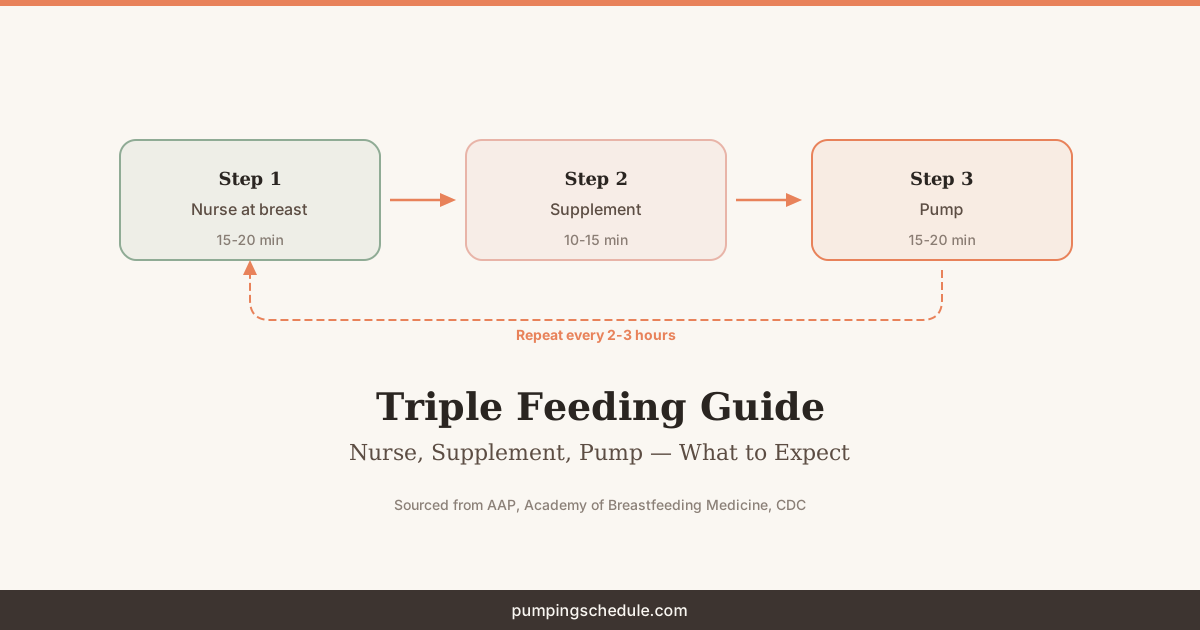
That plan has a name. It's called triple feeding, and it is one of the most exhausting things you can do as a new parent. Nurse the baby. Give a bottle of expressed milk or formula. Pump. Repeat eight times a day. Each cycle runs 45 to 90 minutes. Do the subtraction and you'll see why nobody lasts on this schedule for long.
But here's what the sticky note didn't say: it works. And it doesn't have to last forever.
What Triple Feeding Actually Means
Triple feeding is a three-step cycle you repeat at every feeding session. Step one: nurse the baby. Step two: supplement with expressed breast milk or formula. Step three: pump both breasts. The whole thing happens every two to three hours, around the clock.
So what is triple feeding really solving? Two problems at once. The supplement makes sure your baby eats enough right now. The pumping tells your body to make more milk for later. Neither step alone covers both bases. The Academy of Breastfeeding Medicine's supplementation protocol lays out the clinical reasoning — without pumping, supplementing alone can tank your supply.
A single cycle takes 45 to 90 minutes. With feeds every two to three hours, that leaves you roughly an hour between sessions. Sometimes less. This is not a schedule anyone sustains long-term. Your doctor knows that. It's a bridge — built to carry you across, not to live on.
Why Your Doctor Recommended Triple Feeding
Your pediatrician recommended triple feeding because your baby needs more milk than they're getting from the breast alone. That's a weight check, not a judgment.
Common triggers:
- Weight loss beyond the expected 7-10% in the first days, or slow gain afterward. The AAP's breastfeeding policy flags weight loss above this threshold as a clinical concern.
- Latch issues — tongue tie, lip tie, shallow latch — that reduce how much milk the baby actually transfers per session.
- Low supply in the early days before your mature milk is fully established.
- Premature birth. Preemies often tire at the breast before getting enough because their suck-swallow coordination is still developing.
- Jaundice. Increased feeding helps clear bilirubin faster. The AAP's 2022 hyperbilirubinemia guideline supports supplementation when intake-related jaundice is a concern.
Without the pumping step, supplementing alone causes supply to drift downward — your body reads fewer nursing sessions as lower demand. Without the supplement, baby stays hungry. Triple feeding solves both problems at the cost of your sleep and sanity. (Trade-offs: the unofficial theme of early parenthood.)
What a Triple Feeding Session Looks Like
Every session has three steps, always in order:
- Nurse first. Put baby to breast for 15-20 minutes or until they stop actively swallowing. This is the demand signal — your body registers the sucking and starts planning future supply.
- Supplement. Offer expressed breast milk or formula. Use a slow-flow bottle, syringe, cup, or supplemental nursing system. Watch for baby hunger cuesto know when they've had enough.
- Pump.Once baby is settled, pump both breasts for 15-20 minutes. A hospital-grade double electric pump — the Spectra S1 or Medela Symphony — makes this step significantly faster than a single pump. The expressed milk becomes tomorrow's supplement. (Or tonight's. Time is a flat circle when you're triple feeding.)
A single cycle runs 45 to 90 minutes depending on how cooperative the baby is — and “cooperative” is a generous word for a newborn who just ate and now needs to be burped, changed, and convinced that the bassinet is acceptable.
Sample Triple Feeding Schedule
Here's a realistic triple feeding schedule for a newborn. Realistic means the gaps between sessions are small and some will run long.
| Time | Nurse | Supplement | Pump | Free time |
|---|---|---|---|---|
| 6:00 AM | 15-20 min | 10-15 min | 15-20 min | ~30 min |
| 9:00 AM | 15-20 min | 10-15 min | 15-20 min | ~30 min |
| 12:00 PM | 15-20 min | 10-15 min | 15-20 min | ~30 min |
| 3:00 PM | 15-20 min | 10-15 min | 15-20 min | ~30 min |
| 6:00 PM | 15-20 min | 10-15 min | 15-20 min | ~30 min |
| 9:00 PM | 15-20 min | 10-15 min | 15-20 min | ~30 min |
| 12:00 AM | 15-20 min | 10-15 min | 15-20 min | ~30 min |
| 3:00 AM | 15-20 min | 10-15 min | 15-20 min | ~30 min |
Eight sessions per day. If your baby eats every two hours instead of three, those free windows shrink to almost nothing. Read more about how often to pumpbased on your baby's age and your supply goals.
Your newborn pumping schedule will look slightly different depending on the 2-hour vs. 3-hour cycle. The constant: every feed includes all three steps.
How to Make Triple Feeding Manageable
Triple feeding is not sustainable alone. That's not a weakness — it's arithmetic. Here's how to make the arithmetic hurt less.
Get a partner or helper for overnight feeds.You nurse and pump. They handle the bottle and the burp-settle-pray-for-sleep portion. This alone cuts 15-20 minutes per session. “I didn't sleep more than 40 minutes at a stretch for five days straight. That's when my husband started doing the bottle while I pumped and immediately passed out.” — paraphrased from an EP community discussion.
Build a pumping station.Pump, bottles, flanges, nipple cream, water, snacks, phone charger — everything within arm's reach. Every trip to the kitchen at 3 AM is a trip you didn't need to take.
Combine steps 2 and 3. Some moms bottle-feed the baby while pumping with a hands-free bra. It shaves 15 minutes per session and feels like a productivity hack from a very specific circle of parenting purgatory. A Kindred Bravely or Momcozy hands-free bra makes this possible without needing three arms.
Prep bottles in batches. Pre-measure formula powder or label expressed milk and refrigerate. Clean pump parts once per day using the CDC's breast pump hygiene guidelines — between sessions, store parts in a sealed bag in the fridge.
Set a review date.Ask your pediatrician: “When do we reassess?” Most plans are revisited at the next weight check — 2-3 days for newborns, weekly after that. Triple feeding without an end date feels like a sentence. A date gives it a shape.
When Triple Feeding Becomes Exclusive Pumping
For many moms, triple feeding is the on-ramp to exclusive pumping. It happens gradually and then all at once.
The pattern: baby struggles at the breast. You spend 20 minutes nursing and baby transfers barely an ounce. Then you give the bottle and baby inhales 3 ounces in five minutes. Then you pump and get 4 ounces. After a few days of this, you start asking yourself: why am I still doing step one?
That's a valid question.
If nursing is causing pain, stress, or burning 20+ minutes with minimal transfer, moving to an exclusive pumping schedule may be the right call. “I triple fed for three weeks before I admitted that nursing was the weakest link. Baby screamed at the breast, I cried at the breast, and my Spectra was pulling 5 ounces a side anyway. Going EP was the first time I felt like I could breathe.” — paraphrased from an exclusive pumping forum.
The transition looks like this:
- Drop nursing at one session per day. Replace with pump + bottle only.
- Monitor supply for 2-3 days. If output holds, drop another nursing session.
- Continue until all sessions are pump + bottle.
- Adjust your pump schedule — most EP moms pump 7-8 times per day for newborns, eventually dropping to 4-5 as supply regulates.
If you're heading this direction, our guide on when to start pumping exclusively covers the transition in detail. Combo feeding is another middle ground worth considering.
There's no failure in this transition. The baby needs milk. You're providing milk. The delivery method is logistics, not love.
How to Stop Triple Feeding
The goal of triple feeding is to stop triple feeding. You can step down when your baby demonstrates adequate intake from the breast alone, confirmed through weight checks with your pediatrician.
- Drop the supplement first — at one feed per day. Nurse as usual, skip the bottle, still pump afterward.
- Monitor weight. If baby continues gaining 5-7 oz per week over 2-3 days without that supplement, drop the bottle at a second feed.
- Phase out pumping sessions.Once baby gains well on breast alone, start spacing out pump sessions. Don't drop all pumping at once — that risks engorgement and mastitis.
- Keep one pump session(usually before bed or first morning) until you're confident supply is established. Look for signs of established milk supply before fully stopping.
The step-down usually takes 1-2 weeks. Rushing it risks supply dips or another round of poor weight gain. Slow and boring wins here.
Signs Triple Feeding Is Working
Two things tell you it's working: baby is gaining weight and your supply is moving in the right direction.
Baby signs:
- Weight gain of 5-7 oz per week after the initial newborn loss period, per AAP weight gain benchmarks
- 6+ wet diapers per day by day 4-5
- 3-4+ dirty diapers per day in the first month
- Alert during wake windows, settles after feeds
- Jaundice improving (if that triggered the protocol)
Supply signs:
- Pump output gradually increasing over the first 2 weeks
- You're able to reduce supplement volume because baby transfers more at breast
- Breasts feel softer after nursing — suggesting better emptying
- Letdown happening more predictably
Two weeks in and pump output is flat? Talk to a lactation consultant. You may need to check flange size, adjust pump settings, or add a power pumping session. Our guide on how to increase milk supply while pumping covers the mechanics.
If baby is gaining weight but nursing transfer isn't improving, that's useful data too. It might mean the path forward is exclusive pumping — and that's a perfectly good path.
Related Reading
- Exclusive Pumping Schedule: The Complete Guide
- Newborn Pumping Schedule
- How Often Should You Pump?
- Signs of Established Milk Supply