You are 36 weeks pregnant, staring at a breast pump still sealed in its box, and everyone has an opinion about when you should start using it. Your OB said “wait and see.” Your sister pumped on day one. A Reddit thread with 400 upvotes says the answer is “it depends.”
It does depend — but on specifics, not vibes. Whether you should start pumping within hours of delivery or wait a full month comes down to one question: is your baby getting milk directly from your breast? If yes, the timeline looks different than if no. Here is the breakdown for every scenario.
Why Timing Matters
The first 12 weeks postpartum are a calibration window. Your body is learning how much milk to produce based on how much gets removed — whether by baby or by pump. During the initial 4-6 weeks, milk production runs on hormones (the endocrine phase): prolactin levels are high and your body produces milk regardless of demand. NIH physiology of lactation describes this shift — after about 6-12 weeks, production switches to supply-and-demand (the autocrine phase), where milk removal is the primary signal.
Start pumping too early while nursing successfully, and you tell your body to make more milk than one baby needs. Start too late when exclusively pumping, and you miss the hormonal window where establishing supply is easiest. The stakes are real but not permanent — supply is adjustable at every stage. The timing just determines how hard you have to work.
“I wish someone had told me there was a window. I assumed I could start pumping whenever and just… catch up. By week 6 I was doing everything right and still behind.” (paraphrased from r/ExclusivelyPumping, 2025)
When to Start Pumping If You Are Exclusively Pumping
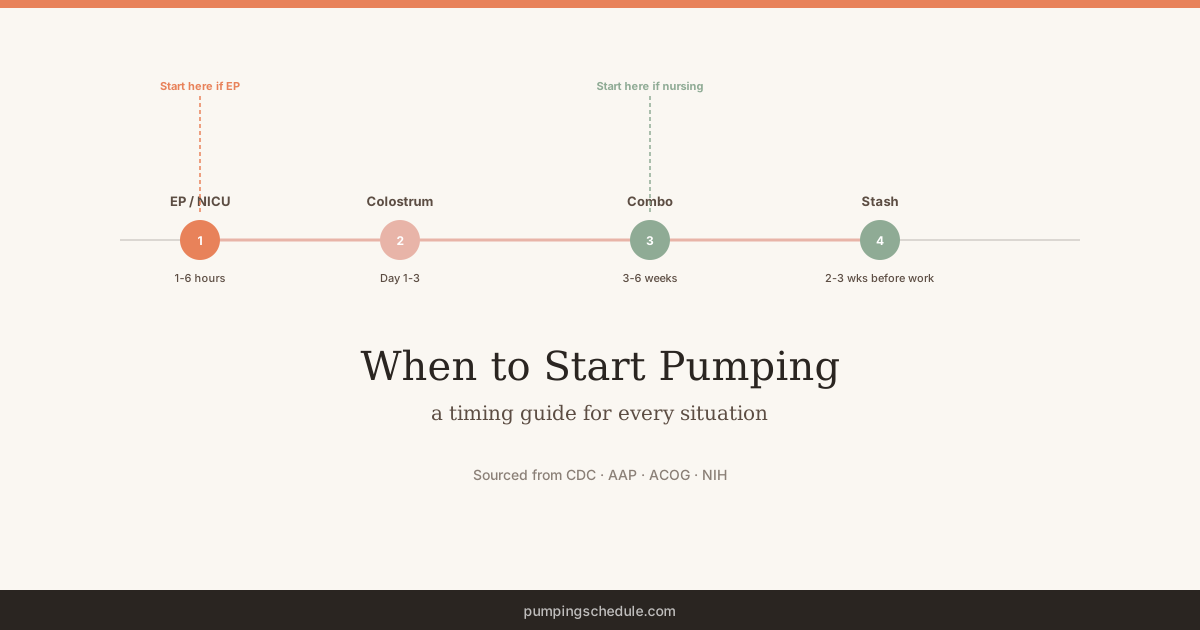
Start within 1-6 hours of delivery. If your baby will not be nursing directly — because of latch failure, anatomical issues, personal choice, or medical circumstances — your pump becomes the demand signal. The clock starts at birth. (If your pediatrician has you triple feeding first, the pump step is already baked in.)
In the first 24-48 hours, hand expression is often more effective than a pump for collecting colostrum. Those initial golden drops come in tiny volumes (5-7 mL per session is normal), and a pump's suction is not designed for the thick, sticky consistency of colostrum. The CDC recommends beginning to pump within 6 hours of birth if the baby is not breastfeeding. Once your milk transitions (typically day 3-5), switch to your electric pump.
Aim for 8-12 sessions in 24 hours during the first two weeks — yes, that includes overnight. Prolactin peaks between 1 AM and 5 AM, and those middle-of-the-night sessions are your most productive, even when they feel like the least. Our night pumping guide covers how to make them survivable.
Your newborn pumping schedule has week-by-week session counts, expected output, and when you can safely start dropping sessions. Most EP moms settle into 7-8 sessions by week 4 and begin tapering toward 5-6 sessions by month 3 — see our exclusive pumping schedule for the full timeline.
When to Start Pumping If You Are Breastfeeding and Pumping
Wait until 3-6 weeks postpartum. If your baby is latching well, gaining weight, and nursing 8-12 times per day, there is no rush. Your baby is your pump — and a more efficient one than anything Spectra or Medela makes.
Adding a pump session before breastfeeding is established creates two risks:
- Oversupply. Your body reads the extra removal as demand for more. Oversupply sounds like a nice problem until you are dealing with engorgement every 3 hours, recurring clogged ducts, and a baby choking on a fire-hose letdown.
- Nipple confusion (or preference). Bottles deliver milk faster than breasts. Some babies figure this out quickly and start refusing the breast in favor of the bottle — not ideal when nursing is still your primary feeding method.
The 3-6 week mark is when most lactation consultants give the green light. The AAP supports introducing a bottle of expressed milk once breastfeeding is well-established, both to build a small stash and to let a partner share feeding duties. Start with one session after your first morning feed — output tends to be highest before 10 AM — and see how your supply responds before adding more.
For detailed scheduling, our breastfeeding and pumping schedule walks through combo timing by age. And if you are not sure whether your supply is ready for the added demand, check the signs of established milk supply.
NICU Pumping: When to Start
Immediately — within 1-6 hours of delivery. If your baby is in the NICU, your milk is medicine. Colostrum contains concentrated immunoglobulins and white blood cells that premature babies need, and the NICU team will likely encourage you to start hand-expressing within the first hour if you are able.
Most NICUs provide hospital-grade pumps (the Medela Symphony is the standard) at your baby's bedside or in a dedicated pumping room. These are rental-grade machines designed for mothers who need to establish supply entirely through pumping — they are more effective at milk removal in the early days than personal-use pumps.
Pump 8-10 times per day, including at least once between 1-5 AM. Even if you collect only drops in the first 48 hours, the stimulation matters — you are building prolactin receptors that will drive your supply for months. Our 1-week pumping schedule and 2-week schedule cover this stage in detail.
“The NICU nurses handed me a pump kit before I even got out of recovery. I remember thinking, I do not know how to use this. Turns out, nobody does at first — you figure it out.” (paraphrased from r/NICUParents, 2024)
Building a Stash Before Returning to Work
Most working moms need 12-16 ounces stored before their first day back — roughly three to four feedings worth. The CDC suggests practicing with your pump and storing extra milk 2-3 weeks before your return date.
The simplest approach: add one pumping session per day, ideally after your first morning feed. Most moms yield 2-4 extra ounces per session. Over two weeks, that is 28-56 ounces in the freezer — more than enough to cover a full day of daycare plus a small buffer.
Do not try to build a massive freezer stash. Instagram photos of freezers packed with 500 ounces of labeled bags are aspirational content, not medical guidance. A 2-3 day buffer is practical. Anything beyond that and you are spending time pumping that you could be spending with your baby before you go back. Store your milk properly using our breast milk storage guidelines — or use the storage calculator to check if a specific bag is still safe.
Our pumping at work guide covers exactly how to structure your sessions once you are back — and your PUMP Act rights to break time and a private space.
Collecting Colostrum Before Birth
Prenatal colostrum collection — hand-expressing colostrum in late pregnancy and freezing it in syringes — has gained popularity over the past few years, especially among moms planning for C-sections, gestational diabetes, or known latch challenges.
The window opens at 37 weeksfor most low-risk pregnancies. Before 37 weeks, nipple stimulation carries a small risk of triggering contractions — always get your provider's go-ahead first. ACOG's breastfeeding guidance supports colostrum collection in appropriate clinical contexts.
Use hand expression, not a pump — colostrum is too thick and low-volume for a pump to extract efficiently. Collect into 1 mL or 3 mL syringes (your hospital or midwife may provide them), cap, label, and freeze immediately. Even 5-10 mL stored before delivery can be meaningful for a baby who needs supplementation in the first 24 hours.
Expect drops, not streams. A “good” prenatal collection session might yield 0.5-2 mL. That feels like nothing until your NICU nurse tells you that 1 mL of colostrum is considered a clinically significant dose for a newborn. Our prenatal colostrum collection guide walks through the full technique, storage protocol, and hospital bag prep. For the broader safety picture — including why hand expression beats an electric pump during pregnancy — see our pumping while pregnant guide.
Common Timing Mistakes
Every lactation consultant has a short list of patterns they see repeatedly. Here are the most common:
- Starting too early while nursing.You pump on day 2 “just to have some extra,” your body interprets it as twin-level demand, and by week 2 you are engorged every 3 hours with a forceful letdown that makes your baby sputter. Solution: wait until 3-6 weeks if breastfeeding is going well.
- Starting too late while EP.You planned to pump from the start but only managed 4-5 sessions per day in the first week because nobody told you it should be 8-12. By week 6, supply is plateaued below your baby's needs. Solution: aim for 8-12 sessions from day 1 if you are not nursing. Read how often to pump for the frequency science.
- Wrong flange size. You unbox the pump, attach the flanges that came in the box, and pump through pain for two weeks before learning that 90% of women need a different size than the stock 24mm. Our flange size guide saves you from this one.
- Skipping night sessions. Prolactin peaks between 1-5 AM. Dropping the overnight pump feels necessary for survival, but doing it in the first 12 weeks — before supply is established — sends a permanent signal to produce less. Hold the MOTN session until your supply is stable, then taper.
- Chasing a freezer stash instead of feeding the baby. A 200-ounce freezer stash at 2 weeks postpartum means you pumped 200 ounces more than your baby needed — and your body is now calibrated to that inflated demand. A 2-3 day buffer is the goal, not a deep freeze full of milk you may never use.
Equipment for Your First Pumps
You do not need much to start, but what you do need matters. Here is the short list:
- A double electric pump. The Spectra S1 or S2 are the workhorses most EP moms start with — closed system, adjustable suction, and insurance-covered through most plans. If you want hands-free, the Elvie Stride or Momcozy M5 let you move around, but they trade some suction power for portability.
- Correctly sized flanges. Measure before you pump. The flanges in the box are almost certainly 24mm, which fits a minority of women. Our flange size guide has a printable ruler and a visual sizing walkthrough.
- Storage containers. Breast milk bags (Lansinoh, Kiinde) for freezer stash, or hard-sided bottles for fridge rotation. See our storage guidelines for the full comparison.
- Nursing pads. Letdown does not wait for your pump to be ready. Disposable or washable — either works.
- A hands-free pumping bra. Not glamorous, not optional. Holding flanges in place for 20 minutes while trying to eat breakfast or text with one thumb is a recipe for spilled milk and actual tears.
Skip the extras for now. Nipple cream, flange inserts, a pumping bag, a drying rack — all useful eventually, all optional on day one. Start with pump, flanges, and containers. Our pumping essentials checklist walks through every category so you know what to buy first and what to add later.
Last reviewed: August 2026 by the Pumping Schedule Editorial Team. Read our editorial standards.
Related Reading
- Newborn Pumping Schedule — week-by-week session counts from birth through 4 weeks
- Exclusive Pumping Schedule — full EP timeline from newborn to 12+ months
- Pumping Schedule to Increase Milk Supply — what to do if your supply is not where you want it
- Breast Milk Storage Guidelines — how long milk is good at room temp, fridge, and freezer