What fit — what Jen hadn't even known existed until a NICU nurse mentioned it — was exclusive pumping. Feeding her baby breast milk, every ounce of it, without ever putting baby to breast.
If you are reading this because nursing did not work, or because you chose pumping deliberately, or because you landed somewhere in between and the internet keeps telling you to “just try harder” — this is the page that explains what exclusive pumping actually is, how it works, and what to realistically expect.
What Exclusive Pumping Actually Means
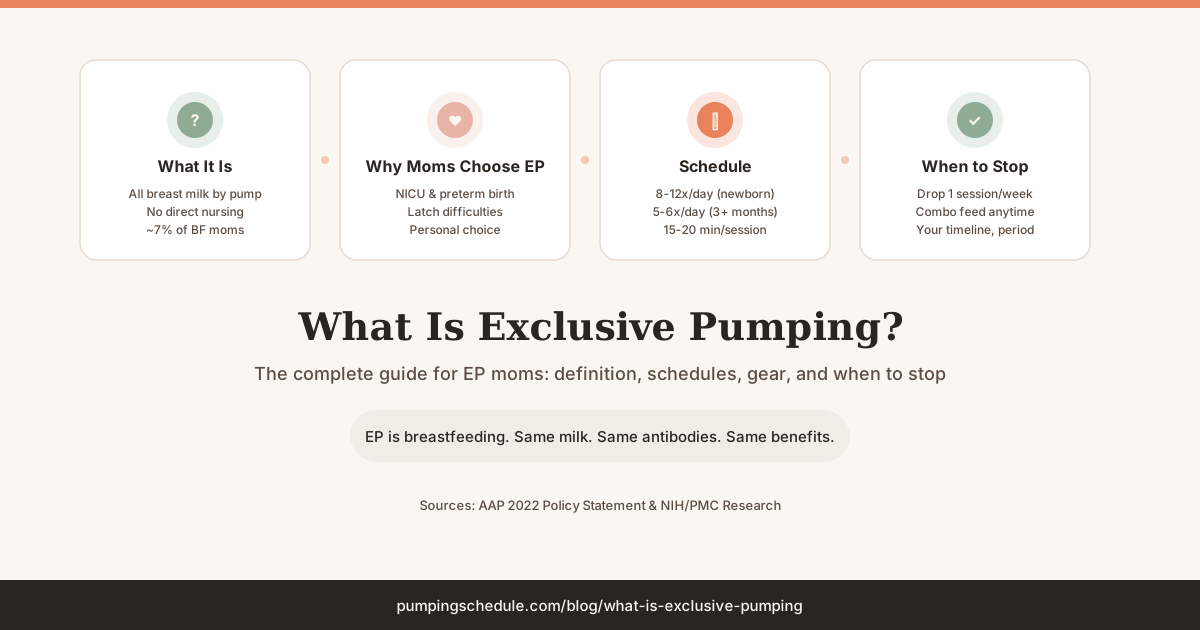
Exclusive pumping means you express all of your breast milk with a pump and feed it to your baby by bottle. You do not nurse for meals. Your baby gets breast milk — just not directly from the breast.
The medical community sometimes calls it “exclusive milk expression” or “pump-dependent lactation.” Most moms call it EP.
One thing that confuses people: exclusive pumping does not mean you cannot supplement with formula. Many EP moms combo-feed. The “exclusive” refers to how the milk leaves your body (pump, not latch), not whether breast milk is the only thing your baby drinks.
EP is breastfeeding. The AAP's 2022 policy statement on breastfeeding makes no clinical distinction between breast milk delivered at the breast and breast milk delivered by bottle. The antibodies, fat content, and immune factors are identical regardless of the delivery method.
About 6.9% of breastfeeding mothers in the U.S. pump exclusively — though the real number is likely higher, since many EP moms stop before getting counted in feeding surveys. Over 85% of lactating women in the U.S. express milk at some point.
Why Moms Choose to Exclusively Pump
Nobody grows up planning to exclusively pump. It is almost always a response to something — and the reasons are as varied as the moms doing it.
Medical reasons are the most common entry point. In one study, 52% of exclusive pumpers delivered preterm, and 58% had babies admitted to the NICU. When your baby is in an incubator connected to monitors, a pump is the only way to give them your milk.
Other medical triggers include:
- Cleft lip or palate making latch physically impossible
- Tongue or lip ties that weren't caught early enough
- Nipple damage so severe that direct nursing became unsustainable
- Breast surgery that altered milk duct pathways
Latch failureis the reason you hear most in online communities. You tried the football hold, the cross-cradle, the nipple shield, the three different lactation consultants. The baby screamed. You cried. Eventually someone said “have you considered just pumping?” and something clicked.
Personal choice is the reason people talk about least but is completely valid. Some moms want to know exactly how many ounces their baby is getting. Some want a partner to share night feeds from day one. Some tried nursing, decided it was not for them, and chose a path that still provided breast milk. None of these reasons need defending.
Work logisticspush some moms toward EP, especially those returning to work early. When you are already pumping eight hours a day at the office, adding nursing sessions at home starts to feel redundant. The pump becomes the whole system. As one working mom put it: “I didn't choose EP. I chose my job. EP chose me” (paraphrased from r/workingmoms).
How to Start Exclusive Pumping
If you are starting from birth — either by choice or because circumstances decided for you — the first 12 weeks set the ceiling for your long-term supply.
The first 72 hours:Start pumping within 1–2 hours of delivery, even if you only get drops of colostrum. Colostrum is concentrated — those tiny amounts matter. Pump every 2–3 hours around the clock, including overnight. Yes, that is 8–12 sessions per day. It is relentless, and it is temporary.
Weeks 1–4:Maintain 8–10 sessions per day. Your body is calibrating — it does not yet know if it is feeding one baby or three, so frequent removal is the signal. The CDC recommends pumping as often as your baby would feed at the breast. The middle-of-the-night pump (MOTN) is not optional in this window. Prolactin peaks between 1–5 AM, making it your most productive session.
Weeks 5–12:Most moms can consolidate to 7–8 sessions as supply stabilizes. You will know your supply is regulating when output becomes more predictable session to session.
After 12 weeks:Supply is typically established. Many EP moms taper to 5–6 sessions without losing volume. This is the light at the end of the tunnel that gets you through weeks 2–8. (And it is a real light — not just something people say to keep you going.)
For a detailed week-by-week breakdown, see our exclusive pumping schedule by age.
What You Actually Need
The internet will try to sell you a hundred accessories. Here is what actually matters:
Non-negotiable:
- A double electric pump — hospital-grade if your insurance covers it, personal-use if not. The Spectra S1 is the workhorse most EP moms swear by for home use. If you need portability for work or travel, a wearable like the Elvie Stride lets you pump during meetings without anyone knowing.
- Correctly sized flanges — wrong size causes pain and tanks output. Our flange size guide has measuring instructions and brand-by-brand size charts.
- Bottles and a bottle warmer
- Breast milk storage bags for freezer stash
Nice to have:
- A hands-free pumping bra (turns you from a statue into a person who can eat, scroll, or hold a baby)
- Extra pump parts so you are never one cracked valve away from a crisis. (Ask any EP mom what she fears more: a flat tire or a broken duck valve. The answer will disturb you.)
- A portable pump for leaving the house
For the full list with specific product picks, see pumping essentials.
How Often and How Long to Pump
The short answer: 8–12 times per day in the beginning, tapering to 4–6 times by 6 months.
| Stage | Sessions/Day | Duration | Gap Between Sessions |
|---|---|---|---|
| Weeks 1–4 | 8–12 | 15–20 min | Every 2–3 hours |
| Weeks 5–12 | 7–8 | 15–20 min | Every 3 hours |
| 3–6 months | 5–6 | 20–25 min | Every 3.5–4 hours |
| 6–12 months | 4–5 | 20–30 min | Every 4–5 hours |
Pump until your breasts feel soft and milk flow has slowed to a trickle — then go another 2–5 minutes to trigger a second letdown. La Leche League's expressing guide recommends pumping “until your milk stops spraying, and then for an additional five minutes.” The clock matters less than emptiness. Some moms are done in 12 minutes. Some need 30.
The CDC's pumping guidance recommends matching your pumping frequency to how often your baby feeds. For most exclusively pumped babies, that is 8–12 feedings in 24 hours during the newborn period.
For a full breakdown by age with sample daily timelines, see how often to pump.
Is Exclusive Pumping as Good as Nursing?
Nutritionally, yes. The milk is the same milk.
The AAP's 2022 policy statement confirms that expressed breast milk contains the same antibodies, nutrients, and immunological properties as milk consumed at the breast. Your baby gets the same protection against infections, the same gut microbiome benefits, the same caloric content.
Where the two diverge is not nutrition — it is logistics and hormones. Direct nursing triggers a stronger oxytocin response in most mothers. EP moms often report lower breastfeeding satisfaction scores in studies, not because the milk is worse, but because the process is harder.
There are also some practical differences:
- Bottle feeding carries a slight overfeeding risk — babies can drink from a bottle faster than from the breast. Paced bottle feeding (holding the bottle horizontal, pausing every few sucks) solves this.
- Supply regulation requires more vigilance— nursing babies adjust demand automatically; pumps cannot. You need to track output and adjust sessions proactively.
- The time commitment is roughly double— you pump, then you feed, then you wash parts, then you store milk. Nursing moms do one step. You do four. (Five if you count staring at the output line on the bottle and deciding how you feel about it.)
None of this makes EP worse. It makes it different — and harder in specific ways that deserve acknowledgment, not dismissal.
The Parts Nobody Warns You About
Exclusive pumping is feeding your baby plus an unpaid part-time job. The logistics alone are staggering: 8 pumping sessions × 20 minutes pumping × 10 minutes setup/cleanup = roughly 4 hours of pump-related work per day in the early months. That is before you feed the baby, wash bottles, or do anything else a human does.
The isolation is real.You do not fit neatly into breastfeeding groups (because you are not nursing) or formula groups (because you are not using formula). EP communities on Reddit — especially r/ExclusivelyPumping — exist because nowhere else quite gets it. One mom there described the feeling: “Nursing moms feed the baby. I feed the pump, then feed the baby, then wash the parts, then do it again three hours later. Nobody sees the middle step” (paraphrased from r/ExclusivelyPumping).
The duration gap is sobering. Research shows EP moms produce milk for a median of 56 days, compared to 228 days for moms who nurse directly. That is not a failure stat — it reflects how much harder it is to sustain, not how much less these moms tried.
Burnout is predictable, not a surprise.If you hit a wall at month 2–3, you are right on schedule. Our guide to EP burnout and what helpscovers this in depth — including when hating pumping might actually be D-MER or postpartum depression rather than ordinary exhaustion.
If you are in the thick of it right now: every ounce you pumped already counted. The goal was never “pump for exactly 12 months.” The goal was to feed your baby in a way that worked for both of you.
When to Adjust, Scale Back, or Stop
Dropping sessions:After 12 weeks with a stable supply, you can start dropping one session every 5–7 days. Start with your lowest-output pump. Track daily totals for a week — if volume holds, the drop stuck. If it dips more than a couple ounces, bring that session back and try again in 2–3 weeks. Our guide to dropping pumping sessions has the full protocol.
Combo feeding: Adding formula does not mean you failed at exclusive pumping. It means you are feeding your baby. Many EP moms settle into a rhythm where they pump what they pump, supplement the rest, and stop white-knuckling every ounce.
Stopping entirely:When you are ready — whether that is 3 weeks, 3 months, or 12 months — drop one session every 5–7 days. Do not go cold turkey (engorgement, mastitis, misery). Our weaning from pumping schedule walks you through it week by week.
Your pumping journey ends when you decide it does. Not when the internet says, not when your mother-in-law has an opinion, and not when some arbitrary milestone passes. You.
Related Reading
- Exclusive Pumping Schedule by Age — session counts and timing from newborn through 12 months
- How to Increase Milk Supply While Pumping — evidence-based strategies when output plateaus
- Pumping Schedule Generator — build a custom schedule in 30 seconds
- Signs of Established Milk Supply — how to know your supply has regulated