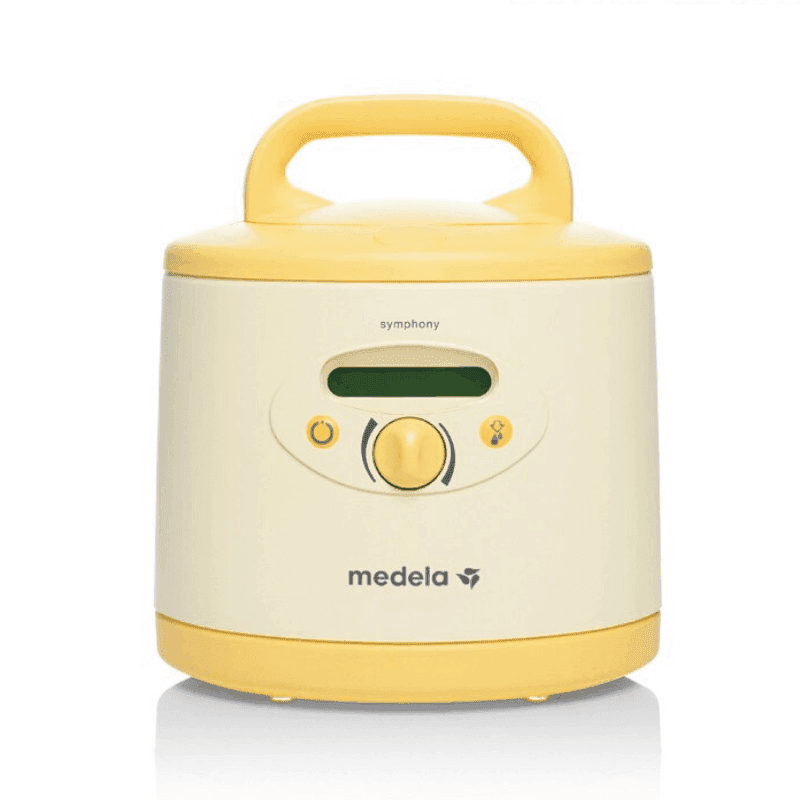
Three in the morning, fluorescent lights humming, your baby across the hall in a plastic box with wires. A nurse hands you flanges and points at the beige pump bolted to the wall shelf. “Twenty minutes each side.” That's how most moms meet the Medela Symphony — not through a review site, not through an Instagram ad, but through a NICU that chose it for a reason.
The Symphony has been the default hospital pump for over two decades. More NICUs run Symphonys than any other brand.
But “hospitals use it” and “you should rent it at home” are two different claims. Below: what this pump actually does, what it costs, and who genuinely benefits from bringing one home.
What Is the Medela Symphony?
A double electric, FDA-cleared, multi-user hospital-grade breast pump — one of only three with that FDA designation (alongside the Ameda Platinum and Ameda Elite). Each mom buys her own accessory kit; the pump motor is shared because it's a fully closed system. Milk never contacts the motor or internal tubing.
Two versions exist. The standard Symphony runs 2-Phase Expression: fast stimulation cycles to trigger letdown, then slower expression cycles to extract milk. The Symphony PLUSadds Medela's patented Initiation Technology — a third program card that mimics the irregular sucking patterns of a newborn during the first days of life. More on that below.
The pump weighs about 8.4 pounds. It is not going in your diaper bag. It's not going to Starbucks. (For context, it weighs about as much as the newborn who got you into this situation.) It sits on your nightstand or kitchen counter, plugged into the wall, and does one job extremely well: pulling milk out of your body with the kind of consistent, research-backed vacuum patterns that personal pumps approximate but don't replicate.
Key Specs and What You Get
The Symphony is a rental pump, so “what ships in the box” is really “what your rental provider hands you.” The pump motor arrives; everything else, you buy separately.
| FDA Status | Class II medical device, FDA-cleared as multi-user |
|---|---|
| Price (Purchase) | $1,800–$2,000 (rarely worth buying) |
| Price (Rental) | $70–$100/month; $35–$40/week |
| Weight | ~8.4 lbs (with rechargeable battery version) |
| Max Suction (Claimed) | Up to 300 mmHg |
| Max Suction (Reported) | ~250 mmHg (PumpingMilk.com) / ~265 mmHg (Genuine Lactation) |
| Modes | 2-Phase Expression + Initiation Technology (Symphony PLUS) |
| Cycle Speed | 52–78 cycles per minute (stimulation); slower in expression |
| Flanges Included | None — personal accessory kit purchased separately ($40–$60) |
| Compatible Flanges | Medela PersonalFit PLUS: 21mm, 24mm, 27mm, 30mm, 36mm |
| Battery | AC adapter standard; rechargeable battery version available (~60 min) |
| Noise | Quieter than Pump In Style — library-level hum |
| System Type | Closed system, multi-user (hygienic barrier) |
| Connectivity | None (no app or Bluetooth) |
| Warranty | N/A for renters — maintained by rental provider |
| Accessory Kit Includes | 2 PersonalFit PLUS flanges, 2 connectors, 2 bottles (150 mL), tubing, membranes, valves |
The personal accessory kit runs $40–$60 and includes flanges, connectors, bottles, tubing, valves, and membranes. You'll replace membranes and valves every 2–4 weeks with daily use — same as any Medela pump. Budget roughly $15–$20 per month for replacement parts on top of the rental fee.
One quirk: the Symphony uses PersonalFit PLUS flanges, not the PersonalFit Flex flanges from the Pump In Style. Same brand, different geometry. The PLUS flanges sit at a standard 180-degree angle (straight out), while the Flex flanges tilt at 105 degrees. If you're switching between a Symphony and a Pump In Style, the flange feel will be different even at the same millimeter size.
What “Hospital Grade” Actually Means
Marketing has diluted this term into meaninglessness. Pump brands slap “hospital-grade suction” on personal pumps that have never been inside a hospital. Here's what the designation actually requires:
FDA multi-user clearance. The pump must be tested and cleared by the FDA as safe for use by multiple mothers, with each user supplying her own accessory kit. The motor and internal components are designed to prevent cross-contamination. Currently, only three pumps hold this clearance: Medela Symphony, Ameda Platinum, and Ameda Elite. A 2016 review in the International Breastfeeding Journal argued that pump selection should be individualized based on dependency level — the longer and more intensive the pumping need, the more the pump's effectiveness and comfort matter.
Durability for continuous operation.Hospital-grade pumps are engineered for thousands of hours of use across years of service. The Symphony uses an internal belt-driven mechanism rather than the direct-drive motors in personal pumps — that's why it weighs 8 pounds instead of 2. The belt system delivers smoother suction ramp-up and release, which is part of why the pumping experience feels different from a personal pump. One IBCLC describes it as “the suction wraps around you instead of grabbing at you.”
What it does NOT mean:“hospital grade” doesn't automatically mean stronger suction. The BabyBuddhaat 6.8 ounces pulls ~290 mmHg — possibly more raw suction than the Symphony. Hospital grade means consistent, research-validated vacuum patterns delivered over thousands of hours without performance degradation. Raw peak suction is one variable among many.
Three pumps have the clearance. The Medela Symphony is the one your NICU almost certainly uses.
Pumping Performance: The Symphony Difference
The Medela Symphony's suction numbers are more honest than most. Medela claims up to 300 mmHg. Independent reviewers measure 250–265 mmHg — a narrower gap than the Pump In Style (160–230 mmHg against a 295 mmHg claim).
But suction numbers miss the point of this pump. The Symphony's real advantage is vacuum pattern, not vacuum strength. Research on breast shield geometry and expression efficiency shows that cycle speed, vacuum curve shape, and the transition between stimulation and expression phases all affect output independently of peak suction.
The Symphony PLUS adds Initiation Technology — a third program that mimics the irregular, rapid sucking of a newborn during colostrum feeding in the first 72 hours. The theory: matching those patterns helps “program” the breasts for higher long-term production when a baby can't feed directly.
Is it marketing or medicine? Somewhere in between. Medela has funded clinical studies supporting the approach, and NICUs worldwide use it based on those results. But the research is largely Medela-funded, and independent replication is thin. What's not debatable: the Symphony's overall effectiveness at early supply establishment is documented across thousands of NICU programs. Whether Initiation Technology specifically deserves credit or the pump's general performance does remains an open question.
Sessions run 15–20 minutes. The 2-Phase Expression auto-switches from stimulation to expression after two minutes (or manually once you feel letdown). And the Symphony operates almost silently — a “library-level hum” versus the 58–59 dB motorboat impression the Pump In Style delivers. If noise was your least favorite part of pumping, the Symphony will feel like a different brand entirely. (Your partner might actually sleep through a midnight session. Whether you tell them is between you and your pump.)
The Rental Math: What It Actually Costs
This is where the Medela Symphony conversation gets real. The pump works. The question is whether the cost structure makes sense for your timeline.
Rental rates:$70–$100 per month through most providers (Aeroflow, Edgepark, hospital rental programs, local lactation centers). Some offer weekly rates at $35–$40. Three-month packages typically run $210–$300. Add the personal accessory kit ($40–$60 upfront) and replacement parts ($15–$20 per month).
Total cost by duration:
- 4 weeks:~$130–$170 (rental + kit)
- 8 weeks:~$200–$270
- 3 months:~$280–$380
- 6 months:~$500–$680
- 12 months:~$900–$1,300
For comparison: a Spectra S1costs $160–$225 once and you own it. A BabyBuddharuns $205–$230. The break-even point where renting a Symphony costs more than buying a personal pump is roughly 8–10 weeks. Past that, you're paying a premium for the privilege of borrowing.
Insurance coverage:Unlike personal pumps (which are broadly covered under the ACA), hospital-grade rental coverage is not guaranteed. Most plans require a physician's prescription documenting medical necessity — NICU admission, premature birth, diagnosed low supply, or specific medical conditions affecting lactation. If you qualify, insurance may cover part or all of the rental.
The practical move: call a DME supplier like Aeroflow or Edgepark before your due date (or as soon as your baby is admitted to the NICU). Give them your insurance info, your OB's name, and the reason you need hospital-grade. They handle the prior authorization paperwork and tell you within a few days what your plan covers. Even partial coverage — say, $50 of a $90 monthly rental — changes the math entirely.
NICU Moms: The Symphony's Core Use Case
If your baby is in the NICU, the Symphony isn't optional equipment — it's the standard of care. Here's why.
When a baby can't feed directly at the breast, pumping within the first hour after delivery (and every 2–3 hours after) is critical for establishing supply. The feedback loop between emptying the breast and prolactin production is time-sensitive — the first 72 hours set the trajectory for weeks and months ahead. A pump that extracts milk efficiently during this window directly affects long-term supply.
The Symphony was designed for exactly this scenario — its pump patterns are optimized for the physiology of early lactation, whether you're pumping colostrum drops into syringes or building volume for bottles.
Practical setup: most hospitals provide the Symphony at bedside at no charge during your stay. When you go home — and your baby stays — that's when the rental kicks in. Arrange the home rental beforedischarge. You don't want a gap between hospital pumping sessions and home pumping sessions. Even 12 hours without emptying during the first week can signal the body to reduce production. Ask the NICU social worker or your lactation consultant about rental logistics before discharge day.
One DC-area mom described the transition on her blog: “I rented the Symphony for the first three months to build up my supply. When I went back to work, I needed something lighter and switched to the Spectra S1. Took two weeks to find my settings, but once I did, I never looked back.” — paraphrased from a mom's pump comparison blog, 2024
Symphony vs Spectra S1 vs BabyBuddha
A hospital-grade rental versus two personal pumps you'd own outright. Different categories, but moms compare them constantly — especially when deciding whether to rent, buy, or both.
| Feature | Medela SymphonyBest for: supply establishment | Spectra S1Best for: long-term EP | BabyBuddha 2.0Best for: on-the-go power |
|---|---|---|---|
| Price | $70–$100/mo rental | $160–$225 (own it) | $205–$230 (own it) |
| Weight | ~8.4 lbs | 3.3 lbs | 6.8 oz |
| Max Suction (Reported) | ~250–265 mmHg | ~270 mmHg | ~290 mmHg |
| Noise | Quiet (library-level) | <45 dB | 42–60 dB |
| Battery | AC standard; rechargeable option | Rechargeable (~3 hours) | Rechargeable (~60 min) |
| Flange Range | 21–36mm (PersonalFit PLUS) | 24–28mm (inserts available) | 13–24mm (with inserts) |
| System Type | Multi-user closed | Single-user closed | Single-user closed |
| Best For | NICU, supply initiation, first 4–12 weeks | Daily EP, portable home use | Maximum portable suction |
The Symphony wins on vacuum consistency, noise, and research-backed programming for supply establishment. It loses on portability (8 pounds, wall outlet) and cost structure (ongoing rental vs. one-time purchase). The Spectra S1is the best long-term EP pump for most moms — our S1 vs S2 comparison covers whether the battery is worth the price premium. The BabyBuddha has the highest portable suction (~290 mmHg at 6.8 ounces).
The pattern that experienced EP moms and lactation consultants recommend: rent the Symphony for weeks 1–8 (supply establishment), then transition to a Spectra or BabyBuddha you own for the rest of your pumping journey. Two pumps, two jobs.
When Renting Makes Sense (and When It Doesn't)
Rent the Symphony if:
- Your baby is in the NICU and you need to establish supply without direct feeding. This is the pump's primary design purpose.
- You're in the first 4–8 weeks postpartum and struggling with supply on a personal pump. Your IBCLC may recommend a short-term hospital-grade rental to boost production before transitioning back.
- You have a diagnosed medical condition affecting lactation (hormonal issues, breast surgery history, PCOS-related supply challenges) where an IBCLC specifically recommends hospital-grade suction.
- Your insurance covers the rental — making the cost comparison with personal pumps irrelevant.
Skip the rental if:
- Your baby latches well and your supply is establishing normally. A personal pump (free through insurance) handles occasional pumping and combination breastfeeding and pumping without the rental overhead.
- You need portability. The Symphony doesn't leave the house. If you're pumping at work, you need a portable pump regardless — and renting a Symphony on top of that doubles your pump budget.
- You plan to exclusively pump for 6+ months and don't have insurance covering the rental. The math doesn't work — buy a Spectra S1 for $180 and invest the savings in supply-boosting strategies that don't carry monthly fees.
A lactation educator summed it up well: “The majority of moms do not need to rent a hospital-grade pump to have a successful pumping journey. But for the moms who do need one — NICU, premature, multiples, undersupply — it can make a world of difference.” — paraphrased from a lactation center rental guide, 2025
Common Problems and How to Fix Them
Rental pump issues hit different than personal pump issues — you're troubleshooting equipment you don't own, and downtime means missed sessions. Most Medela Symphony problems trace back to accessories, not the motor.
Weak suction or declining output.Before blaming the pump: check your personal accessories. Membranes wrinkle, valves wear out, tubing connections loosen. Replace membranes and valves every 2–4 weeks with daily EP use. If fresh parts don't fix it, call your rental provider — the motor may need servicing or replacement.
Legitimate rental companies maintain their fleet. That's what your rental fee covers.
Flange fit.The Symphony uses PersonalFit PLUS flanges — not the PersonalFit Flex from the Pump In Style. Standard kit ships with 24mm. If you've been sized for a different pump, re-measure: nipple diameter in millimeters, plus 2–3mm. Medela PLUS flanges come in 21mm, 24mm, 27mm, 30mm, and 36mm. Our flange size chart covers how to measure. For smaller sizes, look at Pumpin Pals or BeauGen inserts.
Noise changes.Clicking, grinding, or rattling means the internal belt mechanism needs professional attention. Do not open the motor housing — that voids the rental agreement and potentially the FDA clearance. Call your rental provider for a replacement unit.
Condensation in tubing.Run the pump dry for 1–2 minutes after each session with the flanges detached. If milk has entered the tubing, the membrane seal is compromised — replace the membrane and the tubing immediately. The closed-system barrier is only as good as the membrane maintaining it.
Who Should (and Shouldn't) Rent It
Overall score
out of 10
What we like
- FDA-cleared multi-user pump — the real meaning of 'hospital grade'
- Research-backed 2-Phase Expression with Initiation Technology (PLUS model)
- Near-silent operation — dramatically quieter than personal pumps
- Consistent suction delivery across thousands of hours of use
- Used in NICUs worldwide — the default pump for supply establishment
- Closed system ensures hygiene across multiple users
- Insurance may cover rental with a medical necessity prescription
What could be better
- Not portable — 8.4 lbs, wall outlet required (standard version)
- Ongoing rental cost ($70–$100/mo) adds up quickly past 8–10 weeks
- Personal accessory kit purchased separately ($40–$60)
- No smart features — no app, Bluetooth, or session tracking
- Flange range narrower than Pump In Style (21–36mm vs 15–36mm)
- You never own it — return it when you're done
- Insurance coverage for rental requires documented medical necessity
Related Reading
- Medela Pump In Style Review — The Data Nobody Talks About
- Spectra S1 Review — The EP Mom's Workhorse
- Spectra S1 vs S2 — One Real Difference
- Best Hospital Grade Breast Pumps (2026)
- Newborn Pumping Schedule — Birth Through 4 Weeks
- Exclusive Pumping Schedule by Age
- How to Increase Milk Supply While Pumping