
You're looking at two Eufy breast pumps on the same website, trying to figure out what $110 buys you. Every comparison buries the answer under feature tables and affiliate disclaimers. Here it is, first paragraph.
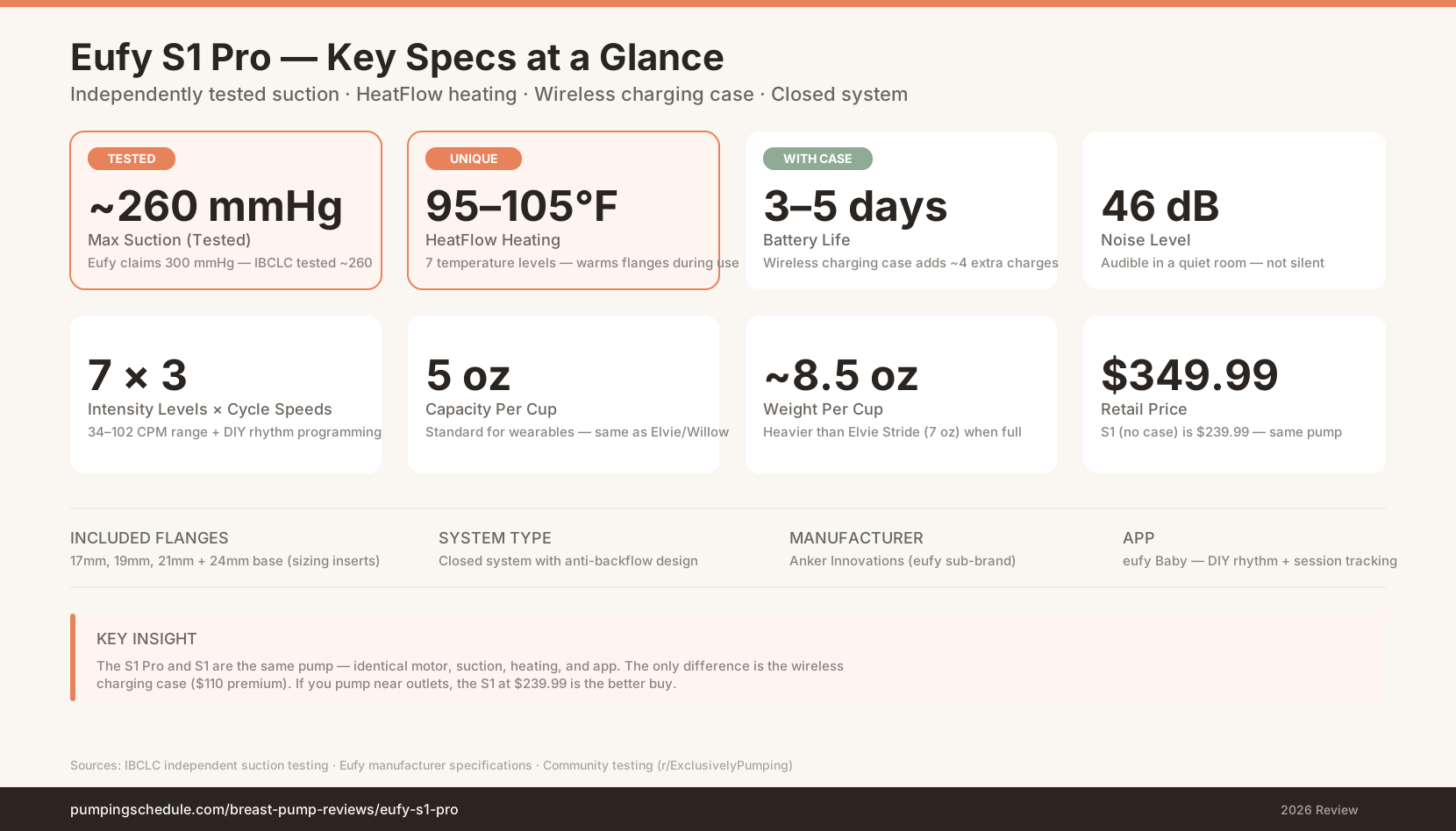
The Eufy S1 vs S1 Pro decision comes down to one thing: a wireless charging case. Same motor. Same suction. Same heating. Same app. The S1 Pro costs $349.99 for a magnetic case that charges your pump between sessions. The S1 costs $239.99 and charges via USB-C. That's the whole comparison.
The Short Answer
If you pump at home or near outlets: get the S1 at $239.99 (or free through insurance). Plug in between sessions. Spend the $110 on replacement parts — you'll need them.
If you pump at work, commute, or travel regularly: the S1 Pro's charging case turns a “charge after every few sessions” pump into a “charge once every few days” pump. For working moms doing three to four sessions during a workday, that difference is the gap between “fine” and “never thinking about the battery.”
What Eufy S1 and S1 Pro Share
Everything that matters for pumping performance is identical between these two models. This is not a Spectra S1 vs S2 situation where the specs are the same but you're comparing portable to tabletop — the Eufy S1 and S1 Pro are the same wearable pump in the same form factor.
- Suction: Up to 300 mmHg claimed, ~260 mmHg in independent IBCLC testing. Seven intensity levels, three cycle speeds. Identical motor.
- Heating:HeatFlow with seven temperature levels (95–105°F). Same smart sensor checking temperature every three seconds. Same heating in both models.
- Noise: 46 dB. Same motor, same noise.
- App: eufy Baby app with DIY rhythm programming, per-side control, four preset modes, heat control. Identical software experience.
- Flanges: 24mm default with 17mm, 19mm, and 21mm inserts included. Same parts, same sizes, fully cross-compatible.
- Capacity: 5 oz (150 ml) per cup. Same cups.
- System type: Closed system with double seal, BPA-free food-grade materials.
If the charging case disappeared from the S1 Pro box, you would have two identical breast pumps at different prices.
Key Specs Side by Side
| Motor | Identical in both models |
|---|---|
| Max Suction (Claimed) | 300 mmHg (both) |
| Max Suction (Tested) | ~260 mmHg (both) |
| Suction Levels | 7 (both) |
| Cycle Speeds | 3: slow, medium, fast (both) |
| Heating | HeatFlow™ 7 levels, 95–105°F (both) |
| Noise | 46 dB (both) |
| Capacity | 5 oz / 150 ml per cup (both) |
| System Type | Closed system, double seal (both) |
| Flanges | 24mm + 17/19/21mm inserts (both) |
| App | eufy Baby with DIY rhythms (both) |
| Warranty | 12 months pump, 3 months parts (both) |
| Charging | S1: USB-C cable | S1 Pro: Wireless case + USB-C |
| Battery Life | S1: 4–6 sessions | S1 Pro: 3–5 days (with case) |
| Retail Price | S1: $239.99 | S1 Pro: $349.99 |
| Insurance | S1: Often $0 | S1 Pro: Upgrade fee likely |
| Feature | Eufy S1 ProBest for: all-day battery | Eufy S1Best for: value | Elvie StrideComparison context |
|---|---|---|---|
| Price | $349.99 | $239.99 | $170–$200 |
| Charging | Wireless magnetic case | USB-C cable | USB cable (hub) |
| Battery Life | 3–5 days with case | 4–6 sessions per charge | ~5 sessions per charge |
| Suction | ~260 mmHg (tested) | ~260 mmHg (tested) | ~170 mmHg (tested) |
| Heating | HeatFlow™ (identical) | HeatFlow™ (identical) | None |
| Noise | 46 dB | 46 dB | ~45 dB |
| Flanges | 24mm + 17/19/21mm inserts | 24mm + 17/19/21mm inserts | 15–28mm (shields) |
| Best For | Work, commute, travel | Home pumping, budget-conscious | Quiet, insurance-friendly |
Where the S1 Pro Wins
Battery endurance.The S1 Pro's wireless charging case is the entire reason the Pro exists. Drop the pump hubs into the case after a session. They charge wirelessly via magnets while you work, eat, or pretend to sleep. The case itself holds enough charge for 3–5 days of typical use (three 20-minute sessions daily without heating). With heating enabled and longer sessions, expect 3–4 days. For heavy exclusive pumpers at 7–8 sessions daily, the case lasts 2–3 days.
Compare that to the S1's 4–6 sessions per USB-C charge. For a mom pumping three times at work, the S1 might last the workday. Might not, if she's using heat. The S1 Pro lasts the workweek.
Convenience factor.The case doubles as a carrying case and protective storage. Magnetic alignment means you drop the hubs in and they snap into charging position — no aligning USB-C ports at 4 AM. It's the AirPods case model applied to breast pumps, and it works.
One caveat:The case only charges the pump hubs. It's not a storage container for used flanges, valves, or milk-contact parts. You still need a separate bag for parts that need washing after pumping at work.
Where the S1 Makes More Sense
Price. $239.99 vs $349.99. The $110 savings buys roughly three months of replacement parts (duckbill valves + diaphragms) or a set of heated flanges plus a backup pair of collection cups.
Insurance coverage.The S1 is more likely to be covered at $0 through insurance plans. The S1 Pro, at $349.99, typically requires an upgrade fee. If your insurance covers the S1 at no cost, you're choosing between a free pump and a $110+ pump — not a $239 pump and a $349 pump.
Simplicity. USB-C charging is universal. You probably already have cables everywhere. The S1 charges the same way your phone does. No case to carry, no case to keep charged, no case to lose. One less thing in a routine that already has too many things.
Identical pumping performance.This is the important one. Every ml of milk you get from the S1 Pro, you get from the S1. The case doesn't make the pump stronger, quieter, or more effective. It makes the battery last longer between charges. If you're near an outlet between sessions, that advantage evaporates.
The Charging Case, Explained
The S1 Pro's case works like this: two magnetic docking slots inside, one for each pump hub. Snap the hubs in after a session. The case charges them wirelessly. The case itself charges via USB-C when it runs low.
Think of it as an external battery pack that also happens to be a carrying case. Anker makes some of the most popular portable chargers on the market — this is their core competency showing up in a breast pump accessory. The magnetic alignment is precise. The charging indicators are clear. It just works, in the way that good consumer electronics should.
What it doesn't do: store milk-contact parts, keep flanges clean, or replace the need for a pump bag. It charges the motor hubs. That's it. Some moms expected an all-in-one carrying solution and were disappointed. Set your expectations to “really good battery case” rather than “pump organizer,” and you won't be let down.
For Exclusive Pumpers
If you're exclusively pumping at 7–8 sessions daily, the charging math changes.
S1:At 4–6 sessions per charge, you're plugging in once or twice a day. That's manageable if you're home — charge during a nap, charge overnight. If one of those sessions is at the grocery store, the park, or in the car during school pickup, you need to have charged recently.
S1 Pro:The case buys you 2–3 days of heavy EP use before anything needs a wall outlet. That's one less variable in a schedule that already has too many. One EP mom put it this way: “I forget to charge my phone. I definitely forget to charge a pump. The case means forgetting doesn't cost me a session.”
That said, neither the S1 nor S1 Pro replaces a dedicated portable pump for sustained EP schedules. At ~260 mmHg tested suction, both Eufy models are strong for wearables but still 10–30 mmHg below a Spectra S1 (270 mmHg) or BabyBuddha (~290 mmHg). Most IBCLCs recommend a wearable alongside a stronger portable for heavy EP — not instead of one.
How Both Compare to Other Wearables
Whether you pick the S1 or S1 Pro, the pumping specs are the same — so how do they stack up against the Elvie Stride, the Willow Go, and the Momcozy M5?
Suction: Both Eufy models test at ~260 mmHg, matching the Willow Go and significantly beating the Elvie Stride (~170 mmHg) and Momcozy M5 (undisclosed). The suction gap between the Eufy and the Stride is the kind that shows up in output over weeks of regular use.
Heating:No competitor offers built-in heating. Period. This is the Eufy's exclusive differentiator in the wearable market.
App:The eufy Baby app's DIY rhythm programming is unmatched. Elvie and Willow offer preset modes. The Eufy lets you design your own. For a full comparison, read our Eufy S1 Pro review which includes a detailed head-to-head table.
Insurance Coverage
Both Eufy models are available through Aeroflow, 1 Natural Way, Edgepark, The Breastfeeding Shop, and Military Pumps (TRICARE). The ACA requires most plans to cover a breast pump at no cost, but which specific model is covered at $0 varies.
The S1 at $239.99 is more likely to fall within the $0 coverage threshold. The S1 Pro at $349.99 will likely require a copay. Both are HSA/FSA eligible.
The smart play: check if your insurance covers the S1 at $0. If it does, get it free. Use it for a few weeks. If you find yourself constantly wishing for longer battery life, buy the charging case separately (if eufy sells it) or consider the S1 Pro for your next pregnancy. Don't pay the $110 premium before you know whether the battery difference matters to your routine.
Which Eufy Should You Buy?
- Pump at home most of the time? Eufy S1. Save $110. USB-C charging works fine when outlets are nearby.
- Pump at work 3+ times daily? Eufy S1 Pro. The case gets you through a full workweek without cable hunting.
- Insurance covers the S1 at $0? Take it. Identical pump, free.
- Budget-conscious but want a wearable? S1 at $239.99 is cheaper than the Willow Go ($250–$300) with comparable suction and heating the Willow doesn't have.
- Exclusively pumping? The Pro's case reduces charging hassle, but pair either model with a stronger portable for your heaviest sessions.
Related Reading
- Eufy S1 Pro Review — Full Deep Dive
- Best Wearable Breast Pump (2026)
- Spectra S1 vs S2 — Similar Decision, Different Pump
- Exclusive Pumping Schedule — Complete Guide by Baby's Age
- All Breast Pump Reviews