
You know the company that makes your phone charger? They make breast pumps now. And somehow, Anker's eufy brand shipped a wearable pump that IBCLCs are genuinely excited about — not the polite “oh that's interesting” excitement, but the “I'm recommending this to clients” kind.
The Eufy S1 Pro landed in a wearable market where every pump makes the same promises: hands-free, discreet, app-controlled. What the S1 Pro actually does differently is heat your flanges while you pump and ship with a charging case that lasts days instead of hours. After three months of real use during exclusive pumping schedules, here's whether those differences translate into more milk or just more marketing.
What Is the Eufy S1 Pro?
A fully wireless wearable breast pump made by Anker under their eufy baby brand. It sits inside your bra with no tubes, no external motor, no cords. Each cup holds up to 5 oz (150 ml) of milk, connects to the eufy Baby app via Bluetooth, and includes a heated flange that warms to 95–105°F during pumping.
The eufy lineup is confusing at first glance. There's the S1, the S1 Pro, the E10, and the E20. The S1 and S1 Pro share identical pumping specs — same motor, same suction, same heating, same app. The difference is the charging case: the S1 Pro includes a wireless magnetic case that charges your pump hubs between sessions without needing a wall outlet. The S1 uses USB-C cables and gives you 4–6 sessions per charge. We wrote a full Eufy S1 vs S1 Pro comparison if you want the detailed breakdown.
Anker is not a medical company. They're a consumer electronics company that makes batteries, chargers, and smart home gear. That background shows in the S1 Pro's engineering — the charging case works exactly like an AirPods case, the app feels polished in a way most pump apps don't, and the magnetic charging is satisfying in a way that shouldn't matter for a breast pump but somehow does at 4 AM.
Key Specs and What's in the Box
The numbers — including the gap between what eufy claims and what independent testing found.
| Product Name | eufy Wearable Breast Pump S1 Pro |
|---|---|
| Manufacturer | Anker Innovations (eufy brand) |
| System Type | Closed system with double seal |
| Max Suction (Claimed) | 300 mmHg |
| Max Suction (Tested) | ~260 mmHg (IBCLC-measured) |
| Suction Levels | 7 |
| Cycle Speed | 3 speeds: slow (34-50), medium (50-70), fast (90-102 CPM) |
| Pumping Modes | Stimulation + Expression (+ 4 app rhythms) |
| Heating | HeatFlow™ — 7 levels, 95–105°F (35–41°C) |
| Battery | ~2 hrs per charge; wireless case extends to 3–5 days |
| Capacity | 5 oz (150 ml) per cup |
| Noise | 46 dB |
| Flanges Included | 24mm + inserts: 17mm, 19mm, 21mm |
| Materials | BPA-free, food-grade silicone |
| App | eufy Baby (iOS + Android) |
| Warranty | 12 months (pump), 3 months (washable parts) |
| Retail Price | $349.99 |
| In the Box | 2 pump hubs, 24mm flanges, 17/19/21mm inserts, wireless charging case, 2 magnetic charging cables, storage bag, dust covers, cleaning brush |
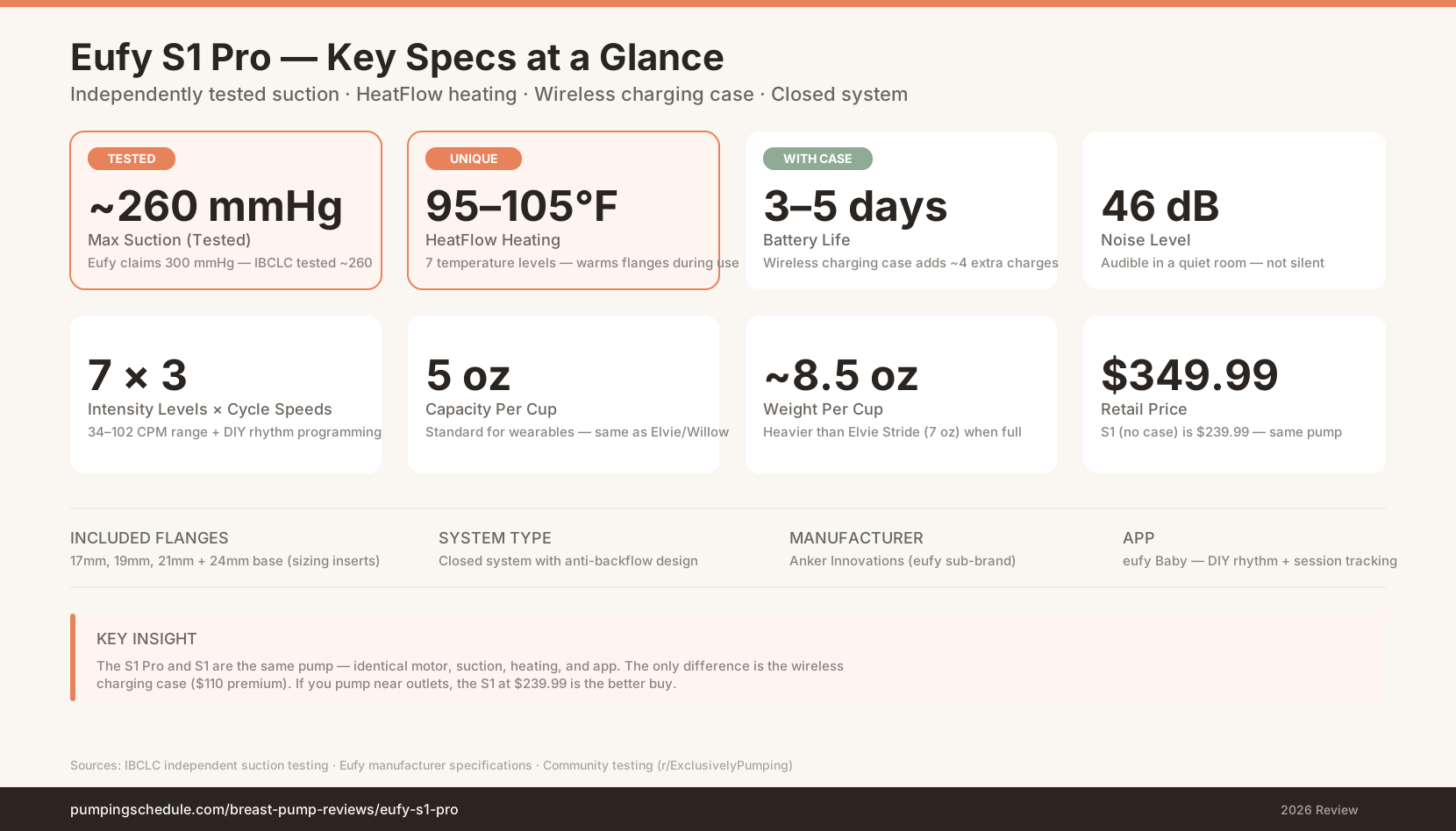
The box is well stocked. Unlike the Spectra S1 which ships with oversized 24mm and 28mm flanges that fit almost nobody, the Eufy S1 Pro includes four sizes (17, 19, 21, and 24mm) from day one. That alone saves you $15–$20 and the frustration of waiting for aftermarket inserts to arrive while your nipples remind you that flange sizing is not optional.

Real Suction Performance
Eufy claims 300 mmHg “hospital-grade” suction. That number needs context.
Independent IBCLC testing measured the S1 Pro's actual suction range at 70–260 mmHg. The 300 mmHg figure appears to be a peak measurement under ideal conditions that you'd rarely reach during a real pumping session. This gap between claimed and tested suction is not unique to eufy — the Elvie Stride advertises 270 mmHg but tests closer to 170, and Medela won't publish independent numbers at all. Still, it's worth knowing.
At ~260 mmHg tested, the S1 Pro matches the Willow Go for the strongest suction among fully wireless wearables. It pulls significantly harder than the Elvie Stride (~170 mmHg) and the Momcozy M5 (which doesn't publish independent data). For context, portable pumps like the Spectra S1 hit 270 mmHg and the BabyBuddha reaches ~290 mmHg — so the S1 Pro closes the wearable-vs-portable suction gap more than any wearable before it, without quite erasing it.
The three cycle speeds are genuinely useful. The slow setting (34–50 CPM) mimics a Spectra's expression mode. The fast setting (90–102 CPM) matches Medela-style quick cycling. One IBCLC noted you can program the S1 Pro to replicate BabyBuddha protocols via the app's DIY rhythm feature — something no other wearable offers.
The Heating Feature — Does It Actually Help?
This is the feature that sets the Eufy S1 Pro apart from every other wearable on the market, so let's be specific about what it does and doesn't do.
HeatFlow uses seven temperature levels ranging from 95°F to 105°F (35–41°C). A smart sensor checks the temperature every three seconds to prevent overheating. In IBCLC testing, the external surface reached 107–109°F while the internal surface (the part touching milk) stayed under 100°F. No burn risk. No discomfort.
Does warmth actually improve output? The science is clear on warm compresses: warming the breast before and during pumping increases milk flow and fat content. Lactation consultants have recommended warm washcloths before pumping for decades. What the Eufy S1 Pro does is make that step automatic — you turn on the pump, the heating kicks in, your letdown triggers faster. No microwaving a washcloth, no holding a heating pad, no extra step in a routine that already has too many steps.
Eufy's claim of “30% more output” with heating is based on user feedback, not a controlled study. Your mileage will vary. Moms who struggle with letdown to a pump — the ones who sit there for three minutes staring at an empty bottle — are most likely to see a real difference. Moms whose letdown triggers quickly regardless may notice faster flow start but similar total volume.
The heating also helps with clogged ducts. One EP mom described using the S1 Pro's heat on a developing clog during a work session — the kind of situation where you normally can't stop everything to apply a warm compress. Having heat built into the pump itself turns that from a “deal with it when I get home” problem into a “dealing with it right now” solution.
Battery Life and the Charging Case
The charging case is why the S1 Pro exists. Without it, you have the S1 — same pump, $110 less, USB-C charging, 4–6 sessions per charge.
How it works:The case is a magnetic charging dock and carrying case in one. Drop the pump hubs in after a session, they recharge wirelessly. The case itself holds enough charge to power the hubs for 3–5 days — eufy claims “up to 5 days” based on three 20-minute sessions daily without heating. Real-world use with heating enabled and longer sessions puts most moms at 3–4 days.
For context, that's a full workweek without plugging anything in. The Elvie Stride gives you about 5 sessions per charge. The Willow Go gets 4–6. Neither comes with a charging case. The S1 Pro's case is genuinely the best battery solution in the wearable category — Anker's core expertise in portable power shows here more than anywhere else in the product.
One important limitation:The case only charges the pump hubs. It's not a storage container for used parts. After pumping away from home, you still need a separate bag for flanges, cups, and anything else that needs washing. The case looks like it should hold everything — it doesn't.
Heavy EP users pumping 7–8 times daily will drain the case in 2–3 days, especially with heating on. That's still dramatically better than hunting for a USB cable every 4–6 sessions. And unlike the Spectra S1's sealed battery that degrades over months, the charging case is a separate battery you can eventually replace without replacing the pump itself.
App and Controls
Most breast pump apps are glorified timers. The eufy Baby app is the exception — and it's the reason one IBCLC called the S1 Pro “really good engineering.”
The standout feature is DIY rhythm programming. Instead of picking from preset modes and hoping one matches your body, you design your own pumping pattern: set the cycle speed, suction level, and duration for each phase, then save it. The app ships with four pre-made rhythms developed with a lactation consultant — Max Flow, Standard, Gentle, and Natural — but the DIY option is where it gets interesting. You can replicate the pumping pattern of a BabyBuddha, a Spectra, or any other pump your body responded well to.
The app controls each side independently. Left side needs higher suction? Adjust it without changing the right. One side needs heat, the other doesn't? Done. This per-side control matters more than it sounds — breast asymmetry in milk production is well documented, and being able to pump each side at its own rhythm and intensity is something portables like the Spectra can do but most wearables can't.
One drawback: there's no on-device timer. If you want to track session length, you need the app open. Most pump apps have this same limitation, but the Spectra's built-in LCD timer feels like a feature you miss once it's gone.
Comfort and Noise
At 46 dB, the Eufy S1 Pro is roughly as loud as a quiet conversation or a library hum. The Elvie Stride at ~45 dB is marginally quieter. The Willow Go at ~50 dB is noticeably louder. In practice, the S1 Pro is quiet enough for a Zoom call on mute and quiet enough that a sleeping baby in the same room won't stir — assuming your baby isn't one of those light sleepers who wakes up when you breathe too confidently.
The 105° ergonomic angle is designed to sit flush against your chest. Most moms report the fit is comfortable under a nursing bra without the cups shifting during normal movement. Bending over is a different story — the S1 Pro shares the same leaking risk as other wearables when you tilt past about 45 degrees. It has a leak warning system, but gravity doesn't care about warnings.
The elastic nipple problem.The S1 Pro's flange tunnel is shorter than traditional pump flanges. If you have elastic nipples — nipples that stretch significantly into the tunnel during pumping — the short tunnel may not provide enough clearance. This can cause discomfort, reduced output, or both. The elastic nipples guide has sizing strategies, but if this is your situation, test the S1 Pro before committing. Pumps with longer tunnels like the Spectra with Legendairy Baby inserts may be a better fit.
Eufy S1 vs S1 Pro: Quick Take
Same motor. Same 300 mmHg (claimed). Same seven suction levels. Same three cycle speeds. Same HeatFlow heating. Same flanges. Same app. Same noise. The Eufy S1 vs S1 Pro decision is one variable: do you want the wireless charging case?
The S1 retails for $239.99. The S1 Pro is $349.99 — $110 more for the case. The S1 charges via USB-C and gives you 4–6 sessions per charge. The S1 Pro's case extends that to 3–5 days without touching a cable.
If you pump at home near outlets, the S1 does everything the Pro does for $110 less. If you pump at work, commute, travel, or just hate USB cables, the S1 Pro's case earns its premium. We wrote a detailed Eufy S1 vs S1 Pro comparison with the full breakdown.
Eufy S1 Pro vs Elvie Stride vs Willow Go
The three wearable pumps that come up in every “which wearable should I buy” thread. Different strengths, different trade-offs.
| Feature | Eufy S1 ProBest for: heated wearable pumping | Elvie StrideBest for: quiet discretion | Willow GoBest for: strongest in-bra suction |
|---|---|---|---|
| Price | $349.99 | $170–$200 (often $0 w/ insurance) | $250–$300 |
| Max Suction (Tested) | ~260 mmHg | ~170 mmHg | ~260 mmHg |
| Noise | 46 dB | ~45 dB | ~50 dB |
| Heating | HeatFlow™ 7 levels (95–105°F) | None | None |
| Battery | 3–5 days (with case) | ~5 sessions per charge | 4–6 sessions per charge |
| Cycle Speed | 34–102 CPM (3 speeds) | Fixed (2-phase auto) | Fixed presets |
| Flange Range | 17–24mm (inserts) | 15–28mm (inserts + shields) | 21mm, 24mm, 27mm |
| App | eufy Baby (DIY rhythms) | Elvie app | Willow app |
| Capacity | 5 oz per cup | 5 oz per cup | 4 oz per cup |
| Best For | Heated wearable + long battery | Quiet office pumping | Maximum wearable suction |
Eufy S1 Pro wins on:suction power (tied with Willow Go at ~260 mmHg, crushes Elvie Stride at ~170 mmHg), heating (no competitor has it), battery life (3–5 days with case vs single charges), app customization (DIY rhythms), and flange range out of box (four sizes included vs competitors' two or three).
Elvie Stride wins on:quietness (45 dB vs 46 dB — marginal but real), insurance coverage (most plans cover at $0), track record (established brand with years of data), lighter cups, and better elastic nipple compatibility.
Willow Go wins on:fully in-bra design (no hub outside the bra at all), and equal suction at ~260 mmHg. But the Willow Go's leaking issues, smaller 4 oz capacity, and higher price ($250–$300) make it harder to recommend over the S1 Pro.
The shift is real: two years ago, buying a wearable meant accepting significantly weaker suction. The S1 Pro puts 260 mmHg in your bra with built-in heating and a battery case. IBCLCs who used to say “wearables are fine for your secondary pump” are starting to say “the Eufy might work as your primary.” Might. Over a six-month EP schedule, the suction gap between 260 mmHg and a Spectra's 270 is small enough that output differences may come down to flange fit and pumping habits rather than raw pump power.
Parts and Replacement Costs
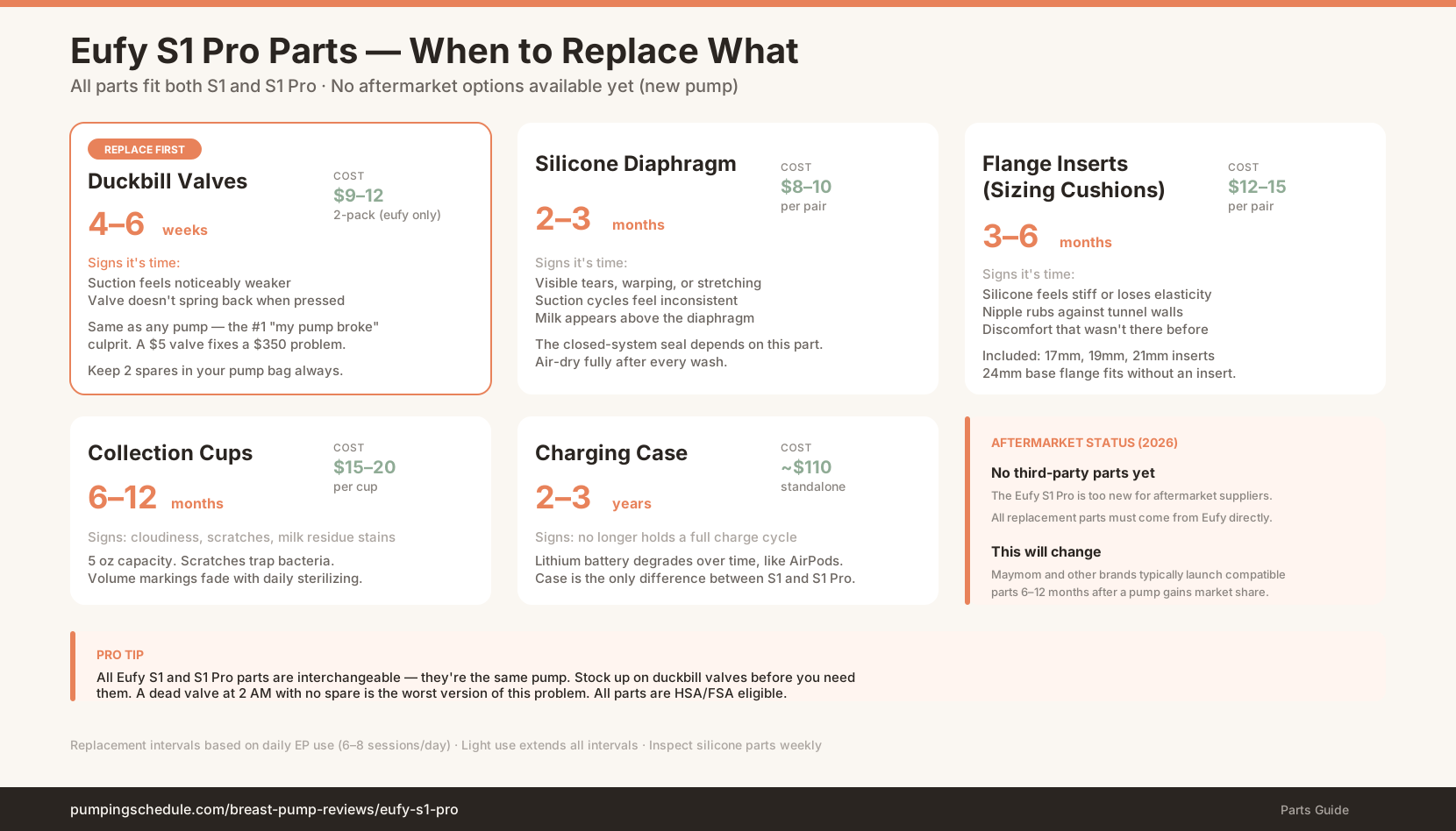
The S1 Pro's biggest ongoing cost is replacement parts — and they're more expensive than most competitors. The heated flanges in particular are a premium consumable.
| Part | Replace Every | Signs It's Time | Approx. Cost |
|---|---|---|---|
| Duckbill valves | 2–4 weeks | Suction feels weaker, valve doesn't snap back | ~$20 / 4-pack |
| Diaphragms | 1–3 months | Reduced suction, visible wear or tearing | ~$20 / set |
| Heated flanges | 3–6 months | Cloudiness, cracking, uneven heating | ~$60 / set |
| Collection cups | 3–6 months | Scratches, seal loosening, volume markings fading | ~$30 / set |
Budget roughly $30–$40 per month in replacement parts for heavy EP use. That's about double what Spectra parts cost (~$15/month) and comparable to Willow Go and Elvie Stride ongoing costs. The heated flanges at $60 per set are the biggest hit — regular flanges on other pumps run $10–$18.
Unlike the Spectra ecosystem where Maymom, Legendairy Baby, and other aftermarket brands sell compatible parts at a fraction of the price, the Eufy S1 Pro's parts are only available from eufy. No aftermarket alternatives exist yet. If third-party manufacturers start making compatible parts — and they probably will once the install base grows — ongoing costs should drop significantly.
Getting the Eufy S1 Pro Through Insurance
Eufy breast pumps are available through several major DME suppliers, including Aeroflow, 1 Natural Way, Edgepark, The Breastfeeding Shop, and Military Pumps (for TRICARE). Coverage varies by plan — some insurers cover the S1 Pro at $0, others classify it as an upgrade with a copay.
The Affordable Care Act requires most health insurance plans to cover a breast pump at no cost. Which specific pumps qualify at $0 depends on your plan. The non-Pro Eufy S1 at $239.99 is more likely to be fully covered than the $349.99 S1 Pro, similar to how the Spectra S2 is covered at $0 while the S1 requires an upgrade fee. Both models are HSA and FSA eligible.
If your insurance covers the S1 at $0 and the S1 Pro as an upgrade, the math is simple: get the S1 for free through insurance and decide if you want the charging case enough to pay the difference out of pocket. If you're buying retail regardless, the S1 at $239.99 is the value play — same pump, USB charging, $110 saved toward replacement parts.
Who Should (and Shouldn't) Buy It
Overall score
out of 10
What we like
- ~260 mmHg tested suction — strongest wearable tied with Willow Go
- HeatFlow heating (95–105°F) — only wearable with built-in warming
- Wireless charging case gives 3–5 days of battery life
- DIY rhythm programming — replicate any pump’s pattern via app
- Four flange sizes included (17, 19, 21, 24mm) — best out-of-box range
- Independent per-side suction and heat control
- Closed system with double seal — BPA-free, food-grade materials
- Available through insurance via major DME suppliers
What could be better
- Tested suction (260 mmHg) is 13% below the 300 mmHg claim
- Replacement parts are expensive ($60 heated flanges, no aftermarket options yet)
- $349.99 retail — premium pricing, though insurance may cover
- Short flange tunnel — problematic for elastic nipples
- No on-device timer (app-dependent for session tracking)
- 5 oz capacity may limit oversuppliers
- Leak risk when bending past 45 degrees (like all wearables)
- 12-month warranty is shorter than Spectra’s 24 months
Related Reading
- Eufy S1 vs S1 Pro — Full Side-by-Side Comparison
- Best Wearable Breast Pump (2026)
- Exclusive Pumping Schedule — Complete Guide by Baby's Age
- All Breast Pump Reviews
- Pumping at Work — Complete Guide
- Flange Size Guide — How to Measure