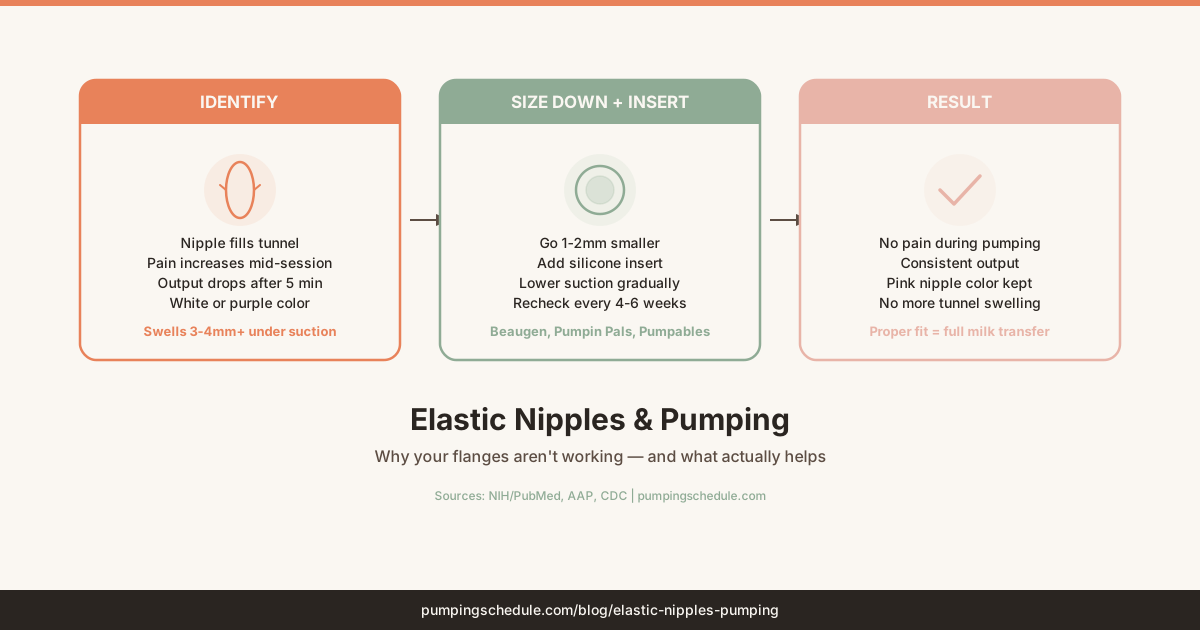
You probably have elastic nipples. And the standard flange sizing advice — measure your nipple diameter, add 2mm — was never designed for you.
Elastic nipples affect an estimated 20-30% of pumping mothers, yet most pump instruction manuals don't mention them once. Research on nipple dimensions in breastfeeding shows that nipple measurements vary significantly — and the variation increases under suction. If your nipple stretches under vacuum, your entire pump setup needs adjusting: flange size, inserts, suction level, possibly even the pump itself. This guide covers all of it.
What Are Elastic Nipples?
Elastic nipples stretch more than average under the vacuum pressure of a breast pump. Your nipple at rest might measure 15mm across, but under suction it could balloon to 21mm or wider — swelling to fill the flange tunnel in ways that standard sizing charts don't predict.
Think of it like a rubber band versus a pencil eraser. Most flange sizing guides assume your nipple is the pencil eraser: it stays roughly the same size under suction. But elastic nipple tissue behaves more like the rubber band — it elongates and expands with each pump cycle.
This isn't a medical problem. It's a tissue characteristic, like having stretchy skin or flexible joints. Your nipples work perfectly fine for breastfeeding. The issue is purely mechanical: breast pumps create a vacuum, and elastic tissue responds to that vacuum differently than rigid tissue does.
Elasticity exists on a spectrum. Some women have mildly elastic nipples that swell 2-3mm under suction. Others have highly elastic tissue that stretches dramatically, filling even oversized flanges. Where you fall on that spectrum determines how aggressively you need to modify your setup.
How to Tell If You Have Elastic Nipples
The clearest sign is what happens during pumping, not before it. Here's a step-by-step self-check:
- Pump for 2-3 minutes on your normal settings with your current flange.
- Stop the pump and immediately look at your nipple before it returns to its resting size.
- Measure across your nipple at its widest point (a soft measuring tape or ruler works).
- Compare this measurement to your resting nipple diameter.
- Check the tunnel walls — is your nipple tissue pressing against the sides of the flange?
- Look for a color change — are your nipples white, purple, or deep red after pumping?
- Note any discomfort pattern — does pain increase as the session goes on rather than easing up?
If your nipple swells more than 3-4mm beyond its resting size, you likely have elastic nipples. If it fills the entire flange tunnel and presses against the walls, you almost certainly do. (If your nipple doesn't stretch much under suction but also doesn't protrude at rest, you might have flat nipples instead — a different problem with a different fix.)
| Sign | What You See or Feel | What It Means |
|---|---|---|
| Nipple fills tunnel | Tissue touches sides of flange during pumping | Flange is too large OR elasticity is stretching tissue to fill the space |
| Increasing pain | Discomfort gets worse 5-10 minutes in | Swelling tissue is being pinched or compressed |
| White or purple nipples | Color change after removing flange | Blood flow restriction from tissue compression |
| Decreasing output mid-session | Good flow at start, then drops off | Swollen tissue is blocking milk ducts against tunnel walls |
| Areola pulling in | Skin beyond the nipple gets sucked into the flange | Suction is too high or flange too large for your elastic tissue |
| “Lipstick” shape | Nipple comes out misshapen, not round | Uneven compression inside the tunnel |
“I spent three months thinking my pump was broken before someone told me to look at my nipples after a session. They were literally the size of the flange opening.” (Paraphrased from an online pumping community.)
Why Elastic Nipples Make Pumping Harder
Elastic nipples create a frustrating chain reaction inside your flange. Understanding the mechanics helps you fix it.
When your nipple stretches under suction, it expands outward against the flange tunnel walls. This does three things at once: it restricts blood flow to the nipple tissue, it compresses the milk ducts that run through your nipple, and it creates friction against the plastic or silicone walls.
Compressed ducts mean less milk gets through. It's like stepping on a garden hose — the water pressure is still there, but the flow drops to a trickle. The AAP's breastfeeding policy statement emphasizes proper pump fit as essential for effective milk transfer. Your supply isn't the problem. The pathway is.
This is why so many women with elastic nipples think they have low supply when they actually don't. The milk is there. It just can't get past the pinch point. If you've been searching for ways to increase milk supply, elastic nipples might be the real bottleneck — literally.
And here's the cruel irony. The standard advice for low output? Turn up the suction. Which makes elastic nipples swell more. Which compresses the ducts more. Which drops your output further. (Your pump is basically gaslighting you at this point.)
Flange Sizing for Elastic Nipples: Why Standard Rules Don't Work
Most women with elastic nipples need to size down, not up.
This feels counterintuitive. Your nipple is swelling, so shouldn't you give it more room? No. A larger flange tunnel gives elastic tissue more space to expand into, which makes the swelling worse, which causes more compression, which reduces output further. It's the garden hose problem again — a wider hose doesn't help if the problem is something squeezing the hose.
A smaller flange — or a standard flange with a silicone insert — limits how far your nipple can stretch in the first place. The insert gently holds the tissue in place, preventing that ballooning effect. For a detailed walkthrough on measuring, check our flange sizing guide.
Start with your resting nipple measurement and go down 1-2mm, then fine-tune from there. If your nipple measures 17mm at rest, try a 15mm or 16mm insert rather than the 19mm flange that standard sizing would recommend.
You'll know you've found the right fit when your nipple moves freely in the tunnel without touching the walls, swelling stays minimal after a 15-minute session, your nipple color stays pink (not white or purple), and output holds steady through the session instead of dropping off.
One caveat: sizing down too aggressively causes its own problems. If the opening is too tight, it compresses the base of your nipple from the start, cutting off milk flow before you even turn the pump on. You want snug but not strangling.
Silicone Inserts, Cushions, and Alternative Flanges Compared
Silicone inserts are the single most effective tool for elastic nipples. They sit inside your existing flange and reduce the tunnel diameter while adding a cushioned surface that's gentler on tissue than hard plastic. (We compare the top options in our best flange inserts roundup.)
| Product | Sizes | Best For | Drawback | Price |
|---|---|---|---|---|
| Beaugen Cushions | 15-21mm (1mm steps) | Mild to moderate elasticity; pain relief | Can slip if not seated properly | ~$15-20/pair |
| Pumpin Pals | S, M, L (angled design) | Moderate to high elasticity | Learning curve; doesn't fit all pumps | ~$30-35/set |
| Pumpables Liquid Shield | 15-27mm | High elasticity; maximum comfort | More expensive; limited pump compatibility | ~$25-30/pair |
| Maymom Inserts | 13-21mm | Budget option; mild elasticity | Less cushioning; can feel rigid | ~$8-12/pair |
Beaugencushions are the most popular starting point — affordable, fit most standard flanges (including Spectra and Medela), and come in enough sizes to dial in your fit precisely. If you're new to the elastic nipple journey, start here.
Pumpin Pals take a different approach. Instead of round tunnel openings, they use an angled design that follows the natural shape of the breast. Many women with elastic nipples find the angled shape prevents tissue from stretching as much because suction distributes differently. The downside: they feel weird at first.
Pumpables Liquid Shieldinserts use a liquid-filled silicone cushion that conforms to your nipple shape in real time. They're the premium option and arguably the most comfortable, but they cost more and don't fit every pump model.
“I went through Maymom, then Beaugen, then Pumpin Pals before landing on Pumpables. Each one was better than the last, but honestly the Beaugen got me 80% of the way there for a quarter of the price.” (Paraphrased from a Reddit pumping forum.)
Pro tip: buy two different sizes. Use the smaller size on whichever side has more elasticity. (Yes, your two sides can be different. Bodies are delightfully asymmetrical.)
Pump Settings That Actually Work for Elastic Nipples
Lower suction with longer cycle times is the general rule for elastic nipples. But “lower” is vague, so here's a specific protocol:
- Start on stimulation/letdown mode for 2-3 minutes, at the lowest suction that triggers tingling.
- Switch to expression mode at the lowest suction setting your pump offers.
- Increase suction by one increment every 30 seconds until you see milk flowing steadily.
- Stop increasing the moment you see good flow.Do not chase “maximum comfortable suction” — that advice is for non-elastic nipples.
- If flow slows after 5-8 minutes, switch back to stimulation mode for 60 seconds to trigger another letdown rather than increasing suction.
- Total session: 15-20 minutes.If you're still pumping after 20, the issue is likely fit, not duration. See our guide on how long to pump.
- After removing the flange, check your nipple. If it's swollen, white, or misshapen, your suction was too high. Drop one level next session.
The Spectra S1 and S2 are particularly good for this protocol because they separate cycle speed from suction strength, letting you fine-tune each independently. Most Medela pumps lock these together, giving you less control.
A common mistake: cranking suction to maximum because output seems low. With elastic nipples, maximum suction almost always makes things worse. Your tissue swells, ducts compress, and you get less milk despite the stronger pull. It feels productive. It isn't.
Which Breast Pumps Work Best with Elastic Nipples
Not all pumps handle elastic nipples equally. The key differentiators are suction adjustability, flange compatibility, and cycle control.
Hospital-grade and closed-system pumps generally work best because they offer the widest range of suction settings and accept aftermarket flanges and inserts. The Spectra S1 remains the top recommendation for elastic nipples — its independent suction and cycle controls let you find the sweet spot without overstimulating tissue.
Wearable pumps are trickier. Their flanges are integrated into the collection cup, which limits your insert options. The Momcozy M5works for mildly elastic nipples with the right insert, but women with moderate to high elasticity often find that wearable pumps don't offer enough suction control.
The BabyBuddhais an interesting middle ground. It's small and portable like a wearable but uses standard flanges, so you can pair it with Beaugen cushions or Pumpin Pals. It also has strong suction granularity for its size.
What matters most for elastic nipples in a pump:
- Fine suction adjustments (10+ levels, not 3-5)
- Separate cycle speed control
- Compatibility with aftermarket flanges and inserts
- Closed system (prevents milk backflow into the motor, which matters more when sessions run longer due to fit adjustments)
When Elastic Nipples Need Professional Help
Most elastic nipple issues resolve with proper flange sizing and inserts. But some situations need a trained eye.
See an IBCLC (International Board Certified Lactation Consultant) if:
- You've tried 3+ flange/insert combinations and still have pain or low output
- Your nipples are cracked or sore from pumping despite adjusting your setup — elastic tissue rubbing inside the tunnel is a common cause of nipple damage
- You notice a significant supply drop that doesn't improve with better fit
- Your nipple tissue has changed color permanently (not just temporarily after a session)
- You suspect nipple vasospasm — nipples turn white, then blue, then red, with burning pain
Vasospasm and elastic nipples sometimes coexist. The restricted blood flow from a poor flange fit can trigger vasospasm episodes. Research on nipple pain causes documents that tissue compression and restricted blood flow are primary mechanisms behind pumping-related nipple pain. An IBCLC can help distinguish between mechanical fit issues and vasospasm.
If pumping is causing consistent pain despite your best efforts, our guide on why pumping hurtscovers other possible causes beyond elasticity — because sometimes it's not just one thing.
An IBCLC visit typically costs $150-350 out of pocket but may be covered by insurance under lactation support benefits. Many now offer virtual consults, which work surprisingly well for flange fit assessments — you just need a well-lit room and a willingness to pump on camera. (Less awkward than it sounds after the first 30 seconds.)
Your Nipple Elasticity Can Change — How to Adapt
Nipple elasticity isn't fixed. It shifts over the course of your pumping journey, and the setup that worked at 2 weeks postpartum might fail at 3 months.
In the early weeks, postpartum swelling and engorgement can mask elasticity. Your nipples may seem rigid because the surrounding tissue is so full. As engorgement resolves (usually by weeks 3-6), your natural elasticity emerges — and suddenly your flanges don't fit anymore.
Some women develop more elasticity over time from the repeated stretching of daily pumping. If you're pumping 6-8 times a day, that's a lot of suction cycles pulling at your tissue. CDC pumping guidelines recommend proper flange fit at every stage — not just when you start pumping.
Recheck your flange fit every 4-6 weeks during the first 4 months, then every 2-3 months after that. Signs you need to resize:
- Output dropped without any change in schedule, diet, or stress
- Pain returned after a period of comfortable pumping
- Your nipple is touching the tunnel walls again
- Pump parts are wearing out — check when to replace pump parts (stretched-out silicone inserts lose their hold)
When you do recheck, go through the full self-assessment from the “How to Tell” section above. Measure after pumping, not before. And remember that each side can change at different rates. (Symmetry is a myth your body never agreed to.)
Last reviewed: August 2026
Related Reading
- Flange Size Calculator — find your size in seconds (note: elastic nipples may need to size down from the result)
- Complete Flange Sizing Guide — step-by-step measurement instructions, size charts for all major brands
- Why Does Pumping Hurt? Common Causes and Fixes — pain troubleshooting beyond elastic nipples
- How to Increase Milk Supply While Pumping — evidence-based strategies when output is low
- When to Replace Breast Pump Parts — worn inserts and flanges affect fit and output
- Nipple Damage From Pumping — healing and prevention when elastic tissue causes skin breakdown
- Signs of Wrong Flange Size — How to Tell If Your Flange Needs Changing